117518
论文已发表
注册即可获取德孚的最新动态
IF 收录期刊
- 3.6 Breast Cancer (Dove Med Press)
- 4.3 Clin Epidemiol
- 2.6 Cancer Manag Res
- 3.2 Infect Drug Resist
- 4.1 Clin Interv Aging
- 6.1 Drug Des Dev Ther
- 4.1 Int J Chronic Obstr
- 8.7 Int J Nanomed
- 2.5 Int J Women's Health
- 3.2 Neuropsych Dis Treat
- 2.4 OncoTargets Ther
- 2.6 Patient Prefer Adher
- 2.6 Ther Clin Risk Manag
- 3.1 J Pain Res
- 3.5 Diabet Metab Synd Ob
- 4.5 Psychol Res Behav Ma
- 3.4 Nat Sci Sleep
- 2.4 Pharmgenomics Pers Med
- 2.6 Risk Manag Healthc Policy
- 4.6 J Inflamm Res
- 2.3 Int J Gen Med
- 3.9 J Hepatocell Carcinoma
- 3.3 J Asthma Allergy
- 2.5 Clin Cosmet Investig Dermatol
- 3.0 J Multidiscip Healthc

深部脑刺激对帕金森病患者泌尿功能障碍影响的临床研究
Authors Zong H, Meng F, Zhang Y, Wei G, Zhao H
Received 6 February 2019
Accepted for publication 11 May 2019
Published 25 June 2019 Volume 2019:14 Pages 1159—1166
DOI https://doi.org/10.2147/CIA.S204368
Checked for plagiarism Yes
Review by Single-blind
Peer reviewers approved by Dr Amy Norman
Peer reviewer comments 2
Editor who approved publication: Dr Zhi-Ying Wu
Purpose: To evaluate the effect of deep brain stimulation (DBS) on urinary dysfunctions in Parkinson’s patients.
Patients and methods: A total of 416 patients, diagnosed with Parkinson’s disease (PD) based on the UK Parkinson’s Disease Society Brain Bank Diagnostic Criteria, were enrolled in the study, including 307 males and 109 females. The effects of DBS treatment on urinary functions during urination and bladder storage of these patients were evaluated using testing and assessment scales, such as the American Urological Association Symptom Index (AUA-SI), Overactive Bladder Symptom Scores (OAB-SS), Quality Of Life Scale (QOL), and urodynamic tests. The data were statistically analyzed with the chi-square test and both independent-samples t-test and paired-samples t-test were used in this study.
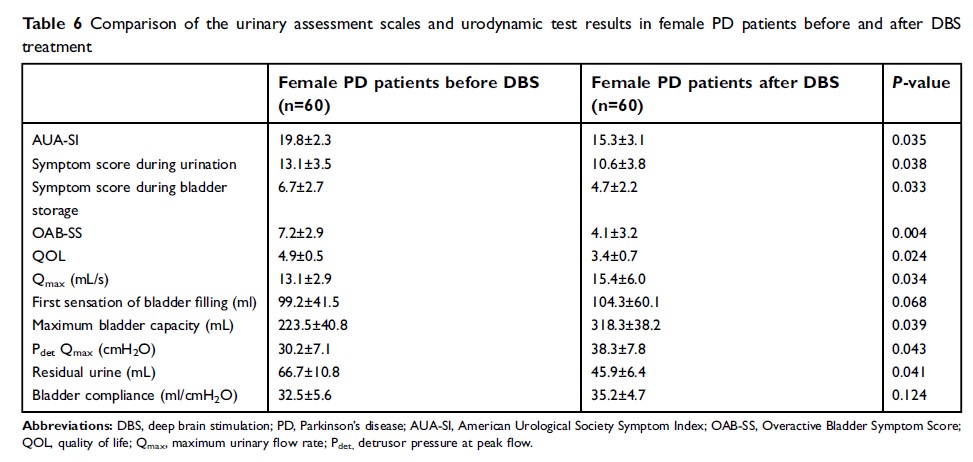
Results: Symptoms of urinary dysfunctions, such as urinary frequency, urgency, and incontinence, in the patients with PD were notably relieved by DBS treatment (P <0.05), and the OAB-SS and bladder storage problems were greatly improved as well (P <0.05). Compared with those in male patients, DBS surgery significantly improved the AUA-SI, urinary symptom scores, and QOL in female PD patients (P <0.05), as well as other functional indicators related to the urinary tract, including the maximum urinary flow rate, detrusor pressure at peak flow, and residual urine volume in female PD patients (P <0.05).
Conclusion: DBS surgery is effective in improving urinary functions in PD patients, as primarily reflected by the alleviation of urinary symptoms such as urinary frequency, urgency, and incontinence. Female PD patients displayed better urinary function outcomes from DBS treatment than did male patients.
Keywords: Parkinson’s disease, urinary dysfunction, deep brain stimulation