117518
论文已发表
注册即可获取德孚的最新动态
IF 收录期刊
- 3.6 Breast Cancer (Dove Med Press)
- 4.3 Clin Epidemiol
- 2.6 Cancer Manag Res
- 3.2 Infect Drug Resist
- 4.1 Clin Interv Aging
- 6.1 Drug Des Dev Ther
- 4.1 Int J Chronic Obstr
- 8.7 Int J Nanomed
- 2.5 Int J Women's Health
- 3.2 Neuropsych Dis Treat
- 2.4 OncoTargets Ther
- 2.6 Patient Prefer Adher
- 2.6 Ther Clin Risk Manag
- 3.1 J Pain Res
- 3.5 Diabet Metab Synd Ob
- 4.5 Psychol Res Behav Ma
- 3.4 Nat Sci Sleep
- 2.4 Pharmgenomics Pers Med
- 2.6 Risk Manag Healthc Policy
- 4.6 J Inflamm Res
- 2.3 Int J Gen Med
- 3.9 J Hepatocell Carcinoma
- 3.3 J Asthma Allergy
- 2.5 Clin Cosmet Investig Dermatol
- 3.0 J Multidiscip Healthc

磷酸肌酸通过 SIRT3-SOD2-线粒体活性氧途径减弱菊三七诱导的肝细胞凋亡
Authors Li DP, Chen YL, Jiang HY, Chen Y, Zeng XQ, Xu LL, Ye Y, Ke CQ, Lin G, Wang JY, Gao H
Received 30 January 2019
Accepted for publication 15 May 2019
Published 27 June 2019 Volume 2019:13 Pages 2081—2096
DOI https://doi.org/10.2147/DDDT.S203564
Checked for plagiarism Yes
Review by Single-blind
Peer reviewers approved by Dr Colin Mak
Peer reviewer comments 2
Editor who approved publication: Dr Sukesh Voruganti
Purpose: To investigate the mitochondria-related mechanism of Gynura segetum (GS)-induced apoptosis and the protective effect of phosphocreatine (PCr), a mitochondrial respiration regulator.
Methods: First, the mechanism was explored in human hepatocyte cell line. The mitochondrial oxidative stress was determined by fluorescence assay. The level of sirtuin 3 (SIRT3), acetylated superoxide dismutase 2 (Ac-SOD2), SOD2, and apoptosis were detected by Western blotting. Mito-TEMPO and cell lines of viral vector-mediated overexpression of SIRT3 and SIRT3H248Y were used to further verify the mechanism of GS-induced apoptosis. GS-induced liver injury mice models were built by GS through intragastric administration and interfered by PCr through intraperitoneal injection. A total of 30 C57BL/6J mice were assigned to 5 groups and treated with either saline, PCr (100 mg/kg), GS (30 g/kg), or PCr (50 or 100 mg/kg)+GS (30 g/kg). Liver hematoxylin and eosin (HE) staining, immunohistochemical analysis, and blood biochemical evaluation were performed.
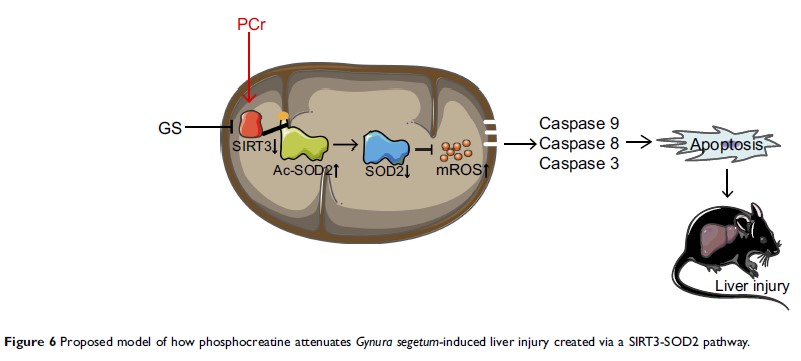
Results: GS induced hepatocyte apoptosis and elevated levels of mitochondrial ROS in L-02 cells. The expression of SIRT3 was decreased. Downregulation of SIRT3 was associated with increased levels of Ac-SOD2, which is the inactivated enzymatic form of SOD2. Conversely, when overexpressing SIRT3 in GS-treated cells, SOD2 activity was restored, and mitochondrial ROS levels and hepatocyte apoptosis declined. Upon administration of PCr to GS-treated cells, they exhibited a significant upregulation of SIRT3 and were protected against apoptosis. In animal experiments, serum ALT level and mitochondrial ROS of the mice treated with GS and 50 mg/kg PCr were significantly attenuated compared with only GS treated. The changes in SIRT3 expression were also consistent with the in vitro results. In addition, immunohistochemical analysis of the mouse liver showed that Ac-SOD2 was decreased in the PCr and GS co-treated group compared with GS treated group.
Conclusion: GS caused liver injury by dysregulating mitochondrial ROS generation via a SIRT3-SOD2 pathway. PCr is a potential agent to treat GS-induced liver injury by mitochondrial protection.
Keywords: Gynura segetum , apoptosis, mitochondrial, ROS, SIRT3, phosphocreatine