117518
论文已发表
注册即可获取德孚的最新动态
IF 收录期刊
- 3.6 Breast Cancer (Dove Med Press)
- 4.3 Clin Epidemiol
- 2.6 Cancer Manag Res
- 3.2 Infect Drug Resist
- 4.1 Clin Interv Aging
- 6.1 Drug Des Dev Ther
- 4.1 Int J Chronic Obstr
- 8.7 Int J Nanomed
- 2.5 Int J Women's Health
- 3.2 Neuropsych Dis Treat
- 2.4 OncoTargets Ther
- 2.6 Patient Prefer Adher
- 2.6 Ther Clin Risk Manag
- 3.1 J Pain Res
- 3.5 Diabet Metab Synd Ob
- 4.5 Psychol Res Behav Ma
- 3.4 Nat Sci Sleep
- 2.4 Pharmgenomics Pers Med
- 2.6 Risk Manag Healthc Policy
- 4.6 J Inflamm Res
- 2.3 Int J Gen Med
- 3.9 J Hepatocell Carcinoma
- 3.3 J Asthma Allergy
- 2.5 Clin Cosmet Investig Dermatol
- 3.0 J Multidiscip Healthc

ZNF488 是鼻咽癌的独立预后指标,通过胶原蛋白 IV/FAK/AKT/Cyclin D1 途径促进细胞粘附和增殖
Authors Zong D, Jiang N, Xu JH, Wang DJ, Zhu HF, Wu LR, Chen C, Yin L, He X
Received 1 January 2019
Accepted for publication 17 May 2019
Published 28 June 2019 Volume 2019:11 Pages 5871—5882
DOI https://doi.org/10.2147/CMAR.S200001
Checked for plagiarism Yes
Review by Single-blind
Peer reviewers approved by Dr Amy Norman
Peer reviewer comments 3
Editor who approved publication: Dr Xueqiong Zhu
Background: ZNF488 acts as an oncogene which promotes cell invasion and endows tumor cells stem cell capacity in nasopharyngeal carcinoma (NPC), but its correlation with clinicopathologic characteristics and patients’ survival in NPC remain undefined.
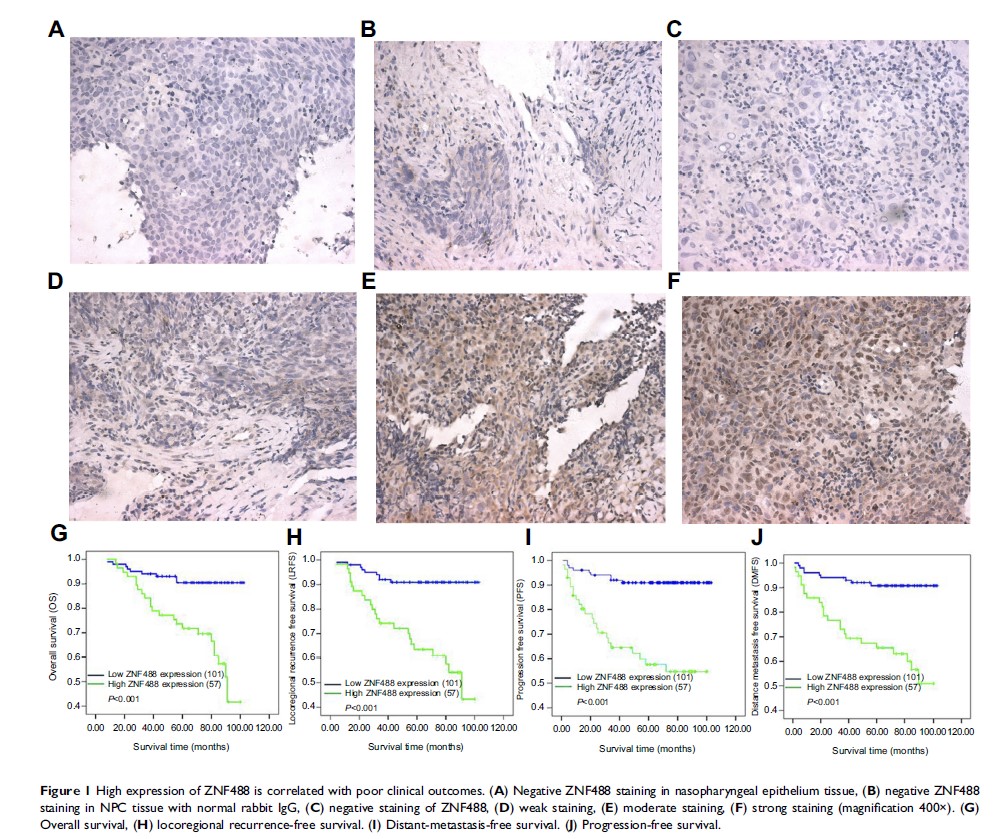
Methods: In this study, 158 cases of confirmed NPC were subjected to immunohistochemistry staining for evaluating endogenous expression. Kaplan–Meier method and log-rank test were used to estimate the survival rates. The relationship between ZNF488 and clinicopathological characteristics was statistically calculated by chi-squared test, univariate and multivariate analysis. In addition, adhesion assay, MTT and colony formation assays were performed for measuring adhesion and proliferation capacity. Cell cycle analysis via flow cytometry was conducted to explore cell cycle distribution. Western blot was used to detect pathway protein levels, and the pFAK (Y397) kit was used for focal adhesion kinase (FAK) activation.
Results: We demonstrated that high expression of ZNF488 was significantly correlated with locoregional failure (P =0.018) and distant metastasis (P =0.001). Patients with high ZNF488 expression had poorer overall survival (P <0.001), loco-regional recurrence-free survival (P <0.001), distance metastasis-free survival (P <0.001) and progression-free survival (P <0.001) than those with low ZNF488 group. Multivariate analysis showed that ZNF488 expression was an independent prognostic indicator for predicting NPC patients’ survival (HR, 3.314; 95% CI, 1.489–7.386; P =0.003). Additionally, ZNF488-induced collagen IV/FAK/AKT to enhance adhesion ability meanwhile led to the upregulation of Cyclin D1 to facilitate cell proliferation through promoting cell cycle progression and inhibition of apoptosis through caspase-independent way.
Conclusion: These results reveal that ZNF488, as an independent prognostic indicator, promotes cell adhesion and proliferation through collagen IV/FAK/AKT/Cyclin D1 pathway in NPC.
Keywords: nasopharyngeal carcinoma, ZNF488, proliferation, FAK/AKT/Cyclin D1, prognostic biomarker