115195
论文已发表
注册即可获取德孚的最新动态
IF 收录期刊
- 3.6 Breast Cancer (Dove Med Press)
- 4.3 Clin Epidemiol
- 2.6 Cancer Manag Res
- 3.2 Infect Drug Resist
- 4.1 Clin Interv Aging
- 6.1 Drug Des Dev Ther
- 4.1 Int J Chronic Obstr
- 8.7 Int J Nanomed
- 2.5 Int J Women's Health
- 3.2 Neuropsych Dis Treat
- 2.4 OncoTargets Ther
- 2.6 Patient Prefer Adher
- 2.6 Ther Clin Risk Manag
- 3.1 J Pain Res
- 3.5 Diabet Metab Synd Ob
- 4.5 Psychol Res Behav Ma
- 3.4 Nat Sci Sleep
- 2.4 Pharmgenomics Pers Med
- 2.6 Risk Manag Healthc Policy
- 4.6 J Inflamm Res
- 2.3 Int J Gen Med
- 3.9 J Hepatocell Carcinoma
- 3.3 J Asthma Allergy
- 2.5 Clin Cosmet Investig Dermatol
- 3.0 J Multidiscip Healthc

地西他滨与标准剂量的阿糖胞苷、盐酸阿克拉霉素和粒细胞集落刺激因子相结合用于治疗新诊断的急性髓细胞白血病患者的临床疗效
Authors Dou L, Xu Q, Wang M, Xiao Y, Cheng L, Li H, Huang W, Mei J, Jing Y, Bo J, Liu D, Yu L
Received 31 December 2018
Accepted for publication 30 April 2019
Published 28 June 2019 Volume 2019:12 Pages 5013—5023
DOI https://doi.org/10.2147/OTT.S200005
Checked for plagiarism Yes
Review by Single-blind
Peer reviewers approved by Ms Shreya Arora
Peer reviewer comments 2
Editor who approved publication: Dr Gaetano Romano
Purpose: The chemotherapeutic regimen DCAG (decitabine with cytarabine, aclarubicin hydrochloride, and granulocyte colony-stimulating factor) is effective for elderly patients with acute myeloid leukemia, but recommendations for young patients remain controversial. This study investigated the tolerance and efficacy of DCAG for patients with newly diagnosed acute myeloid leukemia (aged 14–60 years). The clinical features or molecular markers that may predict response to DCAG were identified.
Patients and methods: One-hundred sixty-one consecutive patients with newly diagnosed acute myelogenous leukemia received DCAG or standard (idarubicin plus cytarabine, IA) induction chemotherapy (n=64 and 97, respectively).
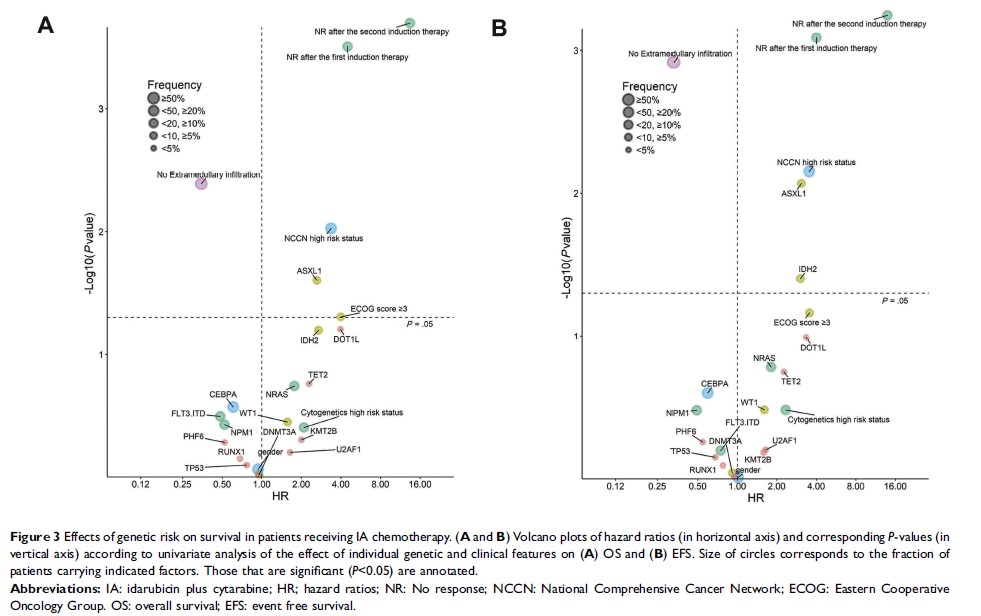
Results: The rates of complete remission after the first cycle, overall survival (OS), and event-free survival (EFS) were comparable. After the second cycle, the complete remission rate of the DCAG group (54.7%) was significantly lower than that of the reference (78.35%, P =0.005). The following were associated with significantly worse OS, and EFS, in the DCAG group: Eastern Cooperative Oncology Group (ECOG) score ≥3 and no response after the second induction therapy; and FLT3-ITD. The multivariate analysis showed the DCAG group with significantly shorter OS associated with ECOG ≥3 and FLT3-ITD. In the DCAG group, after the first cycle of induction chemotherapy the median recovery times of neutrophils and platelets were 15.8 and 13 days.
Conclusion: The DCAG and IA groups were similar with regard to complete remission rate after the first cycle, OS, and EFS. The complete remission rate after the second cycle of the DCAG was significantly lower than that of the IA. Grade 4 neutropenia and thrombocytopenia were a major adverse event associated with DCAG.
Keywords: decitabine, acute myeloid leukemia, induction therapy, conventional chemotherapy