117518
论文已发表
注册即可获取德孚的最新动态
IF 收录期刊
- 3.6 Breast Cancer (Dove Med Press)
- 4.3 Clin Epidemiol
- 2.6 Cancer Manag Res
- 3.2 Infect Drug Resist
- 4.1 Clin Interv Aging
- 6.1 Drug Des Dev Ther
- 4.1 Int J Chronic Obstr
- 8.7 Int J Nanomed
- 2.5 Int J Women's Health
- 3.2 Neuropsych Dis Treat
- 2.4 OncoTargets Ther
- 2.6 Patient Prefer Adher
- 2.6 Ther Clin Risk Manag
- 3.1 J Pain Res
- 3.5 Diabet Metab Synd Ob
- 4.5 Psychol Res Behav Ma
- 3.4 Nat Sci Sleep
- 2.4 Pharmgenomics Pers Med
- 2.6 Risk Manag Healthc Policy
- 4.6 J Inflamm Res
- 2.3 Int J Gen Med
- 3.9 J Hepatocell Carcinoma
- 3.3 J Asthma Allergy
- 2.5 Clin Cosmet Investig Dermatol
- 3.0 J Multidiscip Healthc

血清 D-二聚体在开放复位内固定术前诊断感染性骨不连时的作用
Authors Wang Z, Zheng C, Wen S, Wang J, Zhang Z, Qiu X, Chen Y
Received 23 April 2019
Accepted for publication 29 May 2019
Published 1 July 2019 Volume 2019:12 Pages 1827—1831
DOI https://doi.org/10.2147/IDR.S213099
Checked for plagiarism Yes
Review by Single-blind
Peer reviewers approved by Dr Cristina Weinberg
Peer reviewer comments 2
Editor who approved publication: Dr Sahil Khanna
Purpose: Infected nonunion after open reduction internal fixation (ORIF) is a serious complication. The aim of this study was to evaluate the usefulness of serum D-dimer for preoperative diagnosis of infected nonunion.
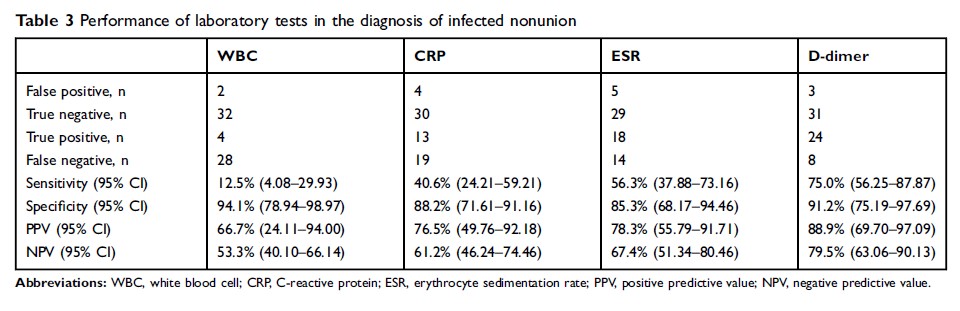
Patients and methods: Patients undergoing debridement and external fixation for infected nonunion (n=32) and replacement of internal fixation due to aseptic failure (n=34) were enrolled and compared in this retrospective study. The optimum cutoff value of D-dimer for identification of infected nonunion was determined by calculating the Youden J statistic. The sensitivity, specificity, positive predictive value (PPV), and negative predictive value (NPV) of four preoperative laboratory parameters—serum D-dimer level, white blood cell (WBC) count, erythrocyte sedimentation rate (ESR), and C-reactive protein (CRP)—for diagnosis of infected nonunion were compared.
Results: Serum D-dimer level was significantly higher in patients with infected nonunion than in patients with aseptic nonunion: 2.62 mg/mL (range, 0.13–11.90 mg/mL) vs 0.35 mg/mL (range, 0.07–6.46 mg/mL; p <0.001). WBC count, CRP, and ESR demonstrated sensitivity of 12.5% (95% CI: 4.08–29.93), 40.6% (95% CI: 24.22–59.21), and 56.3% (95% CI: 37.88–73.16), respectively, and specificity of 94.1% (95% CI: 78.94–98.97), 88.2% (95% CI: 71.61–96.16), and 85.3% (95% CI: 68.17–94.46), respectively. Using the Youden index, 1.70 mg/mL was determined as the optimal threshold value for serum D-dimer for the diagnosis of infected nonunion. The sensitivity and specificity of serum D-dimer (>1.70 mg/mL) were 75.0% (95% CI: 56.25–87.87) and 91.2% (95% CI: 75.19–97.69).
Conclusions: Serum D-dimer level may be useful for preoperative prediction of infected nonunion in patients after ORIF.
Keywords: fracture-related infection, laboratory test, preoperative prediction, non-union