117518
论文已发表
注册即可获取德孚的最新动态
IF 收录期刊
- 3.6 Breast Cancer (Dove Med Press)
- 4.3 Clin Epidemiol
- 2.6 Cancer Manag Res
- 3.2 Infect Drug Resist
- 4.1 Clin Interv Aging
- 6.1 Drug Des Dev Ther
- 4.1 Int J Chronic Obstr
- 8.7 Int J Nanomed
- 2.5 Int J Women's Health
- 3.2 Neuropsych Dis Treat
- 2.4 OncoTargets Ther
- 2.6 Patient Prefer Adher
- 2.6 Ther Clin Risk Manag
- 3.1 J Pain Res
- 3.5 Diabet Metab Synd Ob
- 4.5 Psychol Res Behav Ma
- 3.4 Nat Sci Sleep
- 2.4 Pharmgenomics Pers Med
- 2.6 Risk Manag Healthc Policy
- 4.6 J Inflamm Res
- 2.3 Int J Gen Med
- 3.9 J Hepatocell Carcinoma
- 3.3 J Asthma Allergy
- 2.5 Clin Cosmet Investig Dermatol
- 3.0 J Multidiscip Healthc

在早期食用天然虾青素可通过下调 F344 大鼠的 NFκB 和 COX2 来抑制 N -亚硝基甲基苄胺诱导的食管癌氧化应激和炎症
Authors Cui L, Xu F, Wang M, Li L, Qiao T, Cui H, Li Z, Sun C
Received 4 December 2018
Accepted for publication 29 April 2019
Published 1 July 2019 Volume 2019:12 Pages 5087—5096
DOI https://doi.org/10.2147/OTT.S197044
Checked for plagiarism Yes
Review by Single-blind
Peer reviewers approved by Dr Colin Mak
Peer reviewer comments 3
Editor who approved publication: Dr Leo Jen-Liang Su
Purpose: Esophageal cancer is a common malignant tumor that develops rapidly and has a poor prognosis clinically. Astaxanthin (AST) is a carotenoid pigment with strong antioxidant, anti-inflammation, and antitumor activities. However, little is known about the effects of astaxanthin in esophageal cancer. The present study aimed to investigate the protective effects and related mechanisms of natural astaxanthin against N -nitrosomethylbenzylamine (NMBA)-induced esophageal cancer in rats.
Methods: F344 rats were induced subcutaneously with NMBA dissolved in dimethyl sulfoxide (0.35 mg/kg body weight three times per week for 5 weeks). Rats were fed normal diets with or without 25 mg/kg/day AST at different stages. At different time points, levels of oxidative stress factors in serum and esophagus tissue were analyzed. Western blotting was performed to observe the expression of NFκB and COX2 in esophagus tissue.
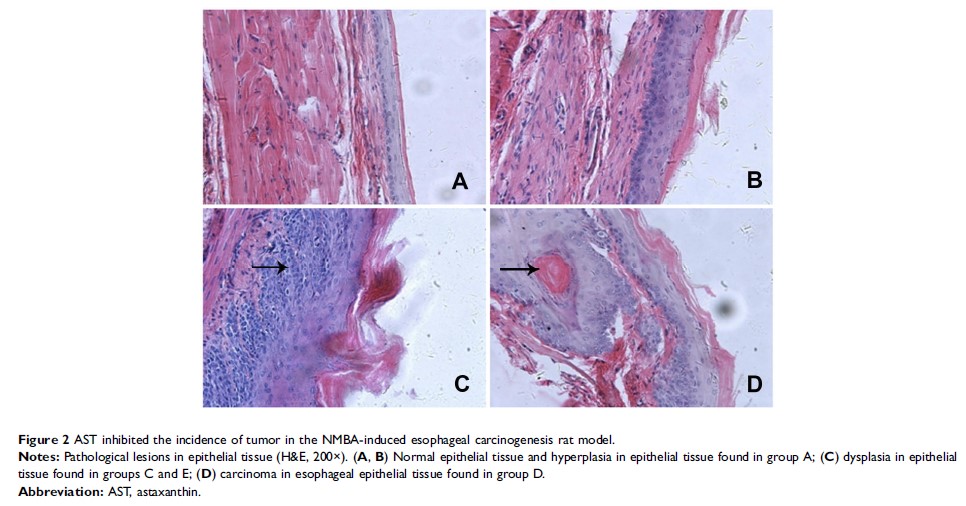
Results: AST clearly reduced the incidence of visible tumors in esophageal cancer during the early-stage intervention group. Furthermore, when compared with the simple exposed group, AST significantly increased levels of GPx and SOD activity, decreased the activity level of malondialdehyde (all P <0.05). Early-stage and whole-stage intervention groups effectively attenuated expression levels of NFκB and COX2 proteins compared with the simple exposed group (all P <0.05).
Conclusion: Natural AST significantly suppressed the occurrence of esophageal cancer by increasing antioxidant capacity and anti-inflammation capacity by inhibiting expression levels of NFκB and COX2 proteins.
Keywords: astaxanthin, esophageal cancer, oxidative stress, NFκB, COX2