117518
论文已发表
注册即可获取德孚的最新动态
IF 收录期刊
- 3.6 Breast Cancer (Dove Med Press)
- 4.3 Clin Epidemiol
- 2.6 Cancer Manag Res
- 3.2 Infect Drug Resist
- 4.1 Clin Interv Aging
- 6.1 Drug Des Dev Ther
- 4.1 Int J Chronic Obstr
- 8.7 Int J Nanomed
- 2.5 Int J Women's Health
- 3.2 Neuropsych Dis Treat
- 2.4 OncoTargets Ther
- 2.6 Patient Prefer Adher
- 2.6 Ther Clin Risk Manag
- 3.1 J Pain Res
- 3.5 Diabet Metab Synd Ob
- 4.5 Psychol Res Behav Ma
- 3.4 Nat Sci Sleep
- 2.4 Pharmgenomics Pers Med
- 2.6 Risk Manag Healthc Policy
- 4.6 J Inflamm Res
- 2.3 Int J Gen Med
- 3.9 J Hepatocell Carcinoma
- 3.3 J Asthma Allergy
- 2.5 Clin Cosmet Investig Dermatol
- 3.0 J Multidiscip Healthc

LincRNA-p21 经由 p53 通路导致食管鳞状细胞癌 G1 期阻滞
Authors Zhang Y, Miao Y, Shang M, Liu M, Liu R, Pan E, Pu Y, Yin L
Received 9 December 2018
Accepted for publication 27 February 2019
Published 4 July 2019 Volume 2019:11 Pages 6201—6214
DOI https://doi.org/10.2147/CMAR.S197557
Checked for plagiarism Yes
Review by Single-blind
Peer reviewers approved by Dr Cristina Weinberg
Peer reviewer comments 2
Editor who approved publication: Dr Antonella D'Anneo
Background: Esophageal squamous cell carcinoma (ESCC) is the fourth most common cause of cancer death in China. Long noncoding RNAs have emerged as critical regulators in cancer. Long intergenic noncoding RNA-p21, a kind of Long noncoding RNAs, LincRNA-p21 have been discussed dysregulated in several cancers, but its role in ESCC remains unknown. This study investigated the role of LincRNA-p21 in ESCC.
Materials and methods: The LincRNA-p21 expression level and its association with esophageal cancer was determined in 64 tumor tissues of esophageal squamous cell carcinoma patients and cells using quantitative real-time reverse transcription PCR. Fluorescence in situ hybridization of single-RNA molecular probes was used to determine subcellular localization of LincRNA-p21 . CCK8 and EdU assays were used for proliferation assay, flow cytometry was performed for apoptosis and cell-cycle distribution, and 24-well Mill cell chamber was made for measuring the abilities of migration and invasion after transfected with lentivirus-expressing LincRNA-p21 in EC109 cells. Then, quantitative real-time reverse transcription PCR and Western blot detected the expression of p21. Further, UC2288, an inhibitor of p21, was used to decrease the level of p21, and flow cytometry was used to detect cell cycle. Finally, screening for differential pathways from microarray analysis and expression of p53 and cyclin D were detected by Western blot.
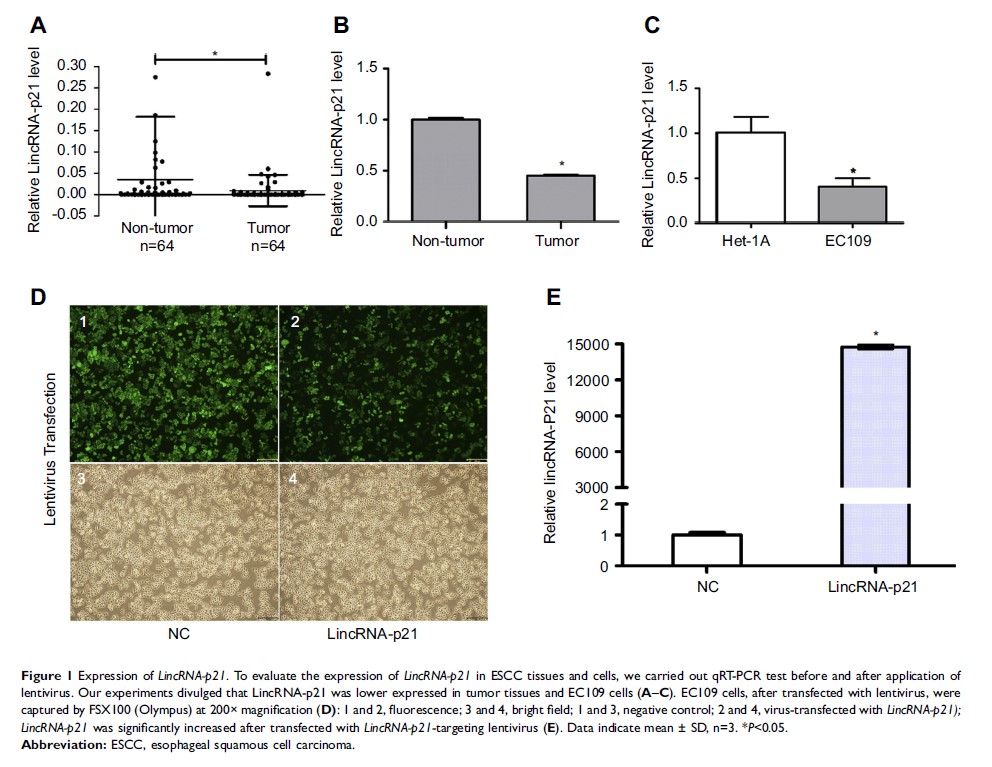
Results: LincRNA-p21 expression level was remarkably lower in tumor tissues versus nontumor tissues and lower in EC109 cells versus Het-1A cells. Statistical analysis found that LincRNA-p21 might enhance the risk of ESCC. We observed that LincRNA-p21 was expressed both in the nucleus and cytoplasm, and a larger proportion of LincRNA-p21 was observed in the cytoplasm. The results demonstrated that upregulating the expression of LincRNA-p21 could inhibit cell proliferation, migration, invasion, and the transition of cell cycle from G1 and promoted apoptosis of EC109. Then, we found that LincRNA-p21 promotes the expression of p21. Decreasing the level of p21 revealed that cell-cycle arrest was restored. Pathway analysis found p53 pathway was downregulated, and upregulation of LincRNA-p21 inhibited the expression of cyclin D.
Conclusion: Our study suggests that LincRNA-p21 plays as a tumor inhibitor in ESCC development and LincRNA-p21 might induce G1 arrest through p53 signal pathway.
Keywords: esophageal squamous-cell carcinoma, LincRNA-p21 , G1 arrest, p53 pathway, Fluorescence in Situ Hybridization