117518
论文已发表
注册即可获取德孚的最新动态
IF 收录期刊
- 3.6 Breast Cancer (Dove Med Press)
- 4.3 Clin Epidemiol
- 2.6 Cancer Manag Res
- 3.2 Infect Drug Resist
- 4.1 Clin Interv Aging
- 6.1 Drug Des Dev Ther
- 4.1 Int J Chronic Obstr
- 8.7 Int J Nanomed
- 2.5 Int J Women's Health
- 3.2 Neuropsych Dis Treat
- 2.4 OncoTargets Ther
- 2.6 Patient Prefer Adher
- 2.6 Ther Clin Risk Manag
- 3.1 J Pain Res
- 3.5 Diabet Metab Synd Ob
- 4.5 Psychol Res Behav Ma
- 3.4 Nat Sci Sleep
- 2.4 Pharmgenomics Pers Med
- 2.6 Risk Manag Healthc Policy
- 4.6 J Inflamm Res
- 2.3 Int J Gen Med
- 3.9 J Hepatocell Carcinoma
- 3.3 J Asthma Allergy
- 2.5 Clin Cosmet Investig Dermatol
- 3.0 J Multidiscip Healthc

β-半乳糖苷 α-2,6-唾液酸转移酶 1(ST6GAL1)通过唾液酸化稳定细胞间粘附分子-1 来抑制结直肠癌转移
Authors Zhou L, Zhang S, Zou X, Lu J, Yang X, Xu Z, Shan A, Jia W, Liu F, Yan X, Su H, Liang T, Zheng M, Zhang Y, Feng B
Received 15 March 2019
Accepted for publication 9 May 2019
Published 4 July 2019 Volume 2019:11 Pages 6185—6199
DOI https://doi.org/10.2147/CMAR.S208631
Checked for plagiarism Yes
Review by Single-blind
Peer reviewers approved by Dr Cristina Weinberg
Peer reviewer comments 2
Editor who approved publication: Dr Antonella D'Anneo
Background: Colorectal cancer (CRC) is one of the most frequent malignancies of the digestive system. Elevated expression of β-galactoside α2,6-sialyltranferase 1 (ST6GAL1) has been observed in multiple cancers. But the mechanism of how ST6GAL1 might affect cancer cells remains to be clarified. Our previous study recognized intercellular adhesion molecule-1(ICAM-1) as a probable substrate of ST6GAL1 through mass spectrometry (MS) analysis. ICAM-1 is related to tumor metastasis in various cancers.
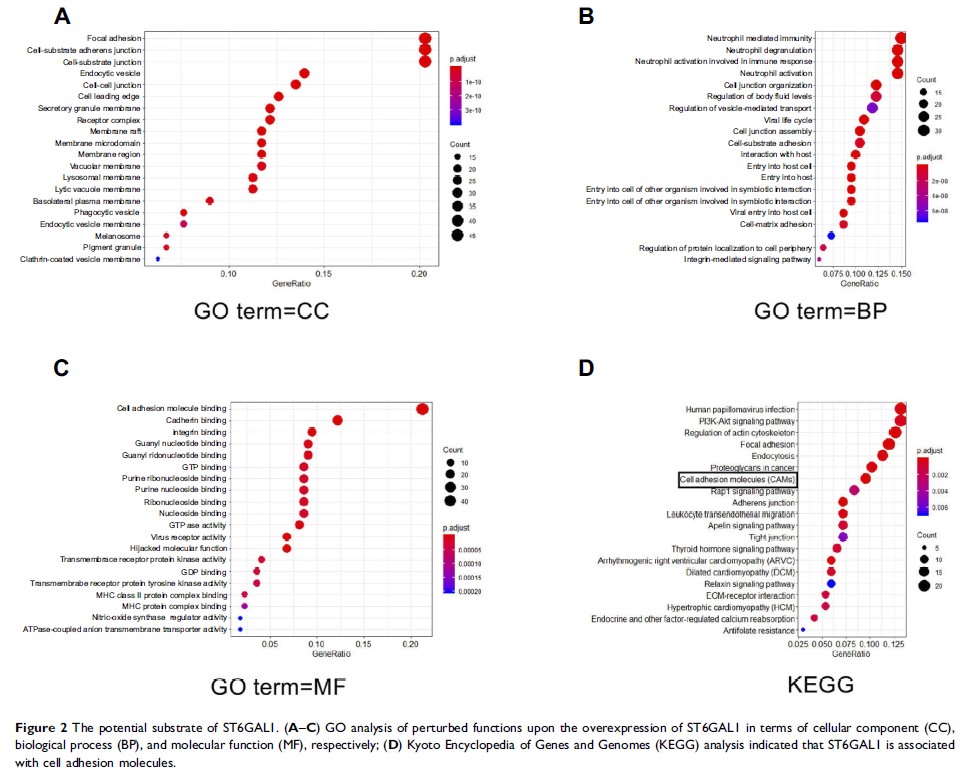
Methods: First, ST6GAL1 was overexpressed and knocked down to perform transwell and wound healing assays, and the results were further confirmed in vivo. Based on the results of MS, GO and KEGG analysis were applied to reveal the connection between ST6GAL1 and ICAM-1. Immunoblot and tissue microarrays were administered to investigate the expression of ICAM-1 in different stages of CRC. Next, PCR, lectin precipitation and cycloheximide (CHX) were used to demonstrate the mechanism of ST6GAL1 on ICAM-1. Moreover, we investigated the sialylation on soluble ICAM in serum and its connection to tumor staging.
Results: Overexpression of ST6GAL1 inhibited the migratory ability, while knockdown of ST6GAL1 cells had the reverse effect. Moreover, nude mice injected with ST6GAL1-knockdown cells harvested more liver metastases. Based on the GO and KEGG analysis, data from TCGA database showed a positive correlation between ST6GAL1 and ICAM-1. ICAM-1 also demonstrated a significant decrease in stage III/IV compared with stage I/II tumors. Our results revealed that ST6GAL1 could increase the stability of ICAM-1 through sialylation but had little influence on transcriptional level. Additionally, results of serum lectin precipitation revealed a correlation between the level of sialylation on soluble ICAM and CRC staging.
Conclusion: This study illustrated that ST6GAL1 inhibited the metastatic ability of CRC by stabilizing ICAM-1 via sialylation and demonstrated a correlation between CRC staging and the sialylation on soluble ICAM-1 in serum.
Keywords: colorectal cancer, β-galactoside α2, 6-sialyltranferase 1, ST6GAL1, intercellular adhesion molecule-1, ICAM-1, sialylation, metastasis