117518
论文已发表
注册即可获取德孚的最新动态
IF 收录期刊
- 3.6 Breast Cancer (Dove Med Press)
- 4.3 Clin Epidemiol
- 2.6 Cancer Manag Res
- 3.2 Infect Drug Resist
- 4.1 Clin Interv Aging
- 6.1 Drug Des Dev Ther
- 4.1 Int J Chronic Obstr
- 8.7 Int J Nanomed
- 2.5 Int J Women's Health
- 3.2 Neuropsych Dis Treat
- 2.4 OncoTargets Ther
- 2.6 Patient Prefer Adher
- 2.6 Ther Clin Risk Manag
- 3.1 J Pain Res
- 3.5 Diabet Metab Synd Ob
- 4.5 Psychol Res Behav Ma
- 3.4 Nat Sci Sleep
- 2.4 Pharmgenomics Pers Med
- 2.6 Risk Manag Healthc Policy
- 4.6 J Inflamm Res
- 2.3 Int J Gen Med
- 3.9 J Hepatocell Carcinoma
- 3.3 J Asthma Allergy
- 2.5 Clin Cosmet Investig Dermatol
- 3.0 J Multidiscip Healthc

TBH 评分:预测和预防癌症患者化疗后严重肝损伤的新模型
Authors Zhang M, Bao Y, Chen W, Wei M, Pang H, Ren YF, Mei J, Ye S, Fu S, Peng ZW
Received 31 December 2018
Accepted for publication 8 May 2019
Published 11 July 2019 Volume 2019:11 Pages 6443—6456
DOI https://doi.org/10.2147/CMAR.S199967
Checked for plagiarism Yes
Review by Single-blind
Peer reviewers approved by Dr Amy Norman
Peer reviewer comments 3
Editor who approved publication: Dr Chien-Feng Li
Purpose: To explore a quantitative predictive model for the risk of chemotherapy-induced severe liver damage (CISLD).
Materials and methods: In total, 3870 consecutive cancer patients initially treated with chemotherapy were retrospectively collected and randomly assigned to a training (n=2580) or internal validation (n=1290) set in a 2:1 ratio to construct and validate the model. Additional external validation was performed using another data set (n=413). A total of 486 patients were prospectively enrolled to assess the clinical significance of the model. CISLD was defined as grade ≥3 hepatotoxicity.
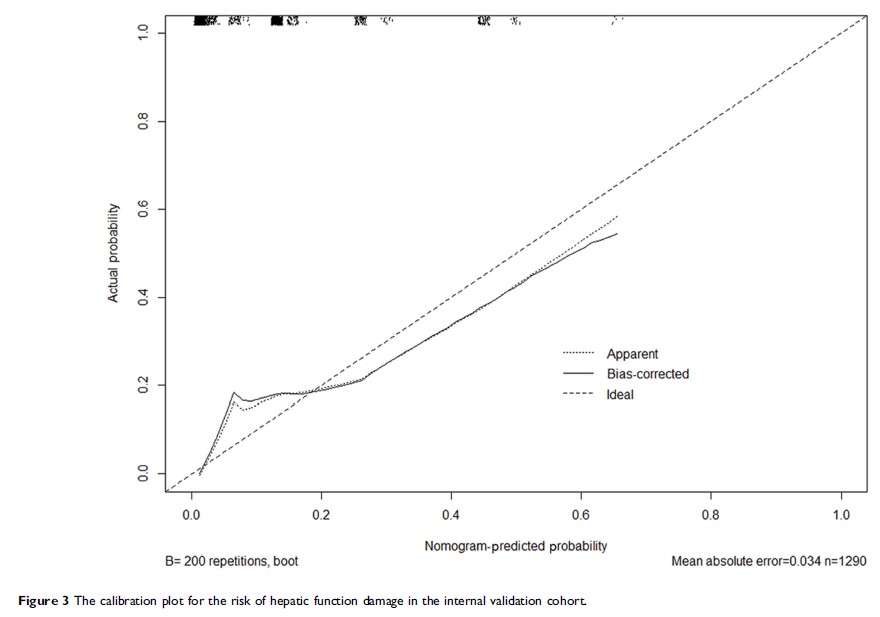
Results: CISLD was found in 255 (9.9%), 128 (9.9%) and 36 (8.7%) patients in the training, internal and external validation sets, respectively. Serum triglyceride, body mass index and history of hypertension formed the basis of the score model. Patients could be stratified into low, intermediate and high-risk groups with <10%, 10–30% and >30% CISLD occurrence, respectively. This model displayed a concordance index (C-index) of 0.834 and was validated in both the internal (C-index, 0.830) and external (C-index, 0.817) sets. The incidence of CISLD was significantly reduced in those who received preventive hepatoprotective drugs compared to those who did not among patients assessed as the intermediate risk group (8.9% vs 17.5%, p =0.042) and the high risk group (15.6% vs 55.8%, p =0.043).
Conclusions: The new score model can be used to accurately predict the risk of CISLD in cancer patients undergoing chemotherapy. Clinically, this can be translated into a reference tool for oncologists in the clinical decision-making process before chemotherapy to provide appropriate prevention and interventions for patients with a high risk of CISLD.
Keywords: chemotherapy, liver damage, predictive model