117518
论文已发表
注册即可获取德孚的最新动态
IF 收录期刊
- 3.6 Breast Cancer (Dove Med Press)
- 4.3 Clin Epidemiol
- 2.6 Cancer Manag Res
- 3.2 Infect Drug Resist
- 4.1 Clin Interv Aging
- 6.1 Drug Des Dev Ther
- 4.1 Int J Chronic Obstr
- 8.7 Int J Nanomed
- 2.5 Int J Women's Health
- 3.2 Neuropsych Dis Treat
- 2.4 OncoTargets Ther
- 2.6 Patient Prefer Adher
- 2.6 Ther Clin Risk Manag
- 3.1 J Pain Res
- 3.5 Diabet Metab Synd Ob
- 4.5 Psychol Res Behav Ma
- 3.4 Nat Sci Sleep
- 2.4 Pharmgenomics Pers Med
- 2.6 Risk Manag Healthc Policy
- 4.6 J Inflamm Res
- 2.3 Int J Gen Med
- 3.9 J Hepatocell Carcinoma
- 3.3 J Asthma Allergy
- 2.5 Clin Cosmet Investig Dermatol
- 3.0 J Multidiscip Healthc

2014 年国际泌尿病理学会(ISUP)针对高风险前列腺癌患者的评分系统的验证:单中心回顾性研究
Authors Liu J, Zhao J, Zhang M, Chen N, Sun G, Yang Y, Zhang X, Chen J, Shen P, Shi M, Zeng H
Received 28 November 2018
Accepted for publication 25 May 2019
Published 12 July 2019 Volume 2019:11 Pages 6521—6529
DOI https://doi.org/10.2147/CMAR.S196286
Checked for plagiarism Yes
Review by Single-blind
Peer reviewers approved by Ms Justinn Cochran
Peer reviewer comments 2
Editor who approved publication: Dr Ahmet Emre Eskazan
Introduction: Since the new 2014 grading system was recommended by the International Society of Urological Pathology (ISUP), it has been validated in patients with localized prostate cancer (PCa) and it has shown excellent prognostic value. However, its predictive power in high-risk PCa remains unclear.
Methods: A total of 420 patients with high-risk PCa who underwent radical prostatectomy (RP) were included in this study. Biochemical recurrence-free survival (BRFS) was set as the endpoint.
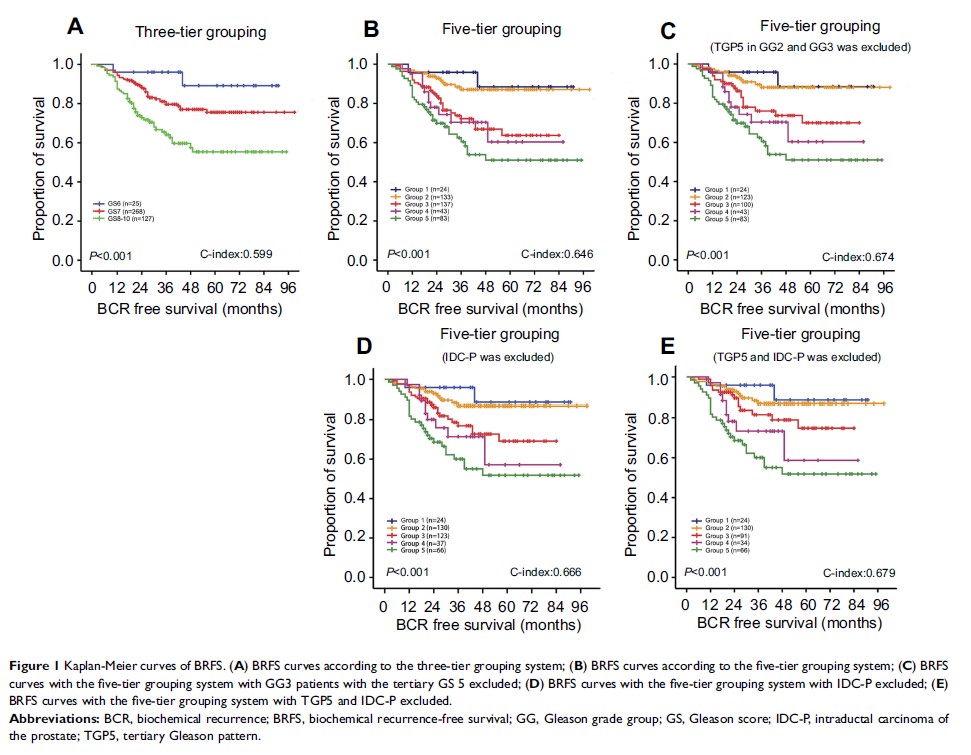
Results: Biochemical recurrence occurred in 84/420 (20.0%) patients at the end of follow-up. Compared to the three-tier grouping system, the five-tier grouping system could more effectively distinguish the BRFS of patients with higher predictive accuracy (C-index: 0.599 vs 0.646). The BRFS of patients with grade group (GG) 1 and GG 2 was similar (P =0.593). Also, the prognosis between those with GG 2 and GG 3 could be clearly distinguished (P =0.001). However, the discrimination capacity between patients with GG 3 and GG 4 was limited (P =0.681). When tertiary Gleason pattern (TGP5) and intraductal carcinoma of the prostate (IDC-P) were excluded, the HR value of the GG 4 group vs the GG 3 group increased from 1.15 (95% CI: 0.59–2.22) to 1.49 (95% CI: 0.72–3.10) and 1.36 (95% CI:0.65–2.83), respectively.
Conclusions: This study is the first to validate the new 2014 ISUP grading system in patients with high-risk PCa who underwent RP. The 2014 system could effectively classify patients into five groups with high predictive accuracy. Notably, the existence of TGP5 and IDC-P needs to be routinely reported in clinical practice, which could help to support the predictive value of the new grading system.
Keywords: biochemical recurrence-free survival, ISUP grading system, high-risk, prostate cancer, radical prostatectomy