117518
论文已发表
注册即可获取德孚的最新动态
IF 收录期刊
- 3.6 Breast Cancer (Dove Med Press)
- 4.3 Clin Epidemiol
- 2.6 Cancer Manag Res
- 3.2 Infect Drug Resist
- 4.1 Clin Interv Aging
- 6.1 Drug Des Dev Ther
- 4.1 Int J Chronic Obstr
- 8.7 Int J Nanomed
- 2.5 Int J Women's Health
- 3.2 Neuropsych Dis Treat
- 2.4 OncoTargets Ther
- 2.6 Patient Prefer Adher
- 2.6 Ther Clin Risk Manag
- 3.1 J Pain Res
- 3.5 Diabet Metab Synd Ob
- 4.5 Psychol Res Behav Ma
- 3.4 Nat Sci Sleep
- 2.4 Pharmgenomics Pers Med
- 2.6 Risk Manag Healthc Policy
- 4.6 J Inflamm Res
- 2.3 Int J Gen Med
- 3.9 J Hepatocell Carcinoma
- 3.3 J Asthma Allergy
- 2.5 Clin Cosmet Investig Dermatol
- 3.0 J Multidiscip Healthc

HOXA10 通过激活 JAK1/STAT3 信号通路使胃癌恶化
Authors Chen W, Wu G, Zhu Y, Zhang W, Zhang H, Zhou Y, Sun P
Received 12 January 2019
Accepted for publication 29 May 2019
Published 15 July 2019 Volume 2019:11 Pages 6625—6635
DOI https://doi.org/10.2147/CMAR.S201342
Checked for plagiarism Yes
Review by Single-blind
Peer reviewers approved by Dr Colin Mak
Peer reviewer comments 2
Editor who approved publication: Dr Rituraj Purohit
Background: HOXA10 has been reported to be deregulated in many kinds of cancers including gastric cancer. But its role in gastric cancer progression is controversial. Therefore, the current study was performed to explore the role and mechanism of HOXA10 in gastric cancer.
Materials and methods: IHC and Western blotting assays were used to assess HOXA10 expression in gastric cancer tissues and cells. Lentivirus infection was used to alter HOXA10, STAT3 and JAK1 expression in gastric cancer NCI-N87 and MKN28 cells. MTT, cloning formation, flow cytometry and in vivo xenotransplantation experiments were carried out to assess cell proliferation, cloning formation, apoptosis and tumorigenesis.
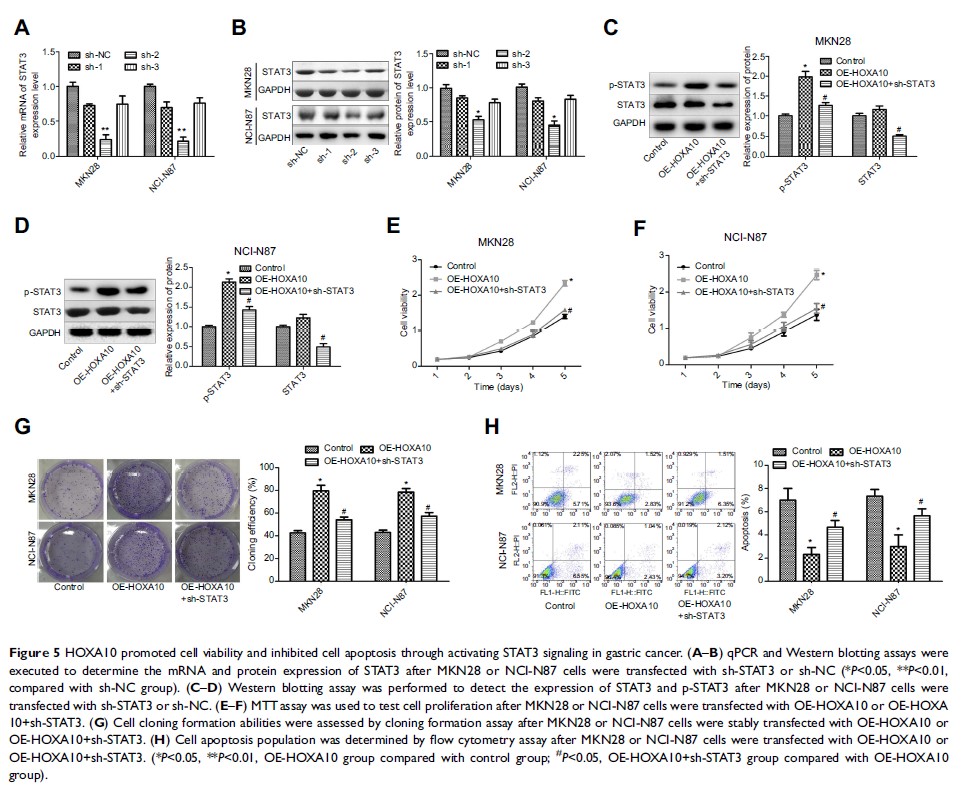
Results: HOXA10 expression was obviously increased in gastric cancer tissues and cells when compared with the normal gastric tissue samples and cells. Upregulation of HOXA10 significantly enhanced cell proliferation, cloning formation and tumorigenesis abilities and reduced cell apoptosis in gastric cancer, and promoted the activation of JAK1/STAT3 signaling. In addition, we showed that the effects of HOXA10 on the promotion of cell viability and tumorigenesis and cell apoptosis repression were all weakened when JAK1 or STAT3 was downregulated.
Conclusion: This study demonstrates that HOXA10 functions as an oncogene in gastric cancer through activating JAK1/STAT3 signaling.
Keywords: HOXA10, JAK1/STAT3, viability, apoptosis, tumorigenesis, gastric cancer