119661
论文已发表
注册即可获取德孚的最新动态
IF 收录期刊
- 3.6 Breast Cancer (Dove Med Press)
- 4.3 Clin Epidemiol
- 2.6 Cancer Manag Res
- 3.2 Infect Drug Resist
- 4.1 Clin Interv Aging
- 6.1 Drug Des Dev Ther
- 4.1 Int J Chronic Obstr
- 8.7 Int J Nanomed
- 2.5 Int J Women's Health
- 3.2 Neuropsych Dis Treat
- 2.4 OncoTargets Ther
- 2.6 Patient Prefer Adher
- 2.6 Ther Clin Risk Manag
- 3.1 J Pain Res
- 3.5 Diabet Metab Synd Ob
- 4.5 Psychol Res Behav Ma
- 3.4 Nat Sci Sleep
- 2.4 Pharmgenomics Pers Med
- 2.6 Risk Manag Healthc Policy
- 4.6 J Inflamm Res
- 2.3 Int J Gen Med
- 3.9 J Hepatocell Carcinoma
- 3.3 J Asthma Allergy
- 2.5 Clin Cosmet Investig Dermatol
- 3.0 J Multidiscip Healthc

SIRT1 可预防城市颗粒物引起的气道炎症
Authors Lai T, Wen X, Wu D, Su G, Gao Y, Chen C, Wu W, Lv Y, Chen Z, Lv Q, Li W, Li D, Chen M, Wu B
Received 25 January 2019
Accepted for publication 24 May 2019
Published 5 August 2019 Volume 2019:14 Pages 1741—1752
DOI https://doi.org/10.2147/COPD.S202904
Checked for plagiarism Yes
Review by Single-blind
Peer reviewers approved by Dr Amy Norman
Peer reviewer comments 4
Editor who approved publication: Prof. Dr. Chunxue Bai
Purpose: Particulate matter (PM) has been implicated as a risk factor for airway injury. However, the molecular mechanisms remain largely unclear. The goal of this study was to determine whether sirtuin1 (SIRT1), an anti-inflammatory and antiaging protein, protects against PM-induced airway inflammation.
Methods: The effect of SIRT1 on PM-induced airway inflammation was assessed by using in vivo models of airway inflammation induced by PM and in vitro culture of human bronchial epithelial (HBE) cells exposed to PM, resveratrol (SIRT1 activator), or both.
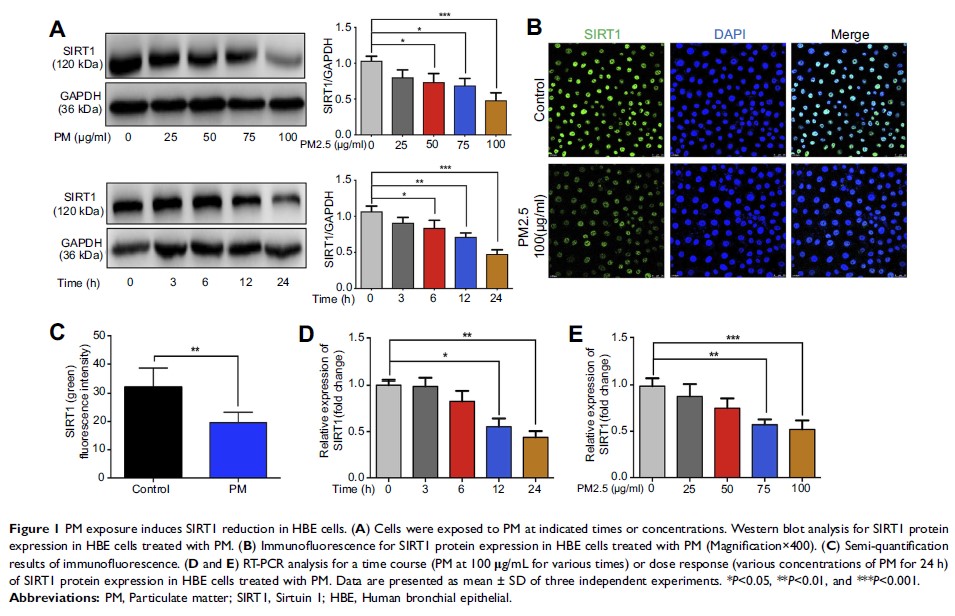
Results: PM-stimulated HBE cells showed a significant decrease in SIRT1 but a notable increase in inflammatory cytokines. SIRT1 gene silencing further enhanced PM-induced expression of inflammatory cytokines. In contrast, resveratrol, a SIRT1 activator, reduced the expression of these cytokines compared with the control cells. In vivo, SIRT1 expression was significantly decreased in lung tissues of PM-exposed mice. Interestingly, resveratrol treatment reversed the enhanced total cells, neutrophils and inflammatory cytokines in PM-induced mice. Moreover, SIRT1 mediated PM-induced inflammatory cytokines expression at least partly through MAPK pathways.
Conclusion: These findings suggest that SIRT1 is involved in the pathogenesis of PM-induced airway inflammation and activation of SIRT1 could prevent airway disorders or disease exacerbations induced by airborne particulate pollution.
Keywords: particulate matter, SIRT1, resveratrol, airway inflammation