119661
论文已发表
注册即可获取德孚的最新动态
IF 收录期刊
- 3.6 Breast Cancer (Dove Med Press)
- 4.3 Clin Epidemiol
- 2.6 Cancer Manag Res
- 3.2 Infect Drug Resist
- 4.1 Clin Interv Aging
- 6.1 Drug Des Dev Ther
- 4.1 Int J Chronic Obstr
- 8.7 Int J Nanomed
- 2.5 Int J Women's Health
- 3.2 Neuropsych Dis Treat
- 2.4 OncoTargets Ther
- 2.6 Patient Prefer Adher
- 2.6 Ther Clin Risk Manag
- 3.1 J Pain Res
- 3.5 Diabet Metab Synd Ob
- 4.5 Psychol Res Behav Ma
- 3.4 Nat Sci Sleep
- 2.4 Pharmgenomics Pers Med
- 2.6 Risk Manag Healthc Policy
- 4.6 J Inflamm Res
- 2.3 Int J Gen Med
- 3.9 J Hepatocell Carcinoma
- 3.3 J Asthma Allergy
- 2.5 Clin Cosmet Investig Dermatol
- 3.0 J Multidiscip Healthc

低剂量 D2/D3 部分受体激动剂普拉克索对精神安定剂诱发的锥体外系疾病症状和精神分裂症症状的疗效:第一阶段开放标签试验研究
Authors Weng JJ, Wang LH, Zhu H, Xu WR, Wei YM, Wang ZY, Yu WJ, Li HF
Received 21 February 2019
Accepted for publication 3 July 2019
Published 7 August 2019 Volume 2019:15 Pages 2195—2203
DOI https://doi.org/10.2147/NDT.S205933
Checked for plagiarism Yes
Review by Single-blind
Peer reviewers approved by Dr Colin Mak
Peer reviewer comments 2
Editor who approved publication: Professor Jun Chen
Objective: Some lines of evidence show that D2/D3 receptor partial agonist pramipexole may be effective in the treatment of extrapyramidal symptoms (EPS) and psychiatric symptoms of schizophrenia. Therefore, we analyzed whether a low dose of pramipexole (0.375–0.75 mg/day) has efficacy on EPS and symptoms of schizophrenia while maintaining tolerability.
Methods: Ten subjects with EPS [including drug-induced parkinsonism (DIP) and akathisia] were recruited in a stage-1, open-label pilot study. All the subjects were treated with a low dose of pramipexole. The evaluations were performed at baseline, day 3, week 1, week 2, week 4, week 6, and week 8. The ratings of SAS, BARS, PANSS, CDSS, and CGI-S and adverse effects (AE) were recorded in every visit.
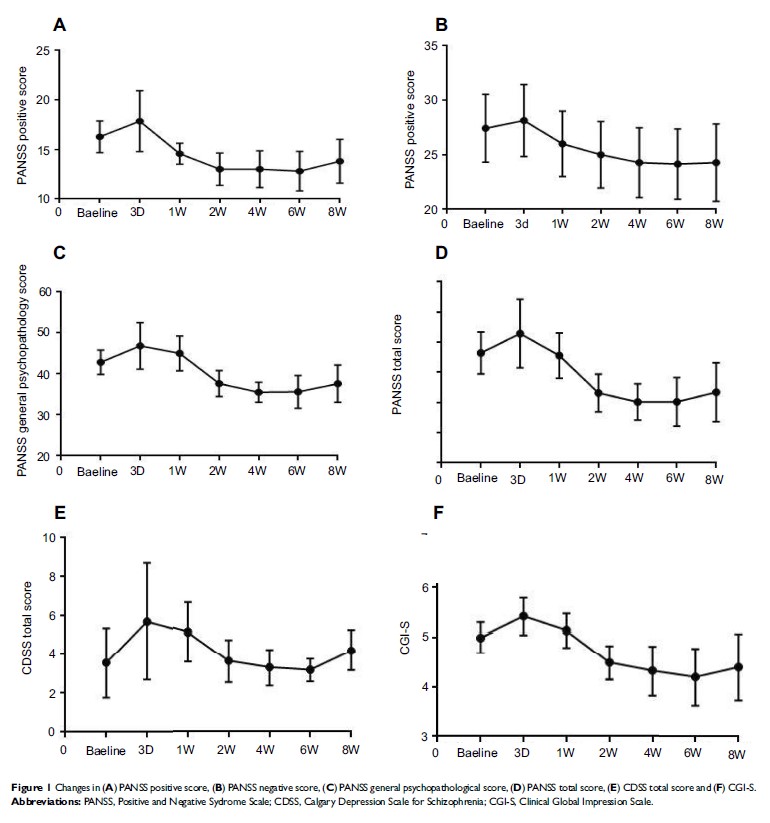
Results: SAS total scores decreased significantly during the study in patients with DIP (P <0.001), and mild AEs were detected. Treatments with pramipexole did not show an anti-akathisia effect during the study, while 2 subjects experienced deterioration of akathisia and mood symptoms. The psychiatric symptoms of schizophrenia showed a trend of improvement during the study, but there was no improvement in depressive mood.
Conclusion: A low dose of pramipexole can significantly relieve antipsychotic-induced parkinsonism, but not akathisia. Improvements in psychiatric symptoms of schizophrenia were found, but the results of this study need to be validated in a larger sample. No improvement of mood disorder was detected.
Keywords: extrapyramidal symptoms, antipsychotics, pramipexole, clinical trial