119942
论文已发表
注册即可获取德孚的最新动态
IF 收录期刊
- 3.6 Breast Cancer (Dove Med Press)
- 4.3 Clin Epidemiol
- 2.6 Cancer Manag Res
- 3.2 Infect Drug Resist
- 4.1 Clin Interv Aging
- 6.1 Drug Des Dev Ther
- 4.1 Int J Chronic Obstr
- 8.7 Int J Nanomed
- 2.5 Int J Women's Health
- 3.2 Neuropsych Dis Treat
- 2.4 OncoTargets Ther
- 2.6 Patient Prefer Adher
- 2.6 Ther Clin Risk Manag
- 3.1 J Pain Res
- 3.5 Diabet Metab Synd Ob
- 4.5 Psychol Res Behav Ma
- 3.4 Nat Sci Sleep
- 2.4 Pharmgenomics Pers Med
- 2.6 Risk Manag Healthc Policy
- 4.6 J Inflamm Res
- 2.3 Int J Gen Med
- 3.9 J Hepatocell Carcinoma
- 3.3 J Asthma Allergy
- 2.5 Clin Cosmet Investig Dermatol
- 3.0 J Multidiscip Healthc

低密度脂蛋白受体相关蛋白 11 在宫颈癌中作为肿瘤启动子的作用
Authors Wang Y, Han S, You X, Shi X, Liu L, Sun Y, Ma Y, Qian Q, Liu H, Cui B, Zhang Y
Received 11 April 2019
Accepted for publication 20 August 2019
Published 30 August 2019 Volume 2019:11 Pages 8081—8093
DOI https://doi.org/10.2147/CMAR.S211912
Checked for plagiarism Yes
Review by Single-blind
Peer reviewers approved by Dr Nicola Ludin
Peer reviewer comments 2
Editor who approved publication: Professor Nakshatri
Background: It is unclear whether low density lipoprotein receptor-related protein 11 (LRP11), a newly found lipoprotein receptor regulatory protein, has the carcinogenic effects in cervical cancer.
Methods: Bioinformatics analysis, immunohistochemical (IHC) staining and evaluation, cell proliferation assay, flow cytometry, transwell migration and invasion assays, Western blotting, growth of LRP11-silenced cells in athymic nude mice were performed in this research.
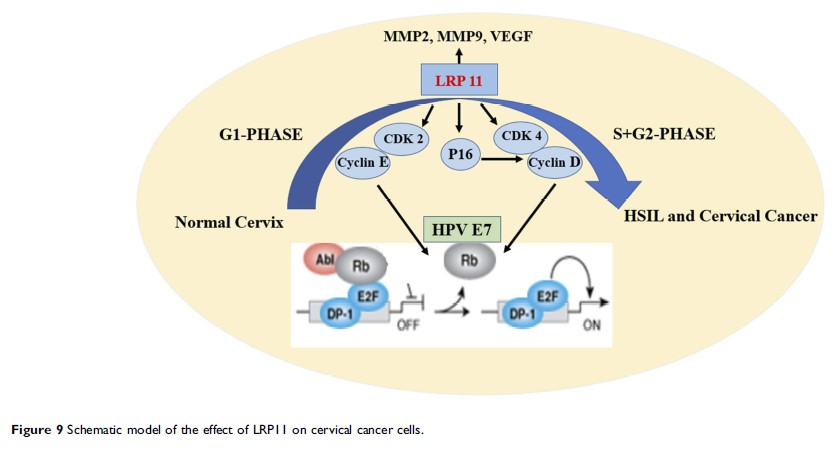
Results: We found that LRP11 expression was higher in high-grade squamous intraepithelial lesions (HSIL) and cervical cancer tissue than in normal cervix, and high expression of LRP11 was associated with differentiation degree (P =0.0266), indicating poor prognosis (P =0.0210). The silencing of LRP11 in SiHa and CaSki cell lines inhibited cell proliferation, reduced migration and invasion and suppressed cell growth in nude mice, which possibly related to cell cycle protein regulation of CDK 2/4, cyclin D1/E1, MMP-2/9, and VEGF. Furthermore, LRP11 showed substantial positive correlation with P16 in vivo and in vitro.
Conclusion: LRP11 plays important roles in proliferation, migration and invasion, with the potential to be a useful prognostic marker and therapeutic target for patients with HSIL and cervical cancer.
Keywords: HPV, cervical cancer, LRP11, P16, cell cycle