115195
论文已发表
注册即可获取德孚的最新动态
IF 收录期刊
- 3.6 Breast Cancer (Dove Med Press)
- 4.3 Clin Epidemiol
- 2.6 Cancer Manag Res
- 3.2 Infect Drug Resist
- 4.1 Clin Interv Aging
- 6.1 Drug Des Dev Ther
- 4.1 Int J Chronic Obstr
- 8.7 Int J Nanomed
- 2.5 Int J Women's Health
- 3.2 Neuropsych Dis Treat
- 2.4 OncoTargets Ther
- 2.6 Patient Prefer Adher
- 2.6 Ther Clin Risk Manag
- 3.1 J Pain Res
- 3.5 Diabet Metab Synd Ob
- 4.5 Psychol Res Behav Ma
- 3.4 Nat Sci Sleep
- 2.4 Pharmgenomics Pers Med
- 2.6 Risk Manag Healthc Policy
- 4.6 J Inflamm Res
- 2.3 Int J Gen Med
- 3.9 J Hepatocell Carcinoma
- 3.3 J Asthma Allergy
- 2.5 Clin Cosmet Investig Dermatol
- 3.0 J Multidiscip Healthc

在绝经后骨质疏松症中 LncRNA CASC11 与 TNF-α 相关联并得到上调
Authors Yu H, Zhou W, Yan W, Xu Z, Xie Y, Zhang P
Received 18 February 2019
Accepted for publication 24 May 2019
Published 20 September 2019 Volume 2019:14 Pages 1663—1669
DOI https://doi.org/10.2147/CIA.S205796
Checked for plagiarism Yes
Review by Single-blind
Peer reviewers approved by Dr Amy Norman
Peer reviewer comments 2
Editor who approved publication: Dr Richard Walker
Purpose: In this study, we aimed to investigate the role of lncRNA cancer susceptibility 11 (CASC11) and tumor necrosis factor (TNF-α) in postmenopausal osteoporosis (POP).
Methods and materials: POP patients and healthy controls were included in this study and levels of CASC11 and TNF-α in plasma of those participants were measured by qPCR and Western blot, respectively. ROC curve was used for diagnostic analysis. Patients were followed up for 2 years and the correlations between the levels of CASC11 and TNF-α and disease conditions were analyzed.
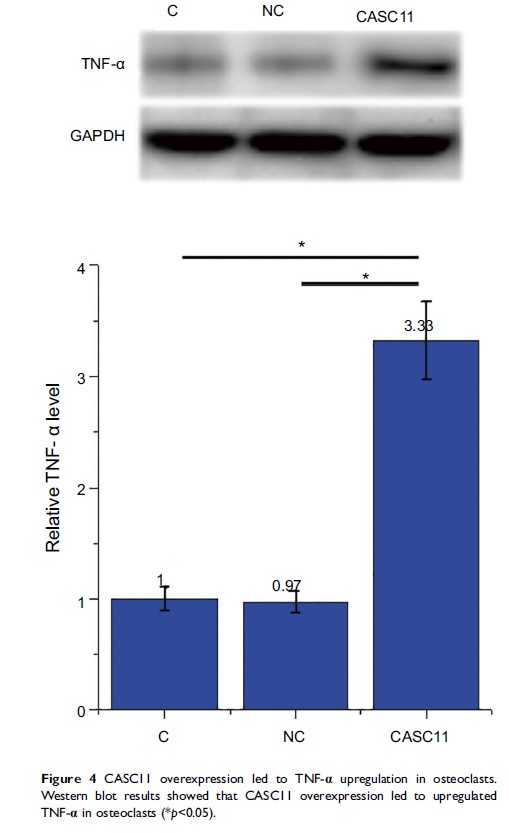
Results: We found that CASC11 and TNF-α were both upregulated in plasma of POP patients than in healthy controls. Plasma levels of CASC11 and TNF-α were positively correlated in both POP patients and in healthy controls. Upregulation of CASC11 and TNF-α distinguished POP patients from healthy controls. Treatment and follow-up study showed that high CASC11 levels were significantly correlated with prolonged treatment course and high recurrence rate. Plasma levels of CASC11 and TNF-α decreased after treatment. CASC11 overexpression led to upregulated TNF-α in osteoclasts.
Conclusion: CASC11 is upregulated in POP and is correlated with TNF-α.
Keywords: postmenopausal osteoporosis, CASC11, TNF-α, osteoclasts