115195
论文已发表
注册即可获取德孚的最新动态
IF 收录期刊
- 3.6 Breast Cancer (Dove Med Press)
- 4.3 Clin Epidemiol
- 2.6 Cancer Manag Res
- 3.2 Infect Drug Resist
- 4.1 Clin Interv Aging
- 6.1 Drug Des Dev Ther
- 4.1 Int J Chronic Obstr
- 8.7 Int J Nanomed
- 2.5 Int J Women's Health
- 3.2 Neuropsych Dis Treat
- 2.4 OncoTargets Ther
- 2.6 Patient Prefer Adher
- 2.6 Ther Clin Risk Manag
- 3.1 J Pain Res
- 3.5 Diabet Metab Synd Ob
- 4.5 Psychol Res Behav Ma
- 3.4 Nat Sci Sleep
- 2.4 Pharmgenomics Pers Med
- 2.6 Risk Manag Healthc Policy
- 4.6 J Inflamm Res
- 2.3 Int J Gen Med
- 3.9 J Hepatocell Carcinoma
- 3.3 J Asthma Allergy
- 2.5 Clin Cosmet Investig Dermatol
- 3.0 J Multidiscip Healthc

下调的 MCOLN1 通过抑制溶酶体自噬来减缓非小细胞肺癌的进展
Authors Yin C, Zhang H, Liu X, Zhang H, Zhang Y, Bai X, Wang L, Li H, Li X, Zhang S, Zhang L, Zhang Y
Received 21 May 2019
Accepted for publication 6 September 2019
Published 23 September 2019 Volume 2019:11 Pages 8607—8617
DOI https://doi.org/10.2147/CMAR.S216538
Checked for plagiarism Yes
Review by Single-blind
Peer reviewers approved by Dr Nicola Ludin
Peer reviewer comments 2
Editor who approved publication: Dr Chien-Feng Li
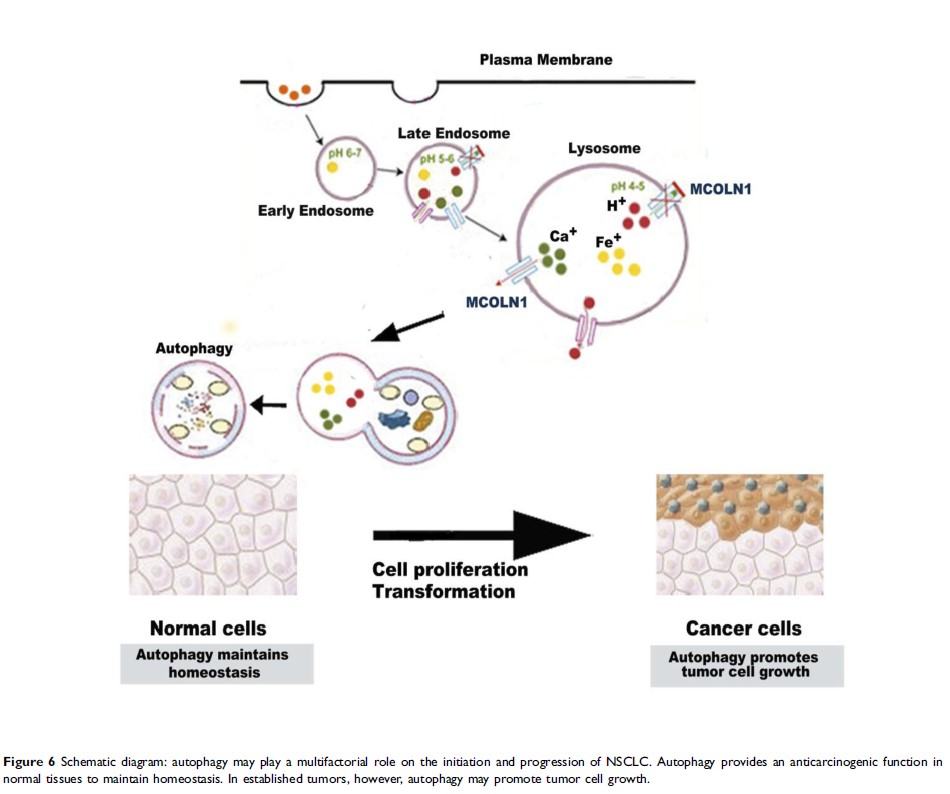
Objectives: Autophagy plays various roles in non-small-cell lung cancer (NSCLC). MCOLN1, a reactive oxygen species sensor, can regulate autophagy via lysosomal Ca(2+); however, the role of MCOLN1 in NSCLC is largely unknown. This study aimed to explore the effects of MCOLN1 on proliferation, invasion and migration in NSCLC and the underling mechanisms.
Materials and methods: The tissues of NSCLC patients were collected, then MCOLN1 expression in tumor and adjacent tissues was measured and its relationship with pathological staging was analyzed. The Cell Counting Kit-8 (CCK-8) assay, wound healing assay and transwell migration assay were used to evaluate the proliferation, migration and invasion ability, respectively. Live-cell imaging and transmission electron microscopy (TEM) were used to observe autophagic flux and autolysosomes.
Results: It was found that MCOLN1 expression was significantly decreased in human NSCLC tissues compared with normal lung tissues while more MCOLN1 in stage III–IV was shown than stage I–II, indicating that MCOLN1 increased along with the progression of NSCLC. Furthermore, CCK-8 assay, wound healing assay and transwell migration assay confirmed that the inhibition of MCOLN1 suppressed NSCLC cells proliferation migration and invasion. Overexpression of MCOLN1 promoted autophagy in A549 and H1299 cells with increased LC3-II/I, lamp1 expression and autolysosomes as well as autophagic flux shown by live-cell imaging and TEM.
Conclusion: Our study shows that downregulated MCOLN1 reduced lysosome-autophagy activity contributing to inhibited tumor progression, which reveals a novel role of MCOLN1 in NSCLC, and targeting MCOLN1 may be a therapeutic potential for NSCLC.
Keywords: MCOLN1, NSCLC, autophagy, lysosome, progression