115195
论文已发表
注册即可获取德孚的最新动态
IF 收录期刊
- 3.6 Breast Cancer (Dove Med Press)
- 4.3 Clin Epidemiol
- 2.6 Cancer Manag Res
- 3.2 Infect Drug Resist
- 4.1 Clin Interv Aging
- 6.1 Drug Des Dev Ther
- 4.1 Int J Chronic Obstr
- 8.7 Int J Nanomed
- 2.5 Int J Women's Health
- 3.2 Neuropsych Dis Treat
- 2.4 OncoTargets Ther
- 2.6 Patient Prefer Adher
- 2.6 Ther Clin Risk Manag
- 3.1 J Pain Res
- 3.5 Diabet Metab Synd Ob
- 4.5 Psychol Res Behav Ma
- 3.4 Nat Sci Sleep
- 2.4 Pharmgenomics Pers Med
- 2.6 Risk Manag Healthc Policy
- 4.6 J Inflamm Res
- 2.3 Int J Gen Med
- 3.9 J Hepatocell Carcinoma
- 3.3 J Asthma Allergy
- 2.5 Clin Cosmet Investig Dermatol
- 3.0 J Multidiscip Healthc

CP-CRE/非 CP-CRE 的分层和 CRE 耐药机制的确定有助于通过使用头孢他啶-阿维巴坦和氨曲南-阿维巴坦更好地治疗 CRE 引起的菌血症
Authors Zou H, Xiong SJ, Lin QX, Wu ML, Niu SQ, Huang SF
Received 16 June 2019
Accepted for publication 2 September 2019
Published 23 September 2019 Volume 2019:12 Pages 3017—3027
DOI https://doi.org/10.2147/IDR.S219635
Checked for plagiarism Yes
Review by Single-blind
Peer reviewers approved by Dr Nicola Ludin
Peer reviewer comments 2
Editor who approved publication: Dr Joachim Wink
Purpose: This observational study aimed to identify the independent risk factors for both the acquisition and mortality of carbapenemase-producing carbapenem-resistant Enterobacteriaceae (CP-CRE) bacteremia and further assess the in vitro antimicrobial activities of ceftazidime–avibactam (CAZ/AVI) and aztreonam–avibactam (ATM/AVI) against recent CRE bacteremic isolates.
Patients and methods: This observational study was conducted to reveal the risk factors and mortality rate for CP-CRE bacteremia between 2012 and 2018 and also evaluate the in vitro antimicrobial activities of CAZ/AVI and ATM/AVI against recent CRE bacteremic isolates from 2016 to 2018.
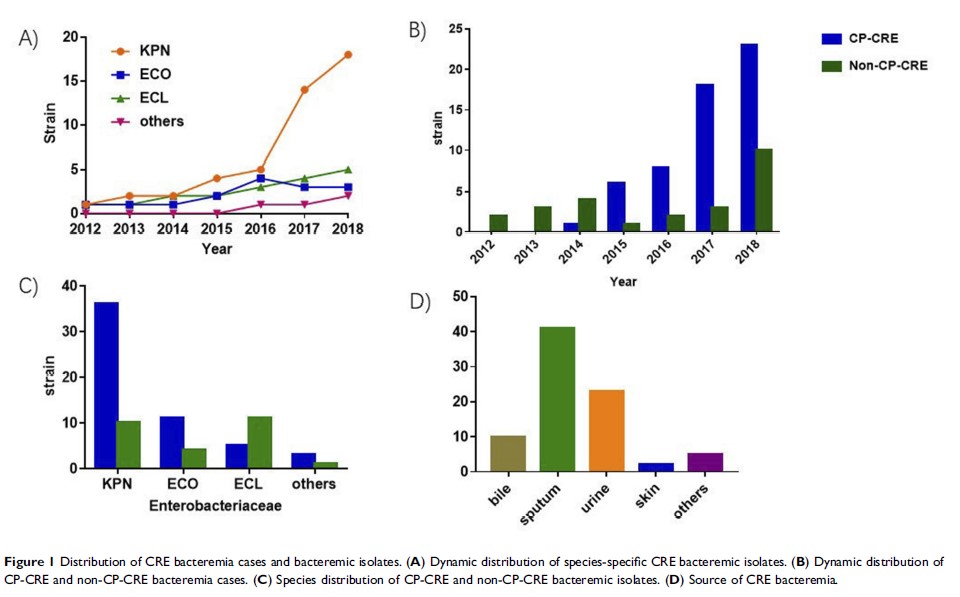
Results: A total of 81 non-repetitive isolates were collected from 2012 to 2018, with 67.90% (55/81) being CP-CRE. Old age (P = 0.01), transfusion [odds ratio (OR): 17.19; 95% CI: 3.15–93.72; P = 0.001], longer ICU stay (P = 0.02), cancer (OR: 15.91; 95% CI: 3.56–71.37; P < 0.001), and previous carbapenem exposure (OR: 27.86; 95% CI: 5.03–154.19; P = 0.001) were identified as independent risk factors for the acquisition of CP-CRE bacteremia compared with the ESBL bacteremia. The in vitro antimicrobial activities of CAZ/AVI and ATM/AVI against the CRE bacteremic isolates from 2016 to 2018 showed a respective susceptibility rate of 70.68% (41/58) and 100.00% (58/58).
Conclusion: The findings indicated that both CP-CRE/non-CP-CRE stratification and CRE resistance mechanism determination were necessary for better guiding the clinical management of CRE bacteremia: ATM/AVI probably works with both non-CP-CRE and CP-CRE bacteremia, even the most notorious double-carbapenemase producer with porin loss/deficiency, whereas CAZ/AVI works with most of the non-CP-CRE and KPC-producers in the region.
Keywords: aztreonam–avibactam, carbapenemase-producing carbapenem-resistant Enterobacteriaceae , carbapenem-resistant Enterobacteriaceae bacteremia, ceftazidime–avibactam