115195
论文已发表
注册即可获取德孚的最新动态
IF 收录期刊
- 3.6 Breast Cancer (Dove Med Press)
- 4.3 Clin Epidemiol
- 2.6 Cancer Manag Res
- 3.2 Infect Drug Resist
- 4.1 Clin Interv Aging
- 6.1 Drug Des Dev Ther
- 4.1 Int J Chronic Obstr
- 8.7 Int J Nanomed
- 2.5 Int J Women's Health
- 3.2 Neuropsych Dis Treat
- 2.4 OncoTargets Ther
- 2.6 Patient Prefer Adher
- 2.6 Ther Clin Risk Manag
- 3.1 J Pain Res
- 3.5 Diabet Metab Synd Ob
- 4.5 Psychol Res Behav Ma
- 3.4 Nat Sci Sleep
- 2.4 Pharmgenomics Pers Med
- 2.6 Risk Manag Healthc Policy
- 4.6 J Inflamm Res
- 2.3 Int J Gen Med
- 3.9 J Hepatocell Carcinoma
- 3.3 J Asthma Allergy
- 2.5 Clin Cosmet Investig Dermatol
- 3.0 J Multidiscip Healthc

消费者购买奢侈品牌的内在动机:一项 EEG 研究
Authors Zhang W, Jin J, Wang A, Ma Q, Yu H
Received 15 May 2019
Accepted for publication 10 September 2019
Published 25 September 2019 Volume 2019:12 Pages 913—929
DOI https://doi.org/10.2147/PRBM.S215751
Checked for plagiarism Yes
Review by Single-blind
Peer reviewers approved by Dr Colin Mak
Peer reviewer comments 4
Editor who approved publication: Professor Mei-chun Cheung
Purpose: This study aims to explore consumers’ implicit motivations for purchasing luxury brands based on the functional theories of attitudes by using event-related potentials (ERPs).
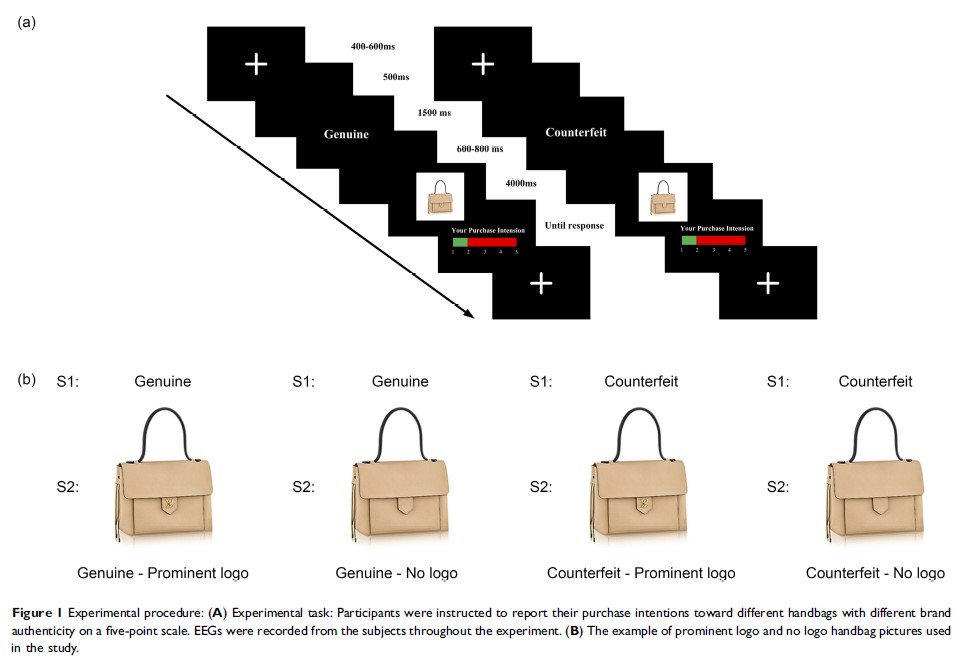
Methods: Brand authenticity and logo prominence were used to modulate the social-adjustive function and value-expressive function, respectively. Twenty right-handed healthy female undergraduates and graduates participated in an experiment that has a 2 brand authenticity (genuine/counterfeit) × 2 brand prominence (prominent logo/no logo) design. In the experiment, participators browsed different luxury handbags with different brand authenticity and logo prominence, and then reported their purchase intentions on a five-point scale. Meanwhile, EEGs were recorded from the subjects throughout the experiment. In the analysis process, three ERP components, which can, respectively, reflect the cognitive conflict (N200), emotional conflict (N400) and motivational emotional arousal (LPP) during the evaluation of marketing-related stimuli, were mainly focused.
Results: For counterfeit brands, the no logo condition elicited significant larger N200 amplitude, marginally significant larger N400 amplitude and significant smaller LPP amplitude than the prominent logo condition. However, for genuine brands, this modulation effect of logo prominence cannot be found. These results imply that consumers’ implicit social motivations for purchasing luxury brands come from the satisfaction of at least one social goal. When one goal cannot be satisfied, consumers will more expect the satisfaction of another one. If this expectation is violated, it seems to be unexpected and unacceptable. Thus, greater anticipation conflict (N200) and emotion conflict (N400) will be induced, and the purchase motivation (LPP) cannot be aroused.
Conclusion: Consumers’ preferences for luxury brands are based on the satisfaction of their social goals. These social goals always coexist and perform as compensation with each other. The dissatisfaction of one social goal would promote their expectation of the satisfaction of another social goal.
Keywords: functional theories of attitudes, brand prominence, brand authenticity, motivation, ERPs, N200, N400, LPP