115195
论文已发表
注册即可获取德孚的最新动态
IF 收录期刊
- 3.6 Breast Cancer (Dove Med Press)
- 4.3 Clin Epidemiol
- 2.6 Cancer Manag Res
- 3.2 Infect Drug Resist
- 4.1 Clin Interv Aging
- 6.1 Drug Des Dev Ther
- 4.1 Int J Chronic Obstr
- 8.7 Int J Nanomed
- 2.5 Int J Women's Health
- 3.2 Neuropsych Dis Treat
- 2.4 OncoTargets Ther
- 2.6 Patient Prefer Adher
- 2.6 Ther Clin Risk Manag
- 3.1 J Pain Res
- 3.5 Diabet Metab Synd Ob
- 4.5 Psychol Res Behav Ma
- 3.4 Nat Sci Sleep
- 2.4 Pharmgenomics Pers Med
- 2.6 Risk Manag Healthc Policy
- 4.6 J Inflamm Res
- 2.3 Int J Gen Med
- 3.9 J Hepatocell Carcinoma
- 3.3 J Asthma Allergy
- 2.5 Clin Cosmet Investig Dermatol
- 3.0 J Multidiscip Healthc

骨质疏松妇女在经皮椎体后凸成形术后接受 12 个月的特立帕肽治疗可减少新的椎骨压缩骨折的发生率和背部疼痛,并改善生活质量
Authors Kong M, Zhou C, Zhu K, Zhang Y, Song M, Zhang H, Tu Q, Ma X
Received 25 July 2019
Accepted for publication 15 September 2019
Published 1 October 2019 Volume 2019:14 Pages 1693—1703
DOI https://doi.org/10.2147/CIA.S224663
Checked for plagiarism Yes
Review by Single-blind
Peer reviewers approved by Dr Cristina Weinberg
Peer reviewer comments 2
Editor who approved publication: Dr Zhi-Ying Wu
Purpose: Define the effectiveness of teriparatide (TPTD) treatment on reducing the incidence of new vertebral compression fractures (NVCFs) and back pain and improving quality of life after percutaneous kyphoplasty (PKP).
Methods: Two years of clinical follow-up data from primary osteoporotic women who had experienced initial osteoporotic vertebral compression fractures (OVCFs) and received PKP plus 12-month TPTD (n=113) or basic treatment (BT) of calcium and vitamin D supplements (n=208) were retrospectively collected. The risk of NVCFs over each 6-month period in the TPTD group was evaluated and compared with the BT group using a logistic regression. Health-related quality of life (HRQoL, EQ-5D questionnaire), back pain [100 mm visual analog scale (VAS)] and bone mineral density (BMD) of the spine were analyzed using linear mixed models for repeated measures (LMMRM).
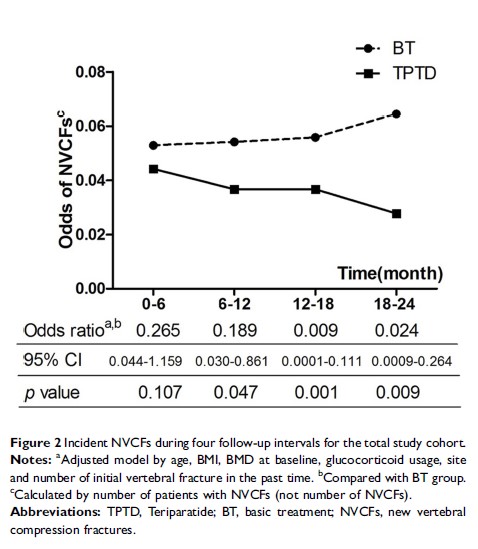
Results: Logistic regression analysis adjusting for baseline characteristics showed that patients in the TPTD group had a lower risk of NVCFs compared with those receiving BT during the final three observation intervals (6–12 months, OR=0.189, 95% CI=0.030–0.681, p =0.046; 12–18 months, OR=0.009, 95% CI=0.0001–0.111, p =0.001; 18–24 months, OR=0.024, 95% CI=0.0009–0.264, p =0.009, respectively). Significant improvements in adjusted EQ-5D and back pain VAS scores were identified in the TPTD group compared with the BT group, and this improvement was sustained for at least 12 months after teriparatide treatment was discontinued (both p <0.001). The BMD of the spine also showed a higher T-value in the TPTD group compared with the BT group (p <0.001).
Conclusion: In routine clinical practice, for patients with OVCFs who receive the PKP procedure, TPTD treatment may be a preferable subsequent therapy because of its ability to reduce the incidence of NVCFs and sustain a high quality of life and back pain alleviation.
Keywords: teriparatide, osteoporosis vertebral fractures, quality of life, back pain, PKP