115195
论文已发表
注册即可获取德孚的最新动态
IF 收录期刊
- 3.6 Breast Cancer (Dove Med Press)
- 4.3 Clin Epidemiol
- 2.6 Cancer Manag Res
- 3.2 Infect Drug Resist
- 4.1 Clin Interv Aging
- 6.1 Drug Des Dev Ther
- 4.1 Int J Chronic Obstr
- 8.7 Int J Nanomed
- 2.5 Int J Women's Health
- 3.2 Neuropsych Dis Treat
- 2.4 OncoTargets Ther
- 2.6 Patient Prefer Adher
- 2.6 Ther Clin Risk Manag
- 3.1 J Pain Res
- 3.5 Diabet Metab Synd Ob
- 4.5 Psychol Res Behav Ma
- 3.4 Nat Sci Sleep
- 2.4 Pharmgenomics Pers Med
- 2.6 Risk Manag Healthc Policy
- 4.6 J Inflamm Res
- 2.3 Int J Gen Med
- 3.9 J Hepatocell Carcinoma
- 3.3 J Asthma Allergy
- 2.5 Clin Cosmet Investig Dermatol
- 3.0 J Multidiscip Healthc

基于聚(3-丙烯酰胺基苯基硼酸-嵌段-N-乙烯基己内酰胺)的葡萄糖敏感的纳米颗粒用于胰岛素输送
Authors Wu J, Yang Y, Li S, Shi A, Song B, Niu S, Chen W, Yao Z
Received 26 June 2019
Accepted for publication 11 September 2019
Published 4 October 2019 Volume 2019:14 Pages 8059—8072
DOI https://doi.org/10.2147/IJN.S220936
Checked for plagiarism Yes
Review by Single-blind
Peer reviewers approved by Dr Cristina Weinberg
Peer reviewer comments 2
Editor who approved publication: Dr Linlin Sun
Background: Compared with random copolymers, block copolymerization is easier to prepare for nanoparticles with core-shell structure, and they will have better glucose sensitivity and higher insulin loading.
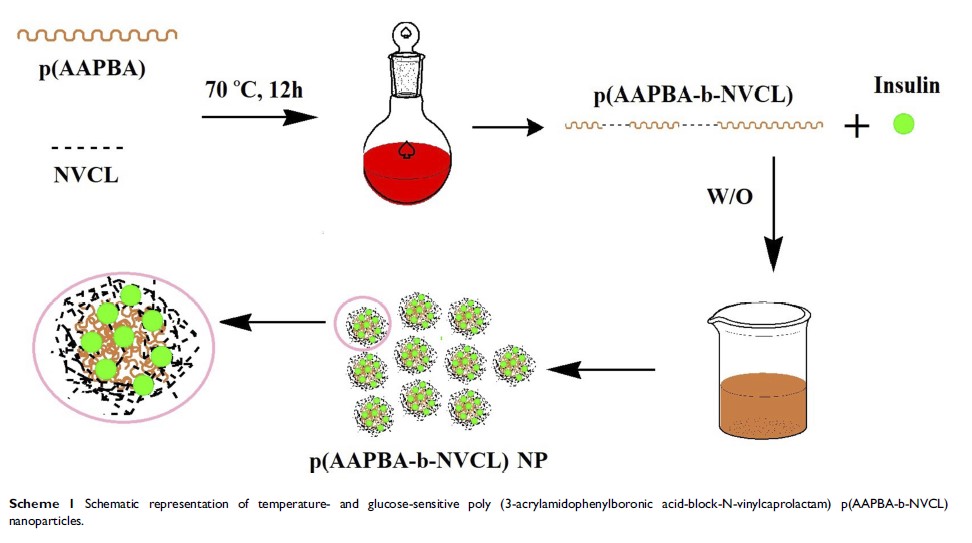
Purpose: In our study, insulin-loaded poly (3-acrylamidophenylboronic acid-block-N-vinyl caprolactam) p(AAPBA-b-NVCL) nanoparticles were successfully prepared and were glucose-sensitive, which could effectively lower the blood sugar levels within 72 hrs.
Methods: The polymer of p(AAPBA-b-NVCL) was produced by reversible addition-fragmentation chain transfer polymerization based on different ratios of 3-acrylamidophenylboronic acid (AAPBA) and N-vinylcaprolactam (NVCL), and its structure was discussed by Fourier transform infrared spectroscopy and 1H-nuclear magnetic resonance . Next, the polymer was manufactured into the nanoparticles, and the characteristics of nanoparticles were detected by dynamic light scattering, lower critical solution temperature, and transmission electron microscopy. After that, the cell and animal toxicity of nanoparticles were also investigated.
Results: The results demonstrated that p(AAPBA-b-NVCL) was successfully synthesized, and can be easily self-assembled to form nanoparticles. The new nanoparticles included monodisperse submicron particles, with the size of the nanoparticle ranged between 150 and 300nm and are glucose- and temperature-sensitive. Meanwhile, insulin can be easily loaded by p(AAPBA-b-NVCL) nanoparticles and an effective sustained release of insulin was observed when the nanoparticles were placed in physiological saline. Besides, MTT assay revealed that cell viability was more than 80%, and mice demonstrated no negative impact on blood biochemistry and heart, liver, spleen, lung, and kidney after intraperitoneal injection of 10 mg/kg/d of nanoparticles. This suggested that the nanoparticles were low-toxic to both cells and animals. Moreover, they could lower the blood sugar level within 72h.
Conclusion: Our research suggested that these p(AAPBA-b-NVCL) nanoparticles might have the potential to be applied in a delivery system for insulin or other hypoglycemic proteins.
Keywords: N-vinylcaprolactam, NVCL, 3-acrylamidophenylboronic acid, AAPBA, nanoparticles, glucose-sensitive, temperature-sensitive