115195
论文已发表
注册即可获取德孚的最新动态
IF 收录期刊
- 3.6 Breast Cancer (Dove Med Press)
- 4.3 Clin Epidemiol
- 2.6 Cancer Manag Res
- 3.2 Infect Drug Resist
- 4.1 Clin Interv Aging
- 6.1 Drug Des Dev Ther
- 4.1 Int J Chronic Obstr
- 8.7 Int J Nanomed
- 2.5 Int J Women's Health
- 3.2 Neuropsych Dis Treat
- 2.4 OncoTargets Ther
- 2.6 Patient Prefer Adher
- 2.6 Ther Clin Risk Manag
- 3.1 J Pain Res
- 3.5 Diabet Metab Synd Ob
- 4.5 Psychol Res Behav Ma
- 3.4 Nat Sci Sleep
- 2.4 Pharmgenomics Pers Med
- 2.6 Risk Manag Healthc Policy
- 4.6 J Inflamm Res
- 2.3 Int J Gen Med
- 3.9 J Hepatocell Carcinoma
- 3.3 J Asthma Allergy
- 2.5 Clin Cosmet Investig Dermatol
- 3.0 J Multidiscip Healthc

顺铂诱导的 miR-425-3p 的外体转移通过激活自噬使 NSCLC 具有顺铂耐药性
Authors Ma Y, Yuwen D, Chen J, Zheng B, Gao J, Fan M, Xue W, Wang Y, Li W, Shu Y, Xu Q, Shen Y
Received 30 June 2019
Accepted for publication 24 September 2019
Published 7 October 2019 Volume 2019:14 Pages 8121—8132
DOI https://doi.org/10.2147/IJN.S221383
Checked for plagiarism Yes
Review by Single-blind
Peer reviewers approved by Dr Thiruganesh Ramasamy
Peer reviewer comments 2
Editor who approved publication: Dr Lei Yang
Introduction: Exosomes are important mediators of intercellular communication. Previously, we characterized circulating exosomal miR-425-3p as a non-invasive prognostic marker for predicting clinical response to platinum-based chemotherapy in patients with non-small cell lung cancer (NSCLC).
Methods: Circulating exosomal miR-425-3p was validated by qRT-PCR in paired serum samples from NSCLC patients during the course of platinum-based chemotherapy. Cell coculture was performed to examine the effects of exosomal miR-425-3p on the sensitivity of recipient A549 cells to cisplatin. Using bioinformatics, ChIP and luciferase reporter assays, the transcription factor essential for miR-425-3p expression was identified. Autophagic activity in the recipient cells was determined by Western blot and fluorescence microscopy.
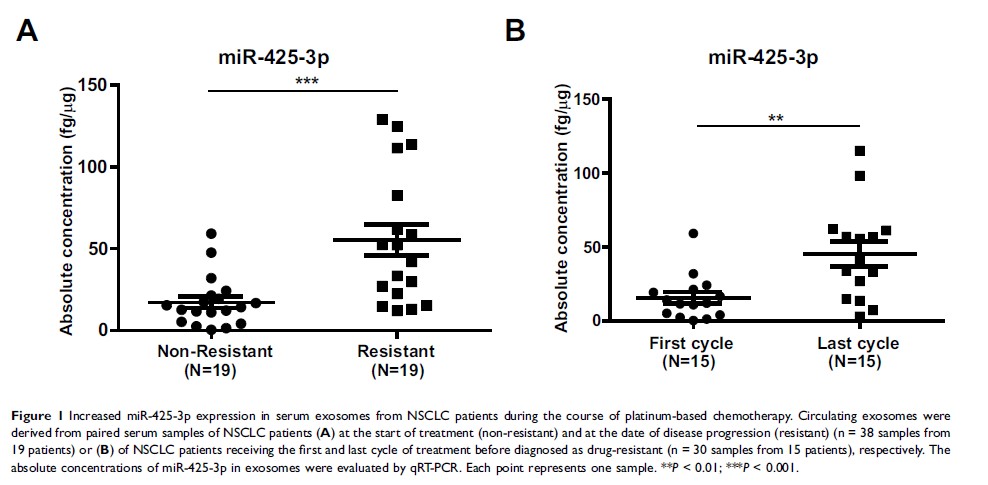
Results: Higher levels of exosomal miR-425-3p were found in serum samples from the patients in tolerance versus those at baseline. An upward trend in the expression of circulating exosomal miR-425-3p was revealed during chemotherapy. Furthermore, the expression of exosomal miR-425-3p could be induced by cisplatin in NSCLC cells. Exosomes isolated from either cisplatin-treated or cisplatin-resistant NSCLC cells conferred chemoresistance to sensitive A549 cells in a miR-425-3p-dependent manner. Cisplatin-induced c-Myc was found to directly bind the miR-425-3p promoter and transactivated its expression. Exosomal miR-425-3p facilitated autophagic activation in the recipient cells by targeting AKT1, eventually leading to chemoresistance.
Discussion: Our results suggest that apart from a prognostic marker of treatment response, exosomal miR-425-3p might be a potential dynamic biomarker to tailor cisplatin resistance in NSCLC patients during the treatment and represent a promising therapeutic target for therapy-resistant NSCLC.
Keywords: exosomes, miR-425-3p, NSCLC, chemoresistance, platinum-based chemotherapy, autophagy