115195
论文已发表
注册即可获取德孚的最新动态
IF 收录期刊
- 3.6 Breast Cancer (Dove Med Press)
- 4.3 Clin Epidemiol
- 2.6 Cancer Manag Res
- 3.2 Infect Drug Resist
- 4.1 Clin Interv Aging
- 6.1 Drug Des Dev Ther
- 4.1 Int J Chronic Obstr
- 8.7 Int J Nanomed
- 2.5 Int J Women's Health
- 3.2 Neuropsych Dis Treat
- 2.4 OncoTargets Ther
- 2.6 Patient Prefer Adher
- 2.6 Ther Clin Risk Manag
- 3.1 J Pain Res
- 3.5 Diabet Metab Synd Ob
- 4.5 Psychol Res Behav Ma
- 3.4 Nat Sci Sleep
- 2.4 Pharmgenomics Pers Med
- 2.6 Risk Manag Healthc Policy
- 4.6 J Inflamm Res
- 2.3 Int J Gen Med
- 3.9 J Hepatocell Carcinoma
- 3.3 J Asthma Allergy
- 2.5 Clin Cosmet Investig Dermatol
- 3.0 J Multidiscip Healthc

超低剂量贝伐单抗治疗放射性脑坏死:一项前瞻性 II 期临床研究
Authors Zhuang H, Zhuang H, Shi S, Wang Y
Received 15 July 2019
Accepted for publication 9 September 2019
Published 11 October 2019 Volume 2019:12 Pages 8447—8453
DOI https://doi.org/10.2147/OTT.S223258
Checked for plagiarism Yes
Review by Single-blind
Peer reviewers approved by Ms Aruna Narula
Peer reviewer comments 3
Editor who approved publication: Prof. Dr. Geoffrey Pietersz
Objective: To investigate the treatment efficacy of ultra-low-dose bevacizumab for cerebral radiation necrosis.
Methods: Patients with cerebral radiation necrosis after stereotactic radiotherapy (SRT) confirmed by imaging were included. Bevacizumab (1 mg/kg, once every three weeks, for at least three continuous treatments) was administered. The primary endpoints included change in cerebral necrosis symptoms, volume of intracranial edema, and changes in MRI signals. The secondary endpoints were adverse reactions of bevacizumab treatment.
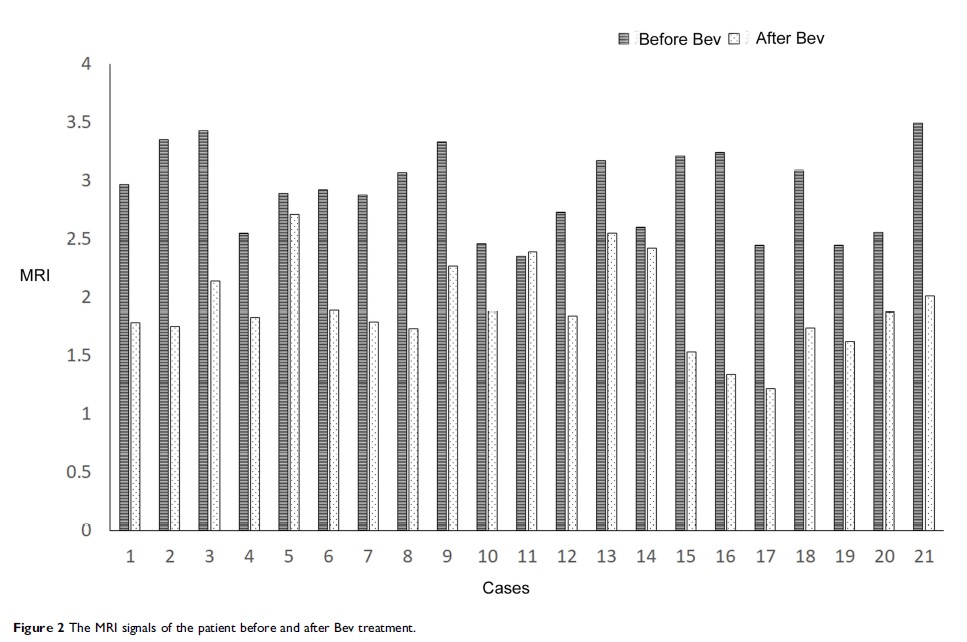
Results: In total, 21 patients were included in this study, all of whom received SRT between December 2016 and February 2019, developed cerebral radiation necrosis, and were treated with bevacizumab. Twenty patients were symptomatic from radiation necrosis, and the symptoms were alleviated in 18 patients (90%). Twenty patients had intracranial edema, and the grade of edema index (EI) was improved in 19 patients (95%). The intensity of the intracranial-enhanced MRI signals was significantly reduced in 20 patients (95.24%). The adverse reactions of bevacizumab treatment were mild, and no adverse reactions more severe than grade 2 were found.
Conclusion: The preliminary results showed that ultra-low-dose bevacizumab had high efficacy for treating cerebral radiation necrosis, and could be a valid alternative to the standard-dose bevacizumab.
Clinical registry: Chinese clinical trial registry (ChiCTR-IOD-16009803).
Keywords: bevacizumab, cerebral radiation necrosis, stereotactic radiotherapy, drug dose, edema index