115195
论文已发表
注册即可获取德孚的最新动态
IF 收录期刊
- 3.6 Breast Cancer (Dove Med Press)
- 4.3 Clin Epidemiol
- 2.6 Cancer Manag Res
- 3.2 Infect Drug Resist
- 4.1 Clin Interv Aging
- 6.1 Drug Des Dev Ther
- 4.1 Int J Chronic Obstr
- 8.7 Int J Nanomed
- 2.5 Int J Women's Health
- 3.2 Neuropsych Dis Treat
- 2.4 OncoTargets Ther
- 2.6 Patient Prefer Adher
- 2.6 Ther Clin Risk Manag
- 3.1 J Pain Res
- 3.5 Diabet Metab Synd Ob
- 4.5 Psychol Res Behav Ma
- 3.4 Nat Sci Sleep
- 2.4 Pharmgenomics Pers Med
- 2.6 Risk Manag Healthc Policy
- 4.6 J Inflamm Res
- 2.3 Int J Gen Med
- 3.9 J Hepatocell Carcinoma
- 3.3 J Asthma Allergy
- 2.5 Clin Cosmet Investig Dermatol
- 3.0 J Multidiscip Healthc

抗菌肽和醋酸洗必泰对革兰氏阴性/革兰氏阳性细菌和真菌的体内和体外功能协同作用
Authors Zhu J, Huang Y, Chen M, Hu C, Chen Y
Received 8 June 2019
Accepted for publication 25 September 2019
Published 15 October 2019 Volume 2019:12 Pages 3227—3239
DOI https://doi.org/10.2147/IDR.S218778
Checked for plagiarism Yes
Review by Single-blind
Peer reviewers approved by Dr Justinn Cochran
Peer reviewer comments 2
Editor who approved publication: Dr Sahil Khanna
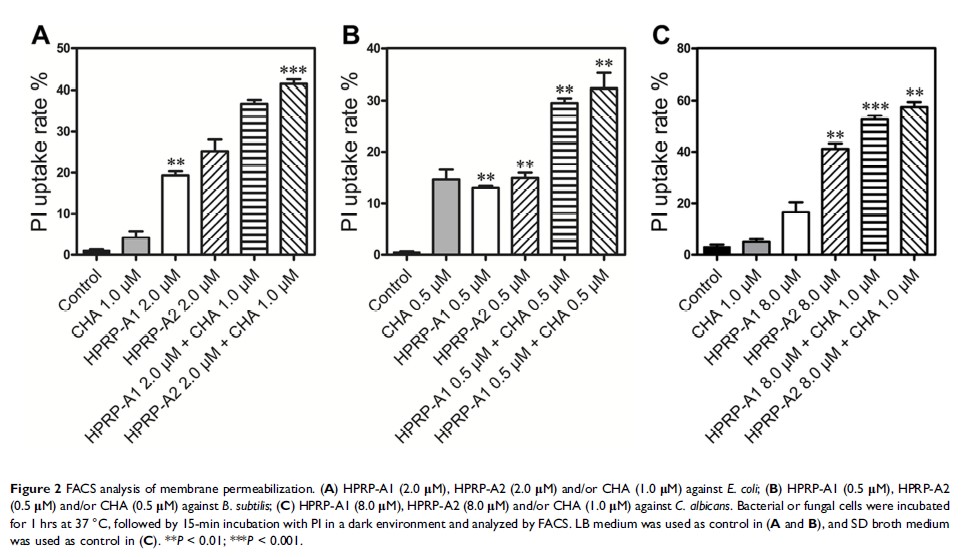
Background and purpose: To reduce the resistance and allergic reaction to chlorhexidine acetate (CHA) in the current treatment of (Bacterial vaginosis) BV and (vulvovaginal candidiasis) VVC in female vaginitis. In this study, the antimicrobial activities and mechanism of action of the synergistic effects of antimicrobial peptides (AMPs) HPRP-A1 and HPRP-A2, and CHA, against Gram-negative and Gram-positive bacteria, and one fungus Candida albicans (C. albicans ) were investigated in vitro and in mouse and rat vaginitis infection models in vivo.
Results: HPRP-A1, HPRP-A2 and CHA showed significant synergistic effects on the antimicrobial activities against different Gram-negative and Gram-positive bacteria and C. albicans . The combined application of HPRP-A2 and CHA exhibited strong synergistic effects in the mouse and rat vaginitis models caused by bacteria or C. albicans .
Conclusion: This study may prompt the development of new drug combinations against vaginitis infections, including mixed bacterial and fungal infections and multi-drug-resistant infections.
Keywords: antimicrobial peptide, chlorhexidine acetate, antibacterial, antifungal, vaginitis