115195
论文已发表
注册即可获取德孚的最新动态
IF 收录期刊
- 3.6 Breast Cancer (Dove Med Press)
- 4.3 Clin Epidemiol
- 2.6 Cancer Manag Res
- 3.2 Infect Drug Resist
- 4.1 Clin Interv Aging
- 6.1 Drug Des Dev Ther
- 4.1 Int J Chronic Obstr
- 8.7 Int J Nanomed
- 2.5 Int J Women's Health
- 3.2 Neuropsych Dis Treat
- 2.4 OncoTargets Ther
- 2.6 Patient Prefer Adher
- 2.6 Ther Clin Risk Manag
- 3.1 J Pain Res
- 3.5 Diabet Metab Synd Ob
- 4.5 Psychol Res Behav Ma
- 3.4 Nat Sci Sleep
- 2.4 Pharmgenomics Pers Med
- 2.6 Risk Manag Healthc Policy
- 4.6 J Inflamm Res
- 2.3 Int J Gen Med
- 3.9 J Hepatocell Carcinoma
- 3.3 J Asthma Allergy
- 2.5 Clin Cosmet Investig Dermatol
- 3.0 J Multidiscip Healthc

带状疱疹后神经痛患者皮肤中的 MicroRNA 和环状 RNA 表达
Authors Cao S, Zhang D, Yuan J, Liu C, Zhou W, Zhang L, Yu S, Qin B, Li Y, Deng W
Received 2 July 2019
Accepted for publication 30 September 2019
Published 16 October 2019 Volume 2019:12 Pages 2905—2913
DOI https://doi.org/10.2147/JPR.S221615
Checked for plagiarism Yes
Review by Single-blind
Peer reviewers approved by Dr Colin Mak
Peer reviewer comments 2
Editor who approved publication: Dr Michael Ueberall
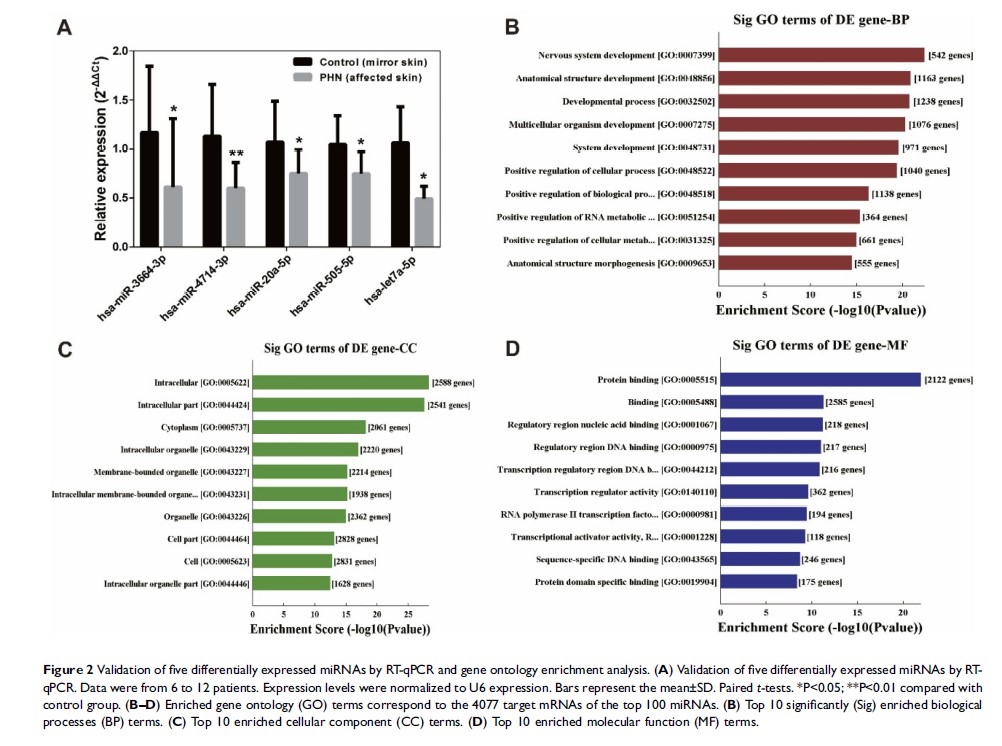
Abstract: Mechanisms of postherpetic neuralgia (PHN) are still not clear. Transcripts such as microRNA (miRNA) and circular RNA (circRNA) in the affected skin may take part in the initiation and development of this neuropathic pain; however, their expression profiles in skins of PHN patients have not been reported. The PHN affected skin and the mirror skin were collected and subjected to miRNA and circRNA microarray, and expression profiles were comparatively analyzed. There were 317 differently expressed miRNAs in PHN affected skin compared with mirror skin (fold change ≥2.0), and 13 of them showed fold change >10 in the PHN skin. Only one circRNA, hsa_circRNA_405463 showed fold change >2 in PHN skin, however, 31 circRNAs with fold change ≥1.5. To evaluate functions of differential miRNAs, their target mRNAs were predicted and bioinformatics analyses including gene ontology, Kyoto Encyclopedia of Genes and Genomes pathway were conducted. Target mRNAs significantly (P<0.05) enriched in 85 pathways, such as FoxO, AMPK, MAPK and pathway. These data reported for the first time that miRNA and circRNA differentially expressed in the PHN skin and these transcripts with abnormal expression could be potential targets to treat PHN.
Keywords: neuropathic pain, postherpetic neuralgia, microRNA, circular RNA