115195
论文已发表
注册即可获取德孚的最新动态
IF 收录期刊
- 3.6 Breast Cancer (Dove Med Press)
- 4.3 Clin Epidemiol
- 2.6 Cancer Manag Res
- 3.2 Infect Drug Resist
- 4.1 Clin Interv Aging
- 6.1 Drug Des Dev Ther
- 4.1 Int J Chronic Obstr
- 8.7 Int J Nanomed
- 2.5 Int J Women's Health
- 3.2 Neuropsych Dis Treat
- 2.4 OncoTargets Ther
- 2.6 Patient Prefer Adher
- 2.6 Ther Clin Risk Manag
- 3.1 J Pain Res
- 3.5 Diabet Metab Synd Ob
- 4.5 Psychol Res Behav Ma
- 3.4 Nat Sci Sleep
- 2.4 Pharmgenomics Pers Med
- 2.6 Risk Manag Healthc Policy
- 4.6 J Inflamm Res
- 2.3 Int J Gen Med
- 3.9 J Hepatocell Carcinoma
- 3.3 J Asthma Allergy
- 2.5 Clin Cosmet Investig Dermatol
- 3.0 J Multidiscip Healthc

E-钙黏着蛋白信号传导在人类肝细胞癌中的遗传和表观遗传调控
Authors Fan X, Jin S, Li Y, Khadaroo PA, Dai Y, He L, Zhou D, Lin H
Received 1 August 2019
Accepted for publication 27 September 2019
Published 16 October 2019 Volume 2019:11 Pages 8947—8963
DOI https://doi.org/10.2147/CMAR.S225606
Checked for plagiarism Yes
Review by Single-blind
Peer reviewers approved by Dr Cristina Weinberg
Peer reviewer comments 3
Editor who approved publication: Professor Nakshatri
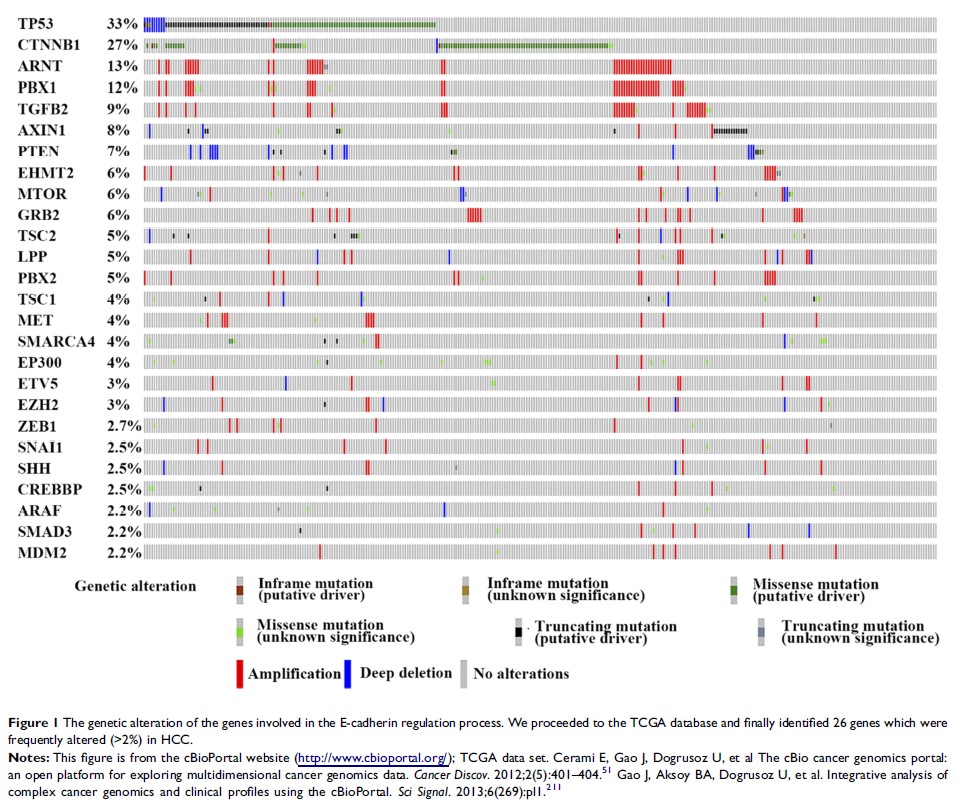
Abstract: E-cadherin is well known as a growth and invasion suppressor and belongs to the large cadherin family. Loss of E-cadherin is widely known as the hallmark of epithelial-to-mesenchymal transition (EMT) with the involvement of transcription factors such as Snail, Slug, Twist and Zeb1/2. Tumor cells undergoing EMT could migrate to distant sites and become metastases. Recently, numerous studies have revealed how the expression of E-cadherin is regulated by different kinds of genetic and epigenetic alteration, which are implicated in several crucial transcription factors and pathways. E-cadherin signaling plays an important role in hepatocellular carcinoma (HCC) initiation and progression considering the highly mutated frequency of CTNNB1 (27%). Combining the data from The Cancer Genome Atlas (TCGA) database and previous studies, we have summarized the roles of gene mutations, chromosome instability, DNA methylation, histone modifications and non-coding RNA in E-cadherin in HCC. In this review, we discuss the current understanding of the relationship between these modifications and HCC. Perspectives on E-cadherin-related research in HCC are provided.
Keywords: E-cadherin, HCC, genetic alterations, epigenetic alterations