115195
论文已发表
注册即可获取德孚的最新动态
IF 收录期刊
- 3.6 Breast Cancer (Dove Med Press)
- 4.3 Clin Epidemiol
- 2.6 Cancer Manag Res
- 3.2 Infect Drug Resist
- 4.1 Clin Interv Aging
- 6.1 Drug Des Dev Ther
- 4.1 Int J Chronic Obstr
- 8.7 Int J Nanomed
- 2.5 Int J Women's Health
- 3.2 Neuropsych Dis Treat
- 2.4 OncoTargets Ther
- 2.6 Patient Prefer Adher
- 2.6 Ther Clin Risk Manag
- 3.1 J Pain Res
- 3.5 Diabet Metab Synd Ob
- 4.5 Psychol Res Behav Ma
- 3.4 Nat Sci Sleep
- 2.4 Pharmgenomics Pers Med
- 2.6 Risk Manag Healthc Policy
- 4.6 J Inflamm Res
- 2.3 Int J Gen Med
- 3.9 J Hepatocell Carcinoma
- 3.3 J Asthma Allergy
- 2.5 Clin Cosmet Investig Dermatol
- 3.0 J Multidiscip Healthc

甘草酸二铵通过抑制 NKT 细胞增殖并促进 Treg 增殖来减轻肝脏损伤
Authors Gao M, Li X, He L, Yang J, Ye X, Xiao F, Wei H
Received 19 June 2019
Accepted for publication 24 August 2019
Published 16 October 2019 Volume 2019:13 Pages 3579—3589
DOI https://doi.org/10.2147/DDDT.S220030
Checked for plagiarism Yes
Review by Single-blind
Peer reviewers approved by Dr Cristina Weinberg
Peer reviewer comments 3
Editor who approved publication: Dr Anastasios Lymperopoulos
Purpose: Diammonium glycyrrhizinate (DG) is a replacement for glycyrrhizic acid, which is used as a hepatic protector in clinical practice for most liver diseases. The potential role of immune response during autoimmune hepatitis—induced by concanavalin A (Con A)—remains to be elucidated.
Methods: C57BL/6J mice were treated with two different doses of DG (75 and 200 mg/kg) 2 hrs before administering Con A. The mice were sacrificed after administering Con A for 0, 6, and 24 hrs. Liver damage grade and serum alanine aminotransferase (ALT), aspartate aminotransferase (AST) and total bilirubin levels were evaluated. The expression level of cleaved-caspase 3 in liver was detected by Western blotting. Inflammatory cytokines such as tumor necrosis factor α (TNF-α), interleukin-6 (IL-6), and interferon γ (IFN-γ) in liver were detected by RT-PCR. Thymus, peripheral blood, spleen, and liver tissues were collected to analyze the percentages of NKT cells, subsets of CD4+CD25−CD69+ and CD8+CD69+ T cells, and subsets of regulatory T cells (Tregs).
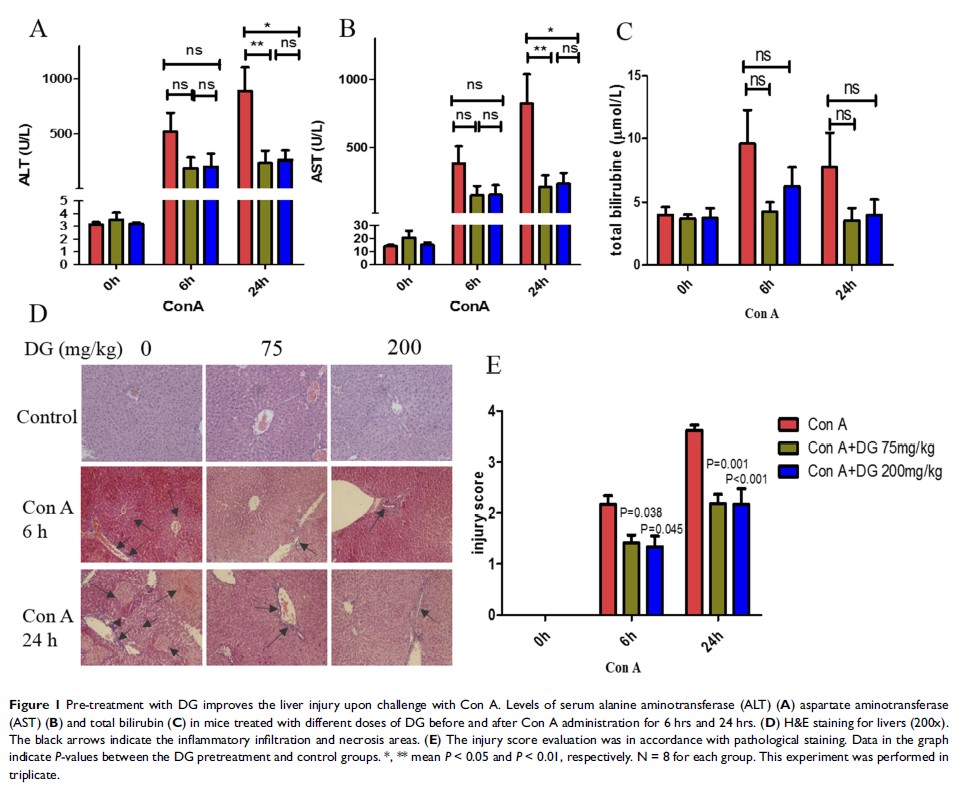
Results: Our results revealed that DG pre-treatment significantly decreased the serum ALT and AST levels and improved the histological damage in Con A-induced autoimmune liver injury. Pre-treatment with DG down-regulated the inflammatory cytokines upon challenge with Con A. The DG pre-treatment inhibited the apoptosis of T lymphocytes in the thymus. Further, it effectively suppressed the proliferation of CD4+CD25−CD69+ and CD8+CD69+ subsets in the peripheral blood and spleen. In addition, the DG pretreatment significantly downregulated the frequency of NKT cells, while upregulating the frequency of Tregs in the liver.
Conclusion: We believe that the potential protective effect of DG against Con A-induced hepatitis may be partially attributed to its inhibitory activities on inflammatory cytokines in the livers, lymphocyte apoptosis in the thymus, NKT cells proliferation, and activation of CD8+T cells; further, there may also be a possibility of DC promoting Tregs proliferation.
Keywords: autoimmune hepatitis, concanavalin A, diammonium glycyrrhizinate, NKT cells, regulatory T-cell