115195
论文已发表
注册即可获取德孚的最新动态
IF 收录期刊
- 3.6 Breast Cancer (Dove Med Press)
- 4.3 Clin Epidemiol
- 2.6 Cancer Manag Res
- 3.2 Infect Drug Resist
- 4.1 Clin Interv Aging
- 6.1 Drug Des Dev Ther
- 4.1 Int J Chronic Obstr
- 8.7 Int J Nanomed
- 2.5 Int J Women's Health
- 3.2 Neuropsych Dis Treat
- 2.4 OncoTargets Ther
- 2.6 Patient Prefer Adher
- 2.6 Ther Clin Risk Manag
- 3.1 J Pain Res
- 3.5 Diabet Metab Synd Ob
- 4.5 Psychol Res Behav Ma
- 3.4 Nat Sci Sleep
- 2.4 Pharmgenomics Pers Med
- 2.6 Risk Manag Healthc Policy
- 4.6 J Inflamm Res
- 2.3 Int J Gen Med
- 3.9 J Hepatocell Carcinoma
- 3.3 J Asthma Allergy
- 2.5 Clin Cosmet Investig Dermatol
- 3.0 J Multidiscip Healthc

小分子物质作为识别胃肿瘤的潜在生物标志物的研究
Authors Zhang J, Gao Q, Luo X, Zhang W, Wang N, Wei Y
Received 2 July 2019
Accepted for publication 7 October 2019
Published 17 October 2019 Volume 2019:12 Pages 8587—8594
DOI https://doi.org/10.2147/OTT.S221589
Checked for plagiarism Yes
Review by Single-blind
Peer reviewers approved by Ms Shreya Arora
Peer reviewer comments 2
Editor who approved publication: Prof. Dr. Nicola Silvestris
Background: Gastric tumor (GT) is associated with high morbidity and mortality, with surgery among the most effective treatment methods. Accurate interoperative determination of the tumor margin is crucial.
Methods: In this study, using internal extractive electrospray ionization-MS, mass spectral data of GT and gastric normal (GN) tissues from 36 patients were collected.
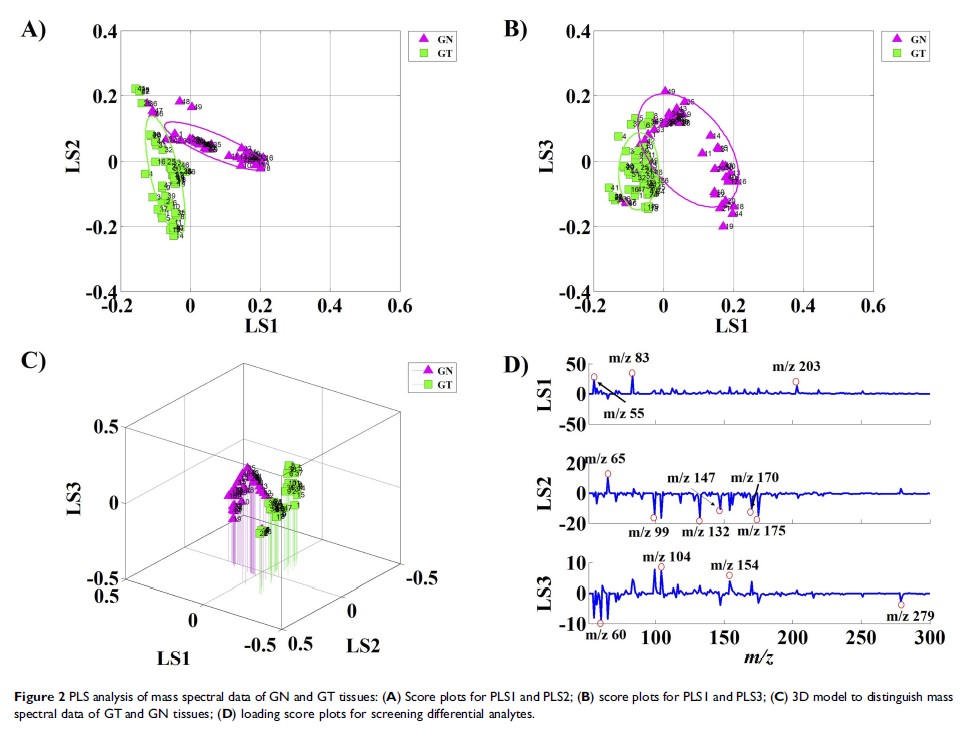
Results: In positive ion detection mode, the relative abundances of m/z 132, 147, 170, and 175 were increased, while the relative abundances of m/z 55, 83, 154, and 203 were decreased in GT tissue. Using partial least squares analysis, the mass spectral data of GT and GN tissues were discriminated, and differential ions (P ≤0.01), including m/z 55, 83, 154, 170, and 203, were obtained from loading plots. After receiver operating characteristic curve analysis, peaks at m/z 83 and 203 showed high accuracy for distinguishing GT from GN tissue. These two peaks were then preliminarily attributed to 5-aminoimidazole and serylproline, respectively, which might be useful molecular biomarkers associated with GT development.
Conclusion: Further investigations of the functions of 5-aminoimidazole and serylproline might provide a better understanding of the underlying mechanisms involved in GT.
Keywords: gastric tumor, biomarkers, mass spectrometry, MS, tumor margin