115195
论文已发表
注册即可获取德孚的最新动态
IF 收录期刊
- 3.6 Breast Cancer (Dove Med Press)
- 4.3 Clin Epidemiol
- 2.6 Cancer Manag Res
- 3.2 Infect Drug Resist
- 4.1 Clin Interv Aging
- 6.1 Drug Des Dev Ther
- 4.1 Int J Chronic Obstr
- 8.7 Int J Nanomed
- 2.5 Int J Women's Health
- 3.2 Neuropsych Dis Treat
- 2.4 OncoTargets Ther
- 2.6 Patient Prefer Adher
- 2.6 Ther Clin Risk Manag
- 3.1 J Pain Res
- 3.5 Diabet Metab Synd Ob
- 4.5 Psychol Res Behav Ma
- 3.4 Nat Sci Sleep
- 2.4 Pharmgenomics Pers Med
- 2.6 Risk Manag Healthc Policy
- 4.6 J Inflamm Res
- 2.3 Int J Gen Med
- 3.9 J Hepatocell Carcinoma
- 3.3 J Asthma Allergy
- 2.5 Clin Cosmet Investig Dermatol
- 3.0 J Multidiscip Healthc

中国一家三级医院暴发可产生肺炎克雷伯菌 碳青霉烯酶的产气克雷白氏菌菌株
Authors Hao M, Shen Z, Ye M, Hu F, Xu X, Yang Y, Wu S, Lin D, Qin X, Wang M
Received 29 June 2019
Accepted for publication 25 September 2019
Published 21 October 2019 Volume 2019:12 Pages 3283—3290
DOI https://doi.org/10.2147/IDR.S221279
Checked for plagiarism Yes
Review by Single-blind
Peer reviewers approved by Dr Colin Mak
Peer reviewer comments 2
Editor who approved publication: Dr Sahil Khanna
Purpose: This study aimed to evaluate the molecular characteristics and prevalence of clinical carbapenem-resistant Klebsiella aerogenes (CRKA), collected during an outbreak in a Chinese tertiary hospital.
Methods: Antimicrobial susceptibility test, using 17 antibiotics, was performed on 14 CRKA isolates. The strains were examined for the presence of β-lactamase genes by PCR, and efflux pump phenotype was determined by efflux pump inhibition test. Presence of outer-membrane porins was examined. Clonal relatedness among the isolates was investigated by pulsed-field gel electrophoresis (PFGE). S1 nuclease-PFGE and plasmid incompatibility group analysis were performed to determine plasmids, and the genetic environment of bla KPC-2 was analyzed. Epidemiological data were collected via chart review.
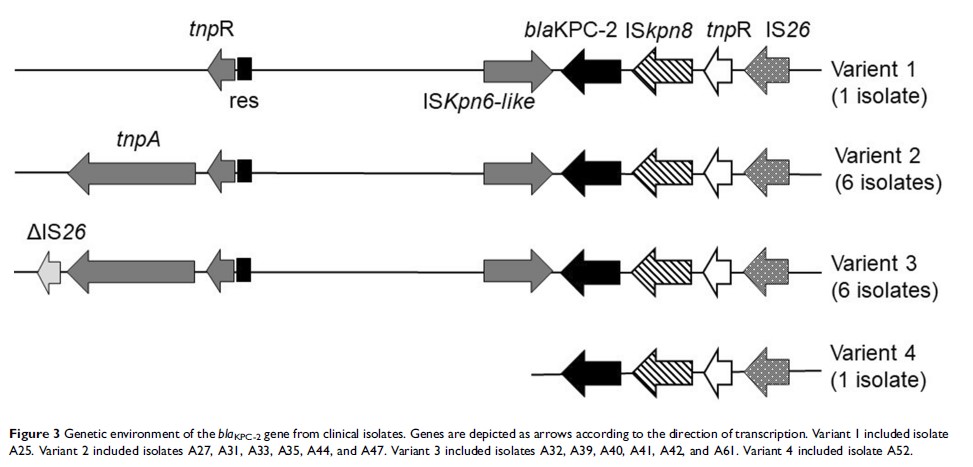
Results: The 14 CRKA isolates were all resistant to carbapenems; five distinct groups (PFGE types A–E) were observed. All 14 isolates carried the bla KPC-2 gene. S1 nuclease-PFGE indicated the size of bla KPC-2-carrying plasmids to range from 20 kb to 200 kb, and the 14 plasmids belonged to various incompatibility groups. The most frequent genetic environment of bla KPC-2 was Tn1721- bla KPC-2-ΔTn3-IS26. PFGE type A group, including 11 KPC-2-producing clinical isolates, was primarily responsible for dissemination.
Conclusion: Our findings suggest both transposons and vertical transmission to contribute to the transformation of bla KPC-2. The results strongly suggest strict implementation of infection control of CRKA, in healthcare facilities.
Keywords: carbapenem resistance, Klebsiella aerogenes , Klebsiella pneumoniae carbapenemase, plasmid, genetic environment, outbreak