115195
论文已发表
注册即可获取德孚的最新动态
IF 收录期刊
- 3.6 Breast Cancer (Dove Med Press)
- 4.3 Clin Epidemiol
- 2.6 Cancer Manag Res
- 3.2 Infect Drug Resist
- 4.1 Clin Interv Aging
- 6.1 Drug Des Dev Ther
- 4.1 Int J Chronic Obstr
- 8.7 Int J Nanomed
- 2.5 Int J Women's Health
- 3.2 Neuropsych Dis Treat
- 2.4 OncoTargets Ther
- 2.6 Patient Prefer Adher
- 2.6 Ther Clin Risk Manag
- 3.1 J Pain Res
- 3.5 Diabet Metab Synd Ob
- 4.5 Psychol Res Behav Ma
- 3.4 Nat Sci Sleep
- 2.4 Pharmgenomics Pers Med
- 2.6 Risk Manag Healthc Policy
- 4.6 J Inflamm Res
- 2.3 Int J Gen Med
- 3.9 J Hepatocell Carcinoma
- 3.3 J Asthma Allergy
- 2.5 Clin Cosmet Investig Dermatol
- 3.0 J Multidiscip Healthc

ANGPTL3 基因遗传变异与缺血性中风易感性的关联研究
Authors Gong Q, Ye L, Gui H, Liu J, Li H, Sun Q
Received 11 May 2019
Accepted for publication 3 August 2019
Published 24 October 2019 Volume 2019:15 Pages 3015—3020
DOI https://doi.org/10.2147/NDT.S215387
Checked for plagiarism Yes
Review by Single-blind
Peer reviewers approved by Prof. Dr. Roumen Kirov
Peer reviewer comments 2
Editor who approved publication: Professor Jun Chen
Background: Stroke ranks as the third-leading cause of years of life lost worldwide. ANGPTL3 plays important roles in lipid metabolism, atherosclerosis, and occurrence of stroke. The purpose of this study was to evaluate associations of genetic variants in the ANGPTL3 gene with ischemic stroke (IS) risk.
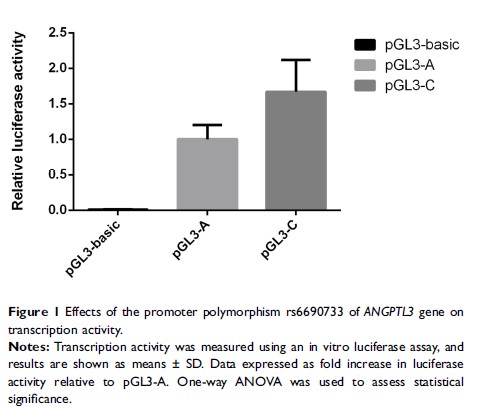
Methods: A case–control study was conducted to evaluate the associations of tag single-nucleotide polymorphisms (SNPs) of the ANGPTL3 gene and risk of IS, as well as serum lipid levels. Dual-luciferase reporter assays in the HEK293T cell line was conducted to evaluate the promoter activity of ANGPTL3 rs6690733.
Results: We found rs6690733 (C vs A: OR 1.34, 95% CI 1.13–1.59; P =0.001) and rs12563308 (C vs T: OR 0.77, 95% CI 0.64–0.93, P =0.007) were significantly associated with susceptibility to IS. Even corrected for Bonferroni adjustment, the two variants were still significant (0.007×4=0.028). Carriers of the minor allele of SNP rs6690733 had significantly higher levels of TC and LDL-C, while carriers of the minor allele of SNP rs12563308 had significantly lower levels of TC and LDL-C (all P <0.05). For rs6690733, the luciferase assay showed that promoter activity was significantly increased by 67% of plasmids containing the minor C allele compared with the major A allele in HEK293 cells.
Conclusion: Our study revealed genetic variants of the ANGPTL3 gene could contribute to susceptibility to IS through participating in the regulation of lipid metabolism.
Keywords: ischemic stroke, ANGPTL3, genetic, atherosclerosis