115195
论文已发表
注册即可获取德孚的最新动态
IF 收录期刊
- 3.6 Breast Cancer (Dove Med Press)
- 4.3 Clin Epidemiol
- 2.6 Cancer Manag Res
- 3.2 Infect Drug Resist
- 4.1 Clin Interv Aging
- 6.1 Drug Des Dev Ther
- 4.1 Int J Chronic Obstr
- 8.7 Int J Nanomed
- 2.5 Int J Women's Health
- 3.2 Neuropsych Dis Treat
- 2.4 OncoTargets Ther
- 2.6 Patient Prefer Adher
- 2.6 Ther Clin Risk Manag
- 3.1 J Pain Res
- 3.5 Diabet Metab Synd Ob
- 4.5 Psychol Res Behav Ma
- 3.4 Nat Sci Sleep
- 2.4 Pharmgenomics Pers Med
- 2.6 Risk Manag Healthc Policy
- 4.6 J Inflamm Res
- 2.3 Int J Gen Med
- 3.9 J Hepatocell Carcinoma
- 3.3 J Asthma Allergy
- 2.5 Clin Cosmet Investig Dermatol
- 3.0 J Multidiscip Healthc

细胞因子释放综合征在 CAR-T 治疗期间的巨大静脉血栓栓塞和出血倾向共存
Authors Liu H, Yang Y, Jiang J, Wang X, Zhang C, Jiang Y, Hong L, Huang H
Received 18 July 2019
Accepted for publication 10 October 2019
Published 30 October 2019 Volume 2019:12 Pages 8955—8960
DOI https://doi.org/10.2147/OTT.S223697
Checked for plagiarism Yes
Review by Single-blind
Peer reviewers approved by Ms Shreya Arora
Peer reviewer comments 2
Editor who approved publication: Dr Federico Perche
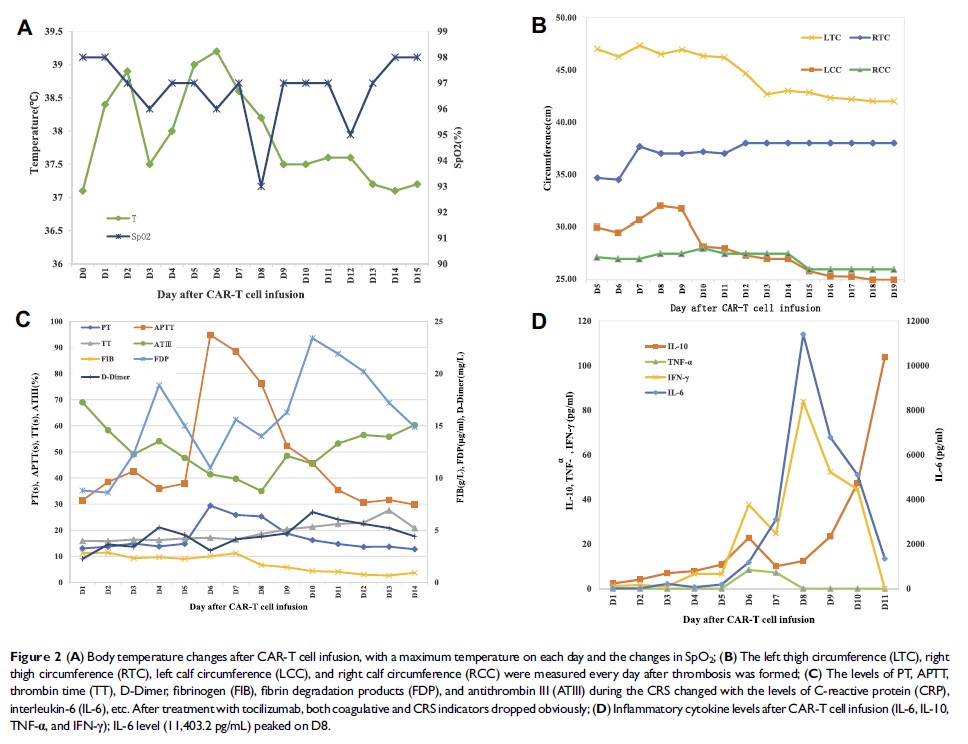
Abstract: Chimeric antigen receptor (CAR)-modified T cell therapy is increasingly administered for hematological malignancies. Cytokine release syndrome (CRS) is a common and severe complication of CAR-T therapy. In the present case, a 62-year-old male patient was diagnosed with relapsed and refractory multiple myeloma (RRMM). Treated with CART-CD19/BCMA therapy, his symptoms remitted, during which occasional but severe CRS associated with coagulation disorder still appeared, as evidenced by the coexistence of a huge thrombosis and bleeding tendency. Through the First Generation Sequencing, we extracted genomic DNA from the patient’s peripheral blood to analyze the distribution of polymorphism at the –572C/G site of the promoter of IL-6 gene. The results showed that the genotype of –572C/G promoter polymorphism was CC, indicating that high level of IL-6 and –572C/G polymorphism might be associated with the risk of thrombotic disorders. We concluded that immediate diagnosis and appropriate treatment of coagulopathy could reduce CRS-related mortality.
Keywords: chimeric antigen receptor-T therapy, cytokine release syndrome, multiple myeloma, coagulation disorder, thrombosis