115195
论文已发表
注册即可获取德孚的最新动态
IF 收录期刊
- 3.6 Breast Cancer (Dove Med Press)
- 4.3 Clin Epidemiol
- 2.6 Cancer Manag Res
- 3.2 Infect Drug Resist
- 4.1 Clin Interv Aging
- 6.1 Drug Des Dev Ther
- 4.1 Int J Chronic Obstr
- 8.7 Int J Nanomed
- 2.5 Int J Women's Health
- 3.2 Neuropsych Dis Treat
- 2.4 OncoTargets Ther
- 2.6 Patient Prefer Adher
- 2.6 Ther Clin Risk Manag
- 3.1 J Pain Res
- 3.5 Diabet Metab Synd Ob
- 4.5 Psychol Res Behav Ma
- 3.4 Nat Sci Sleep
- 2.4 Pharmgenomics Pers Med
- 2.6 Risk Manag Healthc Policy
- 4.6 J Inflamm Res
- 2.3 Int J Gen Med
- 3.9 J Hepatocell Carcinoma
- 3.3 J Asthma Allergy
- 2.5 Clin Cosmet Investig Dermatol
- 3.0 J Multidiscip Healthc

长非编码 RNA SBF2-AS1 通过靶向 miR-302b-3p/E2F 转录因子 3 轴来起到胃癌的致癌作用
Authors Liang C, Yue C, Liang C, Ge H, Wei Z, Li G, Wu J, Huang H, Guo J
Received 31 March 2019
Accepted for publication 23 September 2019
Published 30 October 2019 Volume 2019:12 Pages 8879—8893
DOI https://doi.org/10.2147/OTT.S210697
Checked for plagiarism Yes
Review by Single-blind
Peer reviewers approved by Ms Rachel Predeepa
Peer reviewer comments 2
Editor who approved publication: Dr Arseniy Yuzhalin
Background and aims: Studies show that the long non-coding RNA, SBF2-AS1, plays a critical role in cancer progression, but the role of SBF2-AS1 in gastric cancer has not been reported. Therefore, this study aimed to elucidate the mechanism of SBF2-AS1 in gastric cancer (GC).
Methods: A meta-analysis, based on the gene expression omnibus database and TCGA dataset was performed to explore the prognostic value of SBF2-AS1 in GC. RT-PCR was also conducted to investigate the clinicopathologic value of SBF2-AS1 in GC. The effect of SBF2-AS1 in GC cell lines was conducted by gain or loss-of-function assays, and the SBF2-AS1 target gene was confirmed using a luciferase reporter assay and bioinformatics.
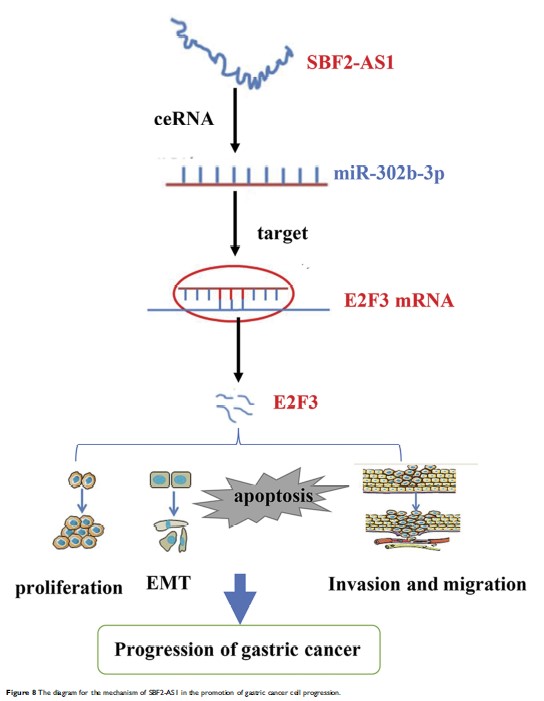
Results: SBF2-AS1 was overexpressed in GC tissues and cell lines, and SBF2-AS1 overexpression indicated poor overall survival and could serve as an independent prognostic factor. Moreover, knockdown of SBF2-AS1 inhibited cell growth, invasion, and metastasis, promoted apoptosis, and caused cell cycle arrest. Luciferase reporter and gain- or loss-of-function assays indicated that SBF2-AS1 acted as a competing endogenous (ceRNA) for microRNA (miR)-302b-3p, which blocked the inhibitory effect of miR-302b-3p on the E2F transcription factor 3 (E2F3).
Conclusion: SBF2-AS1 could be a potential diagnostic and prognostic biomarker in GC, and SBF2-AS1 accelerates tumor progression via the miR-302b-3p/E2F3 axis.
Keywords: SBF2-AS1, gastric cancer, miR-302b-3p, E2F3