115195
论文已发表
注册即可获取德孚的最新动态
IF 收录期刊
- 3.6 Breast Cancer (Dove Med Press)
- 4.3 Clin Epidemiol
- 2.6 Cancer Manag Res
- 3.2 Infect Drug Resist
- 4.1 Clin Interv Aging
- 6.1 Drug Des Dev Ther
- 4.1 Int J Chronic Obstr
- 8.7 Int J Nanomed
- 2.5 Int J Women's Health
- 3.2 Neuropsych Dis Treat
- 2.4 OncoTargets Ther
- 2.6 Patient Prefer Adher
- 2.6 Ther Clin Risk Manag
- 3.1 J Pain Res
- 3.5 Diabet Metab Synd Ob
- 4.5 Psychol Res Behav Ma
- 3.4 Nat Sci Sleep
- 2.4 Pharmgenomics Pers Med
- 2.6 Risk Manag Healthc Policy
- 4.6 J Inflamm Res
- 2.3 Int J Gen Med
- 3.9 J Hepatocell Carcinoma
- 3.3 J Asthma Allergy
- 2.5 Clin Cosmet Investig Dermatol
- 3.0 J Multidiscip Healthc

Id-1 通过激活 NFkB/survivin 信号通路促进血管损伤后的早期内皮细胞再生
Authors Li W, Du D, Li Y
Received 14 March 2019
Accepted for publication 2 October 2019
Published 31 October 2019 Volume 2019:13 Pages 3799—3811
DOI https://doi.org/10.2147/DDDT.S208707
Checked for plagiarism Yes
Review by Single-blind
Peer reviewers approved by Dr Colin Mak
Peer reviewer comments 4
Editor who approved publication: Dr Yan Zhu
Background: Percutaneous coronary intervention (PCI) treatment can benefit patients, but also cause irreversible mechanical damage to the vascular endothelium, ultimately leading to restenosis of the target vessel. Thus, achieving rapid re-endothelialization and restoring the integrity of the vascular endothelium and function plays an important role in inhibiting neointimal hyperplasia and preventing restenosis. Id1 (inhibitor of DNA binding/differentiation factor 1) plays an important role in promoting cell proliferation and angiogenesis.
Study objective: This study aims to investigate the relationship between Id1 and NFκB/survivin signaling pathways and their role in injured vascular repair by establishing a rat carotid balloon injury model.
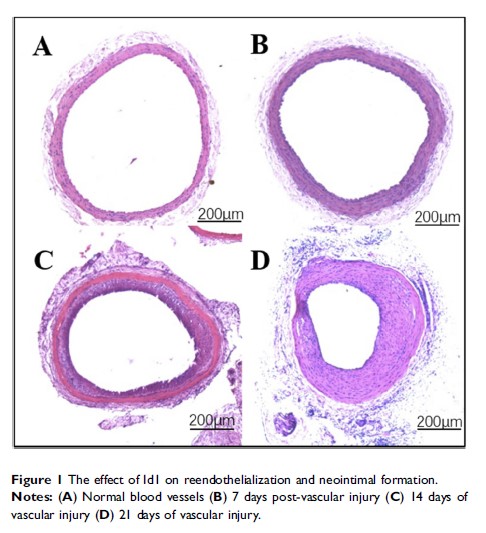
Methods: The carotid artery model of rat balloon injury was established. The injured common carotid artery was obtained at different time points after vascular injury. RNA and protein were extracted and the mRNA and protein expression levels of Id1, NFκB and survivin were detected in vascular injury. The NFκB blocker BAY 11–7082 and survivin blocker YM155 were used and the effects of Id1, NFκB, survivin mRNA and protein expression, revascularization of blood vessels and neointimal responsiveness after vascular injury were observed in the vascular tissues of Ad-Id1 transfected balloon injury.
Results: Id1, NFκB and survivin were expressed in injured rat carotid arteries. Overexpression of Id1 promoted re-endothelialization of injured vessels through NFκB/survivin signaling pathway, inhibited early vascular endometrial reactive hyperplasia; blocked NFκB the/survivin signaling pathway attenuates the re-endothelialization of Ad-Id1 and the early endothelium of Ad-Id1. Blocking the NFκB/survivin signaling pathway attenuates the re-endothelialization and early reactive hyperplasia of vascular intima of Ad-Id1.
Conclusion: NF-kappa B/survivin signaling pathway may play an important role in Id1 promoting vascular re-endothelialization, inhibiting neointimal hyperplasia and preventing vascular restenosis.
Keywords: inhibitor of DNA binding/differentiation 1, survivin, vascular injury, intimal hyperplasia