115195
论文已发表
注册即可获取德孚的最新动态
IF 收录期刊
- 3.6 Breast Cancer (Dove Med Press)
- 4.3 Clin Epidemiol
- 2.6 Cancer Manag Res
- 3.2 Infect Drug Resist
- 4.1 Clin Interv Aging
- 6.1 Drug Des Dev Ther
- 4.1 Int J Chronic Obstr
- 8.7 Int J Nanomed
- 2.5 Int J Women's Health
- 3.2 Neuropsych Dis Treat
- 2.4 OncoTargets Ther
- 2.6 Patient Prefer Adher
- 2.6 Ther Clin Risk Manag
- 3.1 J Pain Res
- 3.5 Diabet Metab Synd Ob
- 4.5 Psychol Res Behav Ma
- 3.4 Nat Sci Sleep
- 2.4 Pharmgenomics Pers Med
- 2.6 Risk Manag Healthc Policy
- 4.6 J Inflamm Res
- 2.3 Int J Gen Med
- 3.9 J Hepatocell Carcinoma
- 3.3 J Asthma Allergy
- 2.5 Clin Cosmet Investig Dermatol
- 3.0 J Multidiscip Healthc

受体相互作用蛋白激酶 1 通过激活蛋白 1 通路促进胆管癌的增殖和淋巴管生成
Authors Li CZ, Lin YX, Huang TC, Pan JY, Wang GX
Received 10 May 2019
Accepted for publication 21 August 2019
Published 1 November 2019 Volume 2019:12 Pages 9029—9040
DOI https://doi.org/10.2147/OTT.S215276
Checked for plagiarism Yes
Review by Single-blind
Peer reviewers approved by Ms Aruna Narula
Peer reviewer comments 3
Editor who approved publication: Dr Carlos E Vigil
Purpose: Receptor-interacting protein kinase 1 (RIPK1) is an important upstream regulator of multiple cell signaling pathways including inflammatory signals. RIPK1 is reported to be closely associated with the prognostic implications of cancer, especially epithelial tumors. But its role in proliferation and lymphangiogenesis in cholangiocarcinoma (CCA) remains unclear and requires further investigation.
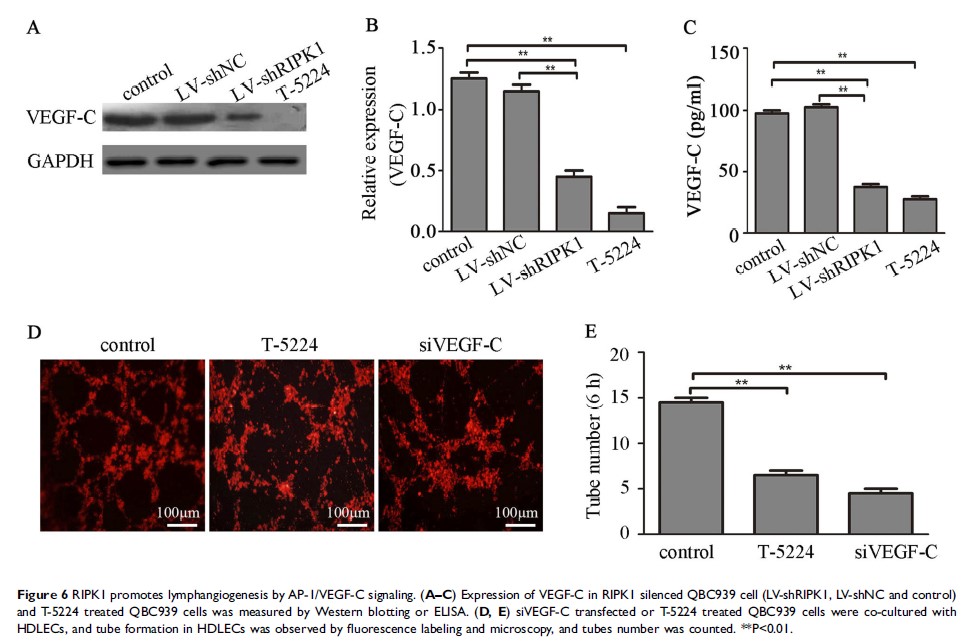
Patients and methods: Expression of RIPK1 in human CCA tissues and CCA cell lines (QBC939, HUH28 and CCPL-1) was measured using qPCR, immunoblotting and immunohistochemistry. Silencing of RIPK1 was achieved by transduction of CCA cells via lentiviral plasmids (LV3-H1/GFP&Puro) encapsulating RIPK1 shRNA (LV-shRIPK1) or negative control shRNA (LV-shNC), and puromycin was used to select stable colonies. Proliferation and lymphangiogenesis were assessed in vitro by CCK-8 and matrigel-based tube formation assays, respectively. Activity of the activation protein-1 (AP-1) was evaluated by double-luciferase reporter gene assay. Protein expression of JNK, P38MAPK, ERK1/2, AP-1, P-AP-1, E-cadherin, N-cadherin and vascular endothelial growth factor-C (VEGF-C) was measured by immunoblotting or ELISA. An orthotopic CCA model in null mice was generated by transplanting QBC939 LV-shRIPK1, LV-shNC and control cells to further evaluate the role of RIPK1 on lymphangiogenesis in vivo. Immunohistochemistry was utilized to evaluate the expression of RIPK1 and VEGF-C, and tumor lymphatic vessels in the CCA model mice.
Results: Upregulated expression of RIPK1 in CCA tissues was closely related to tumor size, lymph node metastasis and poor prognosis. RIPK1 promoted proliferation and lymphangiogenesis in CCA cells, and regulated the activation of JNK and P38MAPK-mediated AP-1/VEGF-C pathway. Finally, in vivo animal experiments in the orthotopic CCA mouse model further confirmed the function of RIPK1 in lymphangiogenesis.
Conclusion: This is the first report demonstrating the role of RIPK1 in proliferation and lymphangiogenesis through the MAPK (JNK and P38MAPK)- AP-1 pathway in CCA.
Keywords: cholangiocarcinoma, RIPK1, AP-1, VEGF-C, proliferation, lymphangiogenesis