115195
论文已发表
注册即可获取德孚的最新动态
IF 收录期刊
- 3.6 Breast Cancer (Dove Med Press)
- 4.3 Clin Epidemiol
- 2.6 Cancer Manag Res
- 3.2 Infect Drug Resist
- 4.1 Clin Interv Aging
- 6.1 Drug Des Dev Ther
- 4.1 Int J Chronic Obstr
- 8.7 Int J Nanomed
- 2.5 Int J Women's Health
- 3.2 Neuropsych Dis Treat
- 2.4 OncoTargets Ther
- 2.6 Patient Prefer Adher
- 2.6 Ther Clin Risk Manag
- 3.1 J Pain Res
- 3.5 Diabet Metab Synd Ob
- 4.5 Psychol Res Behav Ma
- 3.4 Nat Sci Sleep
- 2.4 Pharmgenomics Pers Med
- 2.6 Risk Manag Healthc Policy
- 4.6 J Inflamm Res
- 2.3 Int J Gen Med
- 3.9 J Hepatocell Carcinoma
- 3.3 J Asthma Allergy
- 2.5 Clin Cosmet Investig Dermatol
- 3.0 J Multidiscip Healthc

通过肝硬化队列对早期肝癌进行检测的简单模型的开发和验证
Authors Li T, Li H, Wang A, Su X, Zhao J, Cui Y, Liu J, Hu J
Received 27 June 2019
Accepted for publication 23 October 2019
Published 5 November 2019 Volume 2019:11 Pages 9379—9386
DOI https://doi.org/10.2147/CMAR.S221050
Checked for plagiarism Yes
Review by Single-blind
Peer reviewers approved by Dr Colin Mak
Peer reviewer comments 2
Editor who approved publication: Dr Ahmet Emre Eskazan
Aim: We aimed to develop a simple model combining protein induced by vitamin K antagonist-II (PIVKA-II) and alpha-fetoprotein (AFP) to detect early hepatocellular carcinoma (HCC) in liver cirrhosis (LC) patients.
Method: One hundred and sixty-nine newly diagnosed early HCC patients and 242 LC patients without HCC were enrolled in the current case-control study. All subjects were randomly divided into analysis group and validation group. Serum levels of PIVKA-II, AFP and other laboratory parameters were detected. Chi-squared test, t-test and logistic regression were employed in statistical analysis.
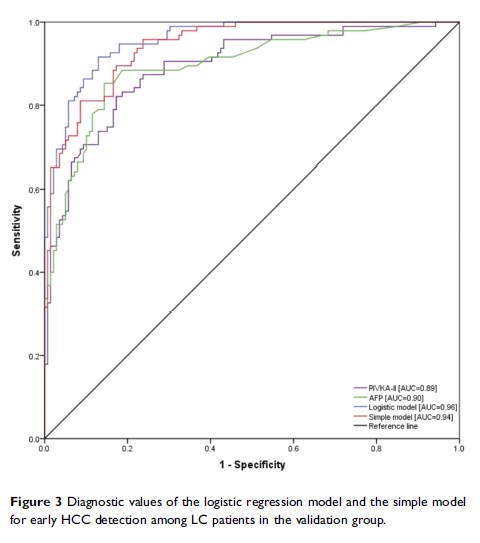
Results: PIVKA-II level in early HCC was significantly higher than that in LC (90.97 mAU/mL vs 18.00 mAU/mL, P < 0.01), as well as AFP level (15.00 ng/mL vs 2.00 ng/mL, P < 0.01) in analysis groups. Multivariate analysis showed that PIVAK-II, AFP, gender, and age were independent risk factors for early HCC detection among LC patients. A logistic regression model and a simple model combining PIVKA and AFP were conducted to detect early HCC. The ROC curve showed that among analysis groups, the area under the ROC curve (AUROC) of the logistic regression model and the simple model were 0.96 (95% CI 0.94–0.98) and 0.94 (95% CI 0.92–0.97), respectively. At a cut-off value of 56.03 the sensitivity and specificity of the simple model were 81.1% and 91.4%, respectively. In the validation group, the sensitivity and specificity of the simple model was 82.4% and 94.2%, respectively. The two models are comparable statistically for early HCC detection, but the logistic regression requires complex calculation.
Conclusion: The present study indicates that the simple model combining PIVKA-II and AFP has comparable diagnostic efficiency in contrast to the logistic model but is easy to use clinically. It might be helpful for early HCC detection among liver cirrhosis patients.
Keywords: hepatocellular carcinoma, PIVKA-II, AFP, liver cirrhosis