115195
论文已发表
注册即可获取德孚的最新动态
IF 收录期刊
- 3.6 Breast Cancer (Dove Med Press)
- 4.3 Clin Epidemiol
- 2.6 Cancer Manag Res
- 3.2 Infect Drug Resist
- 4.1 Clin Interv Aging
- 6.1 Drug Des Dev Ther
- 4.1 Int J Chronic Obstr
- 8.7 Int J Nanomed
- 2.5 Int J Women's Health
- 3.2 Neuropsych Dis Treat
- 2.4 OncoTargets Ther
- 2.6 Patient Prefer Adher
- 2.6 Ther Clin Risk Manag
- 3.1 J Pain Res
- 3.5 Diabet Metab Synd Ob
- 4.5 Psychol Res Behav Ma
- 3.4 Nat Sci Sleep
- 2.4 Pharmgenomics Pers Med
- 2.6 Risk Manag Healthc Policy
- 4.6 J Inflamm Res
- 2.3 Int J Gen Med
- 3.9 J Hepatocell Carcinoma
- 3.3 J Asthma Allergy
- 2.5 Clin Cosmet Investig Dermatol
- 3.0 J Multidiscip Healthc

金属纳米颗粒对肝脏的毒性:亚细胞损伤,机制和结果
Authors Yao Y, Zang Y, Qu J, Tang M, Zhang T
Received 19 April 2019
Accepted for publication 21 October 2019
Published 7 November 2019 Volume 2019:14 Pages 8787—8804
DOI https://doi.org/10.2147/IJN.S212907
Checked for plagiarism Yes
Review by Single-blind
Peer reviewers approved by Dr Thiruganesh Ramasamy
Peer reviewer comments 4
Editor who approved publication: Dr Mian Wang
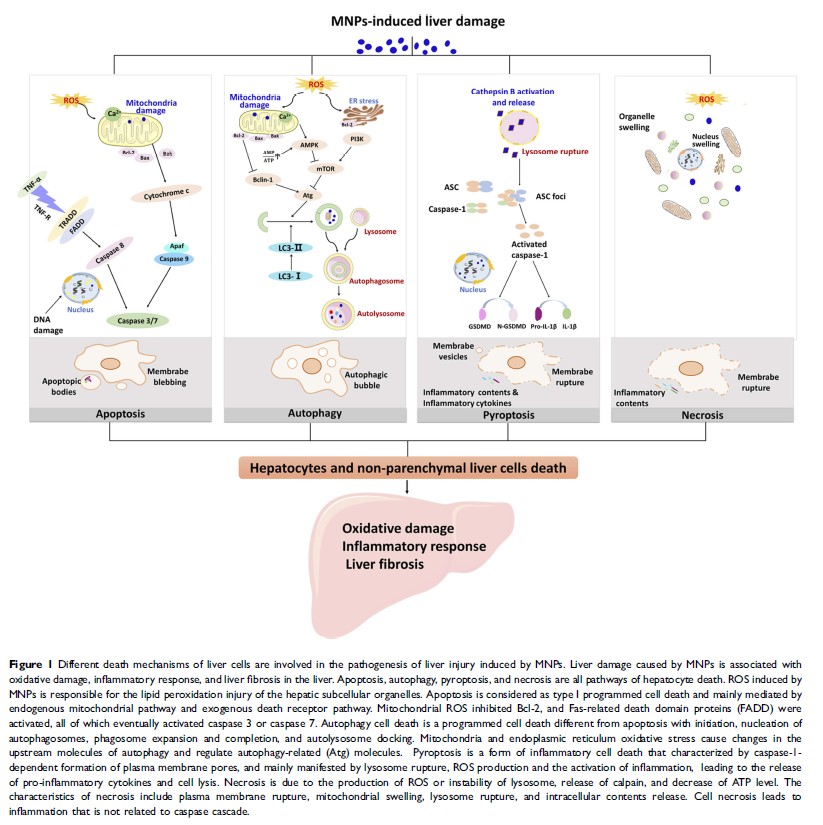
Abstract: Metallic nanoparticles (MNPs) are new engineering materials with broad prospects for biomedical applications; thus, their biosafety has drawn great concern. The liver is the main detoxification organ of vertebrates. However, many issues concerning the interactions between MNPs and biological systems (cells and tissues) are unclear, particularly the toxic effects of MNPs on hepatocytes and other liver cells. Numerous researchers have shown that some MNPs can induce decreased cell survival rate, production of reactive oxygen species (ROS), mitochondrial damage, DNA strand breaks, and even autophagy, pyroptosis, apoptosis, or other forms of cell death. Our review focuses on the recent researches on the liver toxicity of MNPs and its mechanisms at cellular and subcellular levels to provide a scientific basis for the subsequent hepatotoxicity studies of MNPs.
Keywords: metallic nanoparticles, hepatotoxicity, subcellular injury, dysfunctions, toxicity outcome