115195
论文已发表
注册即可获取德孚的最新动态
IF 收录期刊
- 3.6 Breast Cancer (Dove Med Press)
- 4.3 Clin Epidemiol
- 2.6 Cancer Manag Res
- 3.2 Infect Drug Resist
- 4.1 Clin Interv Aging
- 6.1 Drug Des Dev Ther
- 4.1 Int J Chronic Obstr
- 8.7 Int J Nanomed
- 2.5 Int J Women's Health
- 3.2 Neuropsych Dis Treat
- 2.4 OncoTargets Ther
- 2.6 Patient Prefer Adher
- 2.6 Ther Clin Risk Manag
- 3.1 J Pain Res
- 3.5 Diabet Metab Synd Ob
- 4.5 Psychol Res Behav Ma
- 3.4 Nat Sci Sleep
- 2.4 Pharmgenomics Pers Med
- 2.6 Risk Manag Healthc Policy
- 4.6 J Inflamm Res
- 2.3 Int J Gen Med
- 3.9 J Hepatocell Carcinoma
- 3.3 J Asthma Allergy
- 2.5 Clin Cosmet Investig Dermatol
- 3.0 J Multidiscip Healthc

LncRNA ASB16-AS1 通过调节 miR-1827/FZD4 轴并激活 Wnt/β-Catenin 通路可促进肝细胞癌的生长和侵袭
Authors Yao X, You G, Zhou C, Zhang D
Received 22 June 2019
Accepted for publication 11 October 2019
Published 7 November 2019 Volume 2019:11 Pages 9371—9378
DOI https://doi.org/10.2147/CMAR.S220434
Checked for plagiarism Yes
Review by Single-blind
Peer reviewers approved by Dr Colin Mak
Peer reviewer comments 2
Editor who approved publication: Dr Chien-Feng Li
Background: To date, although several long noncoding RNAs (lncRNAs) are reported to regulate hepatocellular carcinoma (HCC) development, their relationship still remains elusive. ASB16-AS1 is a poorly researched novel lncRNA. We aimed to investigate its function in HCC progression.
Methods: qRT-PCR and in situ hybridization (ISH) were used to analyze ASB16-AS1 expression in HCC tissues. CCK8, Edu incorporation and colony formation were used to determine cell proliferation. Transwell assay was used to examine migration and invasion. Luciferase reporter assay was used to analyze the interactions among ASB16-AS1, miR-1827 and FZD4.
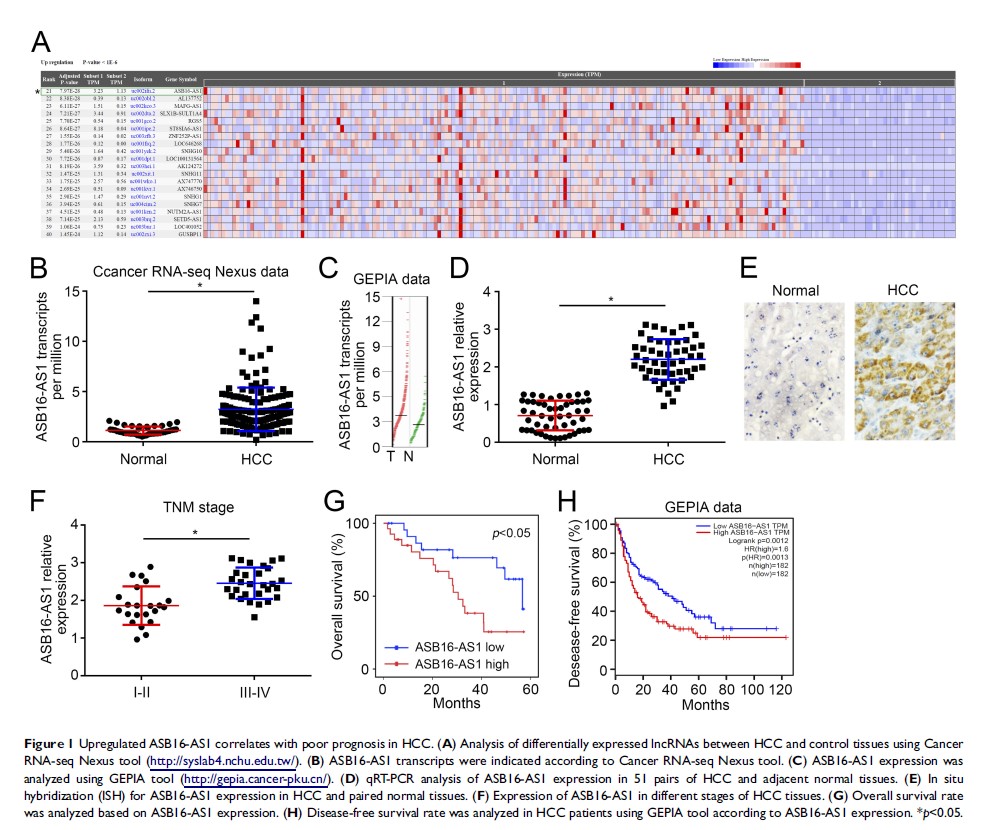
Results: Bioinformatics analysis identified ASB16-AS1 was overexpressed in HCC tissues, which was further validated by qRT-PCR and in situ hybridization (ISH). Besides, ASB16-AS1 was demonstrated to be a potential indicator for HCC prognosis. Functional studies showed ASB16-AS1 knockdown attenuated proliferation, migration and invasion of HCC cells. Mechanistically, ASB16-AS1 directly interacted with miR-1827 and promoted FZD4 expression by sponging miR-1827. Overexpressed FZD4 eventually activated Wnt/β-catenin pathway and contributed to HCC progression.
Conclusion: Our work is the first to identify ASB16-AS1 as an oncogene that enhances HCC progression by modulating miR-1827/FZD4/Wnt/β-catenin pathways.
Keywords: lncRNA, HCC, ASB16-AS1, miR-1827, FZD4