115195
论文已发表
注册即可获取德孚的最新动态
IF 收录期刊
- 3.6 Breast Cancer (Dove Med Press)
- 4.3 Clin Epidemiol
- 2.6 Cancer Manag Res
- 3.2 Infect Drug Resist
- 4.1 Clin Interv Aging
- 6.1 Drug Des Dev Ther
- 4.1 Int J Chronic Obstr
- 8.7 Int J Nanomed
- 2.5 Int J Women's Health
- 3.2 Neuropsych Dis Treat
- 2.4 OncoTargets Ther
- 2.6 Patient Prefer Adher
- 2.6 Ther Clin Risk Manag
- 3.1 J Pain Res
- 3.5 Diabet Metab Synd Ob
- 4.5 Psychol Res Behav Ma
- 3.4 Nat Sci Sleep
- 2.4 Pharmgenomics Pers Med
- 2.6 Risk Manag Healthc Policy
- 4.6 J Inflamm Res
- 2.3 Int J Gen Med
- 3.9 J Hepatocell Carcinoma
- 3.3 J Asthma Allergy
- 2.5 Clin Cosmet Investig Dermatol
- 3.0 J Multidiscip Healthc

艾灸通过脊髓中的 MAPK 信号通路缓解大鼠内脏的慢性炎性疼痛
Authors Huang Y, Zhang D, Li ZY, Yang YT, Wu LJ, Zhang J, Zhi FY, Li XY, Shi Z, Hong J, Ma XP
Received 6 June 2019
Accepted for publication 9 October 2019
Published 7 November 2019 Volume 2019:12 Pages 2999—3012
DOI https://doi.org/10.2147/JPR.S218588
Checked for plagiarism Yes
Review by Single-blind
Peer reviewers approved by Dr Cristina Weinberg
Peer reviewer comments 2
Editor who approved publication: Dr Michael E Schatman
Purpose: The purpose of this study was to explore the central analgesia mechanism of moxibustion for chronic inflammatory visceral pain (CIVP).
Methods: A CIVP rat model was established by 2,4,6-trinitrobenzene sulfonic acid (TNBS) plus 50% ethanol via enema. The analgesic effect of moxibustion was evaluated using the abdominal withdrawal reflex (AWR), mechanical withdrawal threshold (MWT), and thermal withdrawal latency (TWL). The expression profile of phosphorylated proteins of the mitogen-activated protein kinase (MAPK) signaling pathway in the spinal cord was assayed by protein microarray. The differentially expressed proteins were examined by Gene Ontology (GO) and Kyoto Encyclopedia of Genes and Genomes (KEGG) for functional clusters and corresponding signaling pathways.
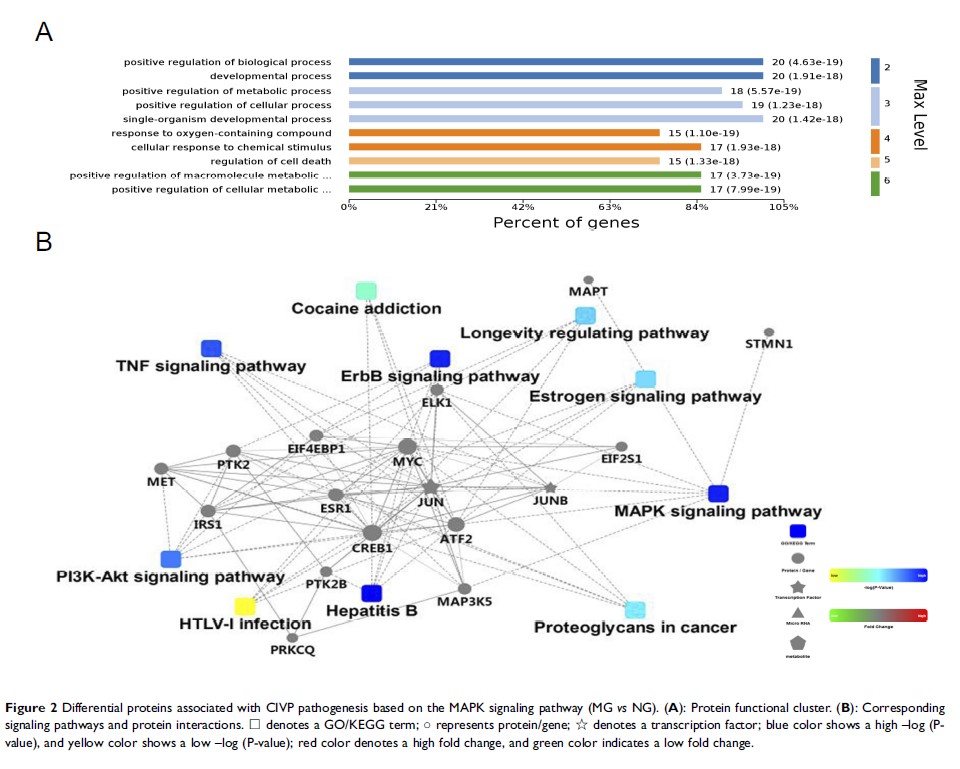
Results: Moxibustion exerted a significant analgesic effect for CIVP rats, mainly presenting as a decrease in the AWR score (all P<0.01) under different levels of distending pressure and an increase in MWT and TWL thresholds (all P<0.05). Compared with the normal group, 76 proteins were upregulated while 15 were downregulated, and MAPK signaling pathway was activated in the model group. Compared with the model group, there were 53 downregulated and 38 upregulated proteins in the moxibustion group, and MAPK signaling pathway was inhibited. Fold change (FC)>1.3 or <0.77 was taken as the screening standard to define the differentially expressed proteins. Fifteen differentially expressed proteins upregulated in the model group were downregulated in the moxibustion group. GO analysis showed that the differentially expressed proteins mainly controlled cellular metabolism regulation, transportation, and stress reactions. KEGG analysis revealed that these differentially expressed proteins were mostly involved in the ERK, JNK, and p38 pathways, and the ERK pathway was predominant.
Conclusion: Moxibustion mitigates CIVP in rats and inhibits the phosphorylation of proteins in the spinal MAPK signaling pathway. The analgesic effect of moxibustion may be associated with the regulation of the spinal MAPK signaling pathway.
Keywords: chronic inflammatory visceral pain, moxibustion, analgesia, spinal cord, MAPK signaling pathway