115195
论文已发表
注册即可获取德孚的最新动态
IF 收录期刊
- 3.6 Breast Cancer (Dove Med Press)
- 4.3 Clin Epidemiol
- 2.6 Cancer Manag Res
- 3.2 Infect Drug Resist
- 4.1 Clin Interv Aging
- 6.1 Drug Des Dev Ther
- 4.1 Int J Chronic Obstr
- 8.7 Int J Nanomed
- 2.5 Int J Women's Health
- 3.2 Neuropsych Dis Treat
- 2.4 OncoTargets Ther
- 2.6 Patient Prefer Adher
- 2.6 Ther Clin Risk Manag
- 3.1 J Pain Res
- 3.5 Diabet Metab Synd Ob
- 4.5 Psychol Res Behav Ma
- 3.4 Nat Sci Sleep
- 2.4 Pharmgenomics Pers Med
- 2.6 Risk Manag Healthc Policy
- 4.6 J Inflamm Res
- 2.3 Int J Gen Med
- 3.9 J Hepatocell Carcinoma
- 3.3 J Asthma Allergy
- 2.5 Clin Cosmet Investig Dermatol
- 3.0 J Multidiscip Healthc

结核病自我效能量表(TBSES)的心理计量学特性的开发和初步评估
Authors Cao Y, Chen W, Zhang S, Jiang H, Liu H, Hua Z, Ren D, Ren J
Received 11 March 2019
Accepted for publication 6 September 2019
Published 8 November 2019 Volume 2019:13 Pages 1817—1827
DOI https://doi.org/10.2147/PPA.S208336
Checked for plagiarism Yes
Review by Single-blind
Peer reviewers approved by Dr Melinda Thomas
Peer reviewer comments 2
Editor who approved publication: Dr Naifeng Liu
Purpose: No instrument exists for measuring TB patients’ self-efficacy which is vital for choosing and insisting in benefit TB-management behaviors. Our study aimed to develop and test a new tuberculosis self-efficacy scale (TBSES).
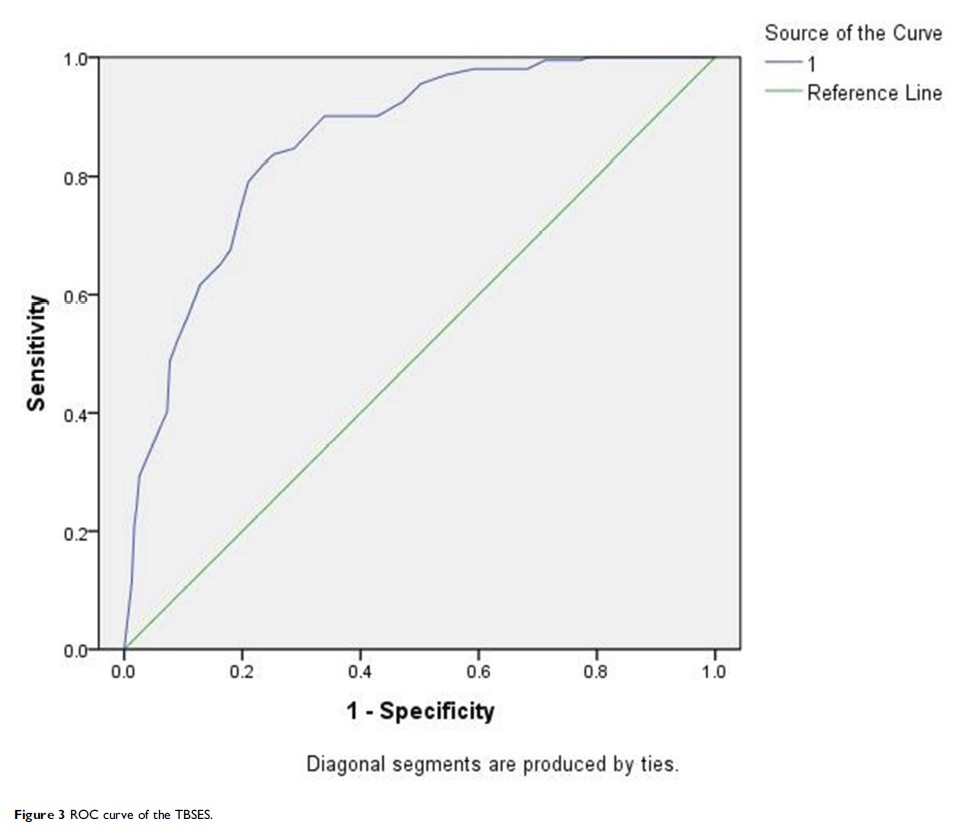
Patients and methods: The TBSES was designed through literature review, individual interviews, Delphi surveys, and pilot testing. After that, 460 TB patients were recruited to validate TBSES. Exploratory and confirmatory factor analysis and correlation analysis were used to evaluate the scale reliability and validity. The cut-off point for TBSES was identified using receiver operating characteristic (ROC) analysis.
Results: The final TBSES includes 21 items scored on a 5-point Likert scale, and these items are loaded in four distinct factors that explain 67.322% of the variance, both exploratory and confirmatory factor analysis proved that the scale had good construct validity. The scale had adequate internal consistency, split-half reliability, test-retest reliability, as well as demonstrated content, concurrent validity. The ROC analysis results showed the cut-off point was 86.5.
Conclusion: This 21-item TBSES demonstrated favorable psychometric properties. It provides an instrument for not only measuring specific self-efficacy in TB, but also identifying patients with low self-efficacy and determining the specific area toward designing interventions for enhance self-efficacy.
Keywords: tuberculosis, self-efficacy, scale development, reliability, validity