115195
论文已发表
注册即可获取德孚的最新动态
IF 收录期刊
- 3.6 Breast Cancer (Dove Med Press)
- 4.3 Clin Epidemiol
- 2.6 Cancer Manag Res
- 3.2 Infect Drug Resist
- 4.1 Clin Interv Aging
- 6.1 Drug Des Dev Ther
- 4.1 Int J Chronic Obstr
- 8.7 Int J Nanomed
- 2.5 Int J Women's Health
- 3.2 Neuropsych Dis Treat
- 2.4 OncoTargets Ther
- 2.6 Patient Prefer Adher
- 2.6 Ther Clin Risk Manag
- 3.1 J Pain Res
- 3.5 Diabet Metab Synd Ob
- 4.5 Psychol Res Behav Ma
- 3.4 Nat Sci Sleep
- 2.4 Pharmgenomics Pers Med
- 2.6 Risk Manag Healthc Policy
- 4.6 J Inflamm Res
- 2.3 Int J Gen Med
- 3.9 J Hepatocell Carcinoma
- 3.3 J Asthma Allergy
- 2.5 Clin Cosmet Investig Dermatol
- 3.0 J Multidiscip Healthc

PDCD4/eIF4A1 信号的异常表达可预测早期口腔鳞状细胞癌的术后复发
Authors Zhao M, Ding L, Yang Y, Chen S, Zhu N, Fu Y, Ni Y, Wang Z
Received 15 July 2019
Accepted for publication 9 October 2019
Published 11 November 2019 Volume 2019:11 Pages 9553—9562
DOI https://doi.org/10.2147/CMAR.S223273
Checked for plagiarism Yes
Review by Single-blind
Peer reviewers approved by Dr Cristina Weinberg
Peer reviewer comments 2
Editor who approved publication: Dr Eileen O'Reilly
Background: Programmed cell death 4 (PDCD4 ) as a tumor suppressor gene inhibits growth and metastasis of cancer cells, which involved with eIF4A1, the inhibitor of translation initiation. Although the prognosis of early-stage oral squamous cell carcinoma (OSCC) is generally better, but many patients occur recurrence after surgery. Understanding the clinical expression pattern of PDCD4/eIF4A1 signal would provide diagnostic biomarker and target therapy premise for early-stage OSCC patients.
Methods: Immunohistochemical analysis was performed on 69 early-stage (T1/2N0M0) OSCC samples to evaluate temporal expression and prognostic value of eIF4A1 and PDCD4 in early-stage OSCC according to cell types and microlocalization. The correlations between PDCD4/eIF4A1 signal and Ki-67, postoperative recurrence and metastasis were determined.
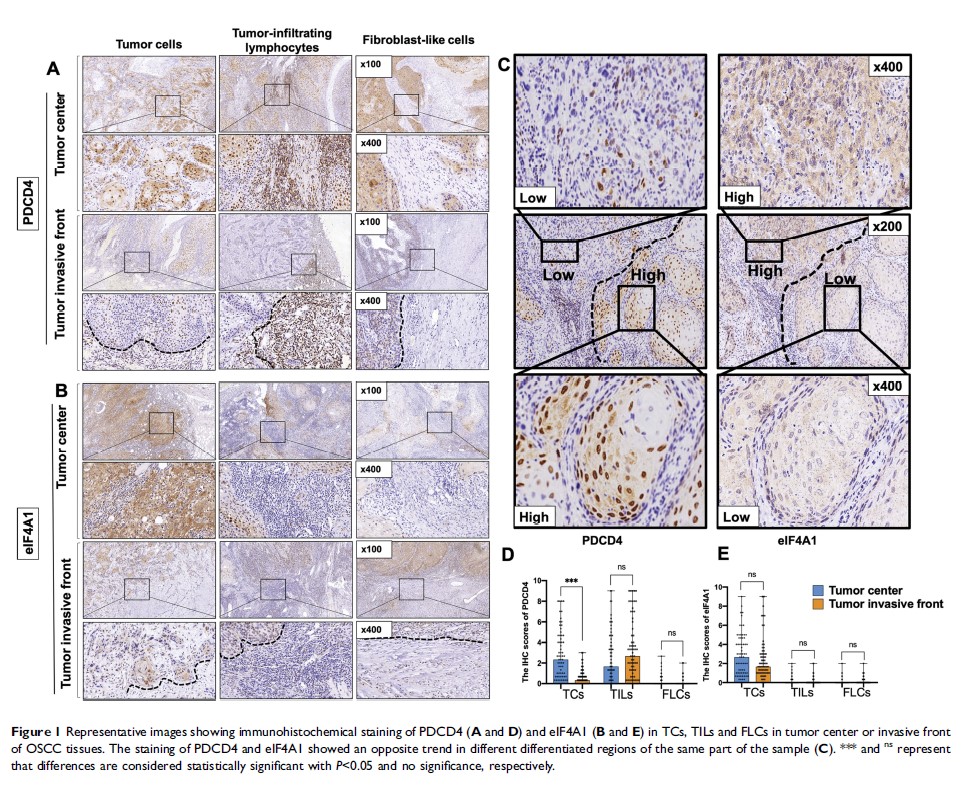
Results: We found that PDCD4 was presented in tumor cells (TCs) and tumor-infiltrating lymphocytes (TILs) but absent in fibroblast-like cells (FLCs). eIF4A1 was only presented in TCs. PDCD4TCs was negative associated with eIF4A1TCs in tumor center, and patients with low PDCD4TCs or high eIF4A1TCs had poorer differentiation. Moreover, aberrant PDCD4/eIF4A1 signal led to higher Ki-67 level. Interestingly, patients with low expressed PDCD4TILs had better prognosis, indicating the function heterogeneity of PDCD4 in different cell types. Furthermore, low PDCD4 TCs and high eIF4A1TCs predicted higher postoperative recurrence rate and are significant independent risk factors for early-stage OSCC.
Conclusion: Patients with low PDCD4TCs and high eIF4A1TCs have higher recurrence rate and poor clinical outcome. Of note, PDCD4TILs exerts contradictory function. Thus, PDCD4/eIF4A1 targeting therapeutics should consider the function heterogeneity of PDCD4.
Keywords: PDCD4, eIF4A1, early-stage OSCC, prognosis, diagnosis