115195
论文已发表
注册即可获取德孚的最新动态
IF 收录期刊
- 3.6 Breast Cancer (Dove Med Press)
- 4.3 Clin Epidemiol
- 2.6 Cancer Manag Res
- 3.2 Infect Drug Resist
- 4.1 Clin Interv Aging
- 6.1 Drug Des Dev Ther
- 4.1 Int J Chronic Obstr
- 8.7 Int J Nanomed
- 2.5 Int J Women's Health
- 3.2 Neuropsych Dis Treat
- 2.4 OncoTargets Ther
- 2.6 Patient Prefer Adher
- 2.6 Ther Clin Risk Manag
- 3.1 J Pain Res
- 3.5 Diabet Metab Synd Ob
- 4.5 Psychol Res Behav Ma
- 3.4 Nat Sci Sleep
- 2.4 Pharmgenomics Pers Med
- 2.6 Risk Manag Healthc Policy
- 4.6 J Inflamm Res
- 2.3 Int J Gen Med
- 3.9 J Hepatocell Carcinoma
- 3.3 J Asthma Allergy
- 2.5 Clin Cosmet Investig Dermatol
- 3.0 J Multidiscip Healthc

控制营养状况(CONUT)得分是接受胃切除术的老年胃癌患者手术后结果的预测指标:一项前瞻性研究
Authors Huang Y, Huang Y, Lu M, Sun W, Sun X, Chen X, Li L, Chandoo A, Li L
Received 8 October 2019
Accepted for publication 6 November 2019
Published 18 November 2019 Volume 2019:11 Pages 9793—9800
DOI https://doi.org/10.2147/CMAR.S233872
Checked for plagiarism Yes
Review by Single-blind
Peer reviewers approved by Ms Sonali Singh
Peer reviewer comments 2
Editor who approved publication: Dr Eileen O'Reilly
Purpose: The Controlling Nutritional Status (CONUT) score is a recently developed measure that is calculated using the serum albumin level, total cholesterol level, and lymphocyte counts. The aim of this study was to examine whether the CONUT score can predict post-operative outcomes in elderly patients undergoing curative gastrectomy.
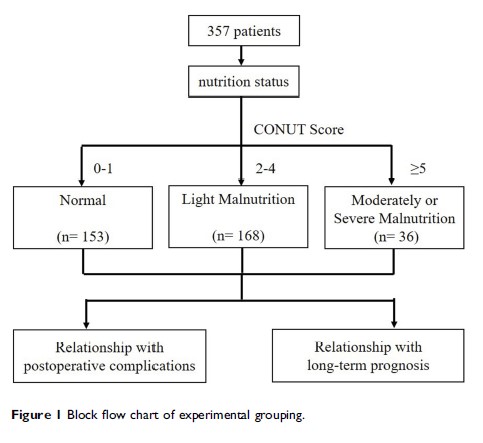
Patients and methods: Pre-operative CONUT scores were evaluated from August 2014 to September 2016 in 357 gastric cancer patients who were scheduled to undergo curative gastrectomy. The patients were divided into three groups according to pre-operative CONUT scores: normal, light, moderate, and severe. We then calculated the association between the patient’s CONUT score and post-operative complications.
Results: CONUT scores were statistically associated with age (P = 0.015), body mass index (P < 0.001), pre-operative hemoglobin level (P < 0.001), tumor-node-metastasis stage (P < 0.001), surgical method (P = 0.036), and post-operative complications (P < 0.001). Multivariate analysis showed that age and the CONUT score were independent predictors of post-operative complications and 1-year survival.
Conclusion: CONUT scores can be used to predict post-operative complications and 1-year survival in elderly gastric cancer patients undergoing curative gastrectomy. They can also be used to classify the nutritional status of patients, which can be helpful for pre–and post-operative nutritional management.
Keywords: gastric cancer, nutrition, post-operative complications, CONUT score, elderly patients