115195
论文已发表
注册即可获取德孚的最新动态
IF 收录期刊
- 3.6 Breast Cancer (Dove Med Press)
- 4.3 Clin Epidemiol
- 2.6 Cancer Manag Res
- 3.2 Infect Drug Resist
- 4.1 Clin Interv Aging
- 6.1 Drug Des Dev Ther
- 4.1 Int J Chronic Obstr
- 8.7 Int J Nanomed
- 2.5 Int J Women's Health
- 3.2 Neuropsych Dis Treat
- 2.4 OncoTargets Ther
- 2.6 Patient Prefer Adher
- 2.6 Ther Clin Risk Manag
- 3.1 J Pain Res
- 3.5 Diabet Metab Synd Ob
- 4.5 Psychol Res Behav Ma
- 3.4 Nat Sci Sleep
- 2.4 Pharmgenomics Pers Med
- 2.6 Risk Manag Healthc Policy
- 4.6 J Inflamm Res
- 2.3 Int J Gen Med
- 3.9 J Hepatocell Carcinoma
- 3.3 J Asthma Allergy
- 2.5 Clin Cosmet Investig Dermatol
- 3.0 J Multidiscip Healthc

FGFR1 通过激活 NSCLC 中的 AKT/mTOR 信号通路诱导获得性吉非替尼耐药
Authors Zhang D, Han L, Du F, Liu X, Li J, Wang H, Song M, Li Z, Li G
Received 22 June 2019
Accepted for publication 31 October 2019
Published 18 November 2019 Volume 2019:12 Pages 9809—9816
DOI https://doi.org/10.2147/OTT.S220462
Checked for plagiarism Yes
Review by Single-blind
Peer reviewers approved by Ms Shreya Arora
Peer reviewer comments 2
Editor who approved publication: Professor Jianmin Xu
Objective: As an epidermal growth factor, receptor-tyrosine kinase inhibitor (EGFR-TKI), gefitinib demonstrates a good therapeutic effect in patients with EGFR-mutant non-small-cell lung cancer (NSCLC). However, an overwhelming majority of these patients inevitably develop resistance against gefitinib. Unfortunately, the mechanism underlying this phenomenon is still not fully understood. Here we aim to reveal the mechanism of gefitinib resistance in NSCLC induced by FGFR1.
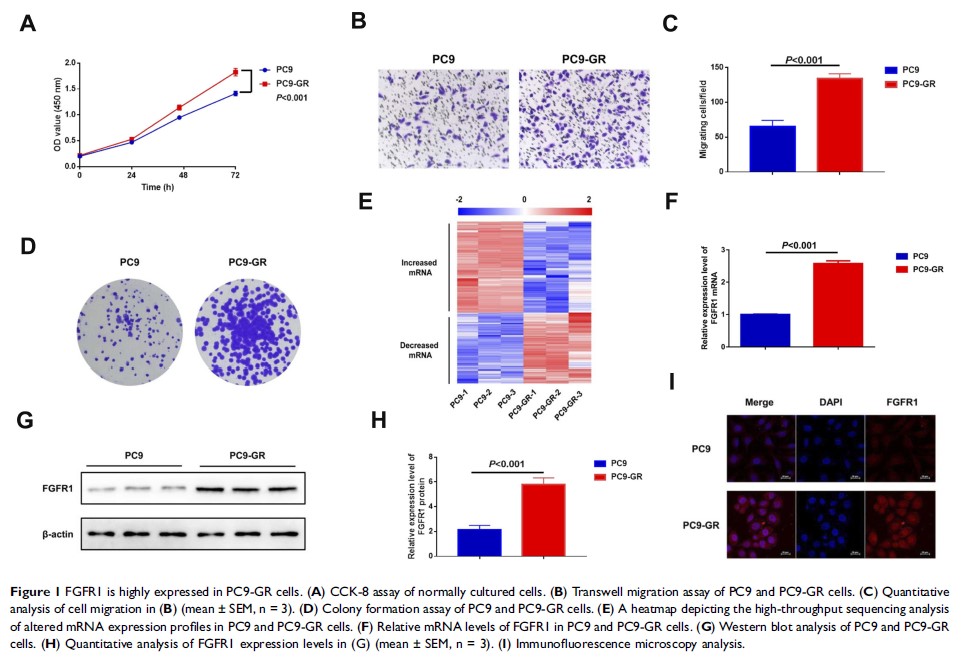
Materials and methods: We used high-throughput sequencing to compare the mRNA expression profiles of PC9 and PC9-GR (gefitinib-resistant) cells. The clinical significance of fibroblast growth factor receptor 1 (FGFR1) in NSCLC was also investigated using immunohistochemistry and Kaplan-Meier survival analysis. Finally, the in vitro molecular mechanisms were analyzed using confocal laser microscopy, Western blotting, transwell assay, colony formation assay, CCK-8 assay, and apoptosis assay.
Results: We observed that FGFR1 was highly expressed in NSCLC tissues and was closely associated with poor prognosis. Cytological experiments showed that FGFR1 promoted the proliferation and migration of PC9-GR cells and mediated their resistance to gefitinib. Furthermore, studies aimed at unraveling this mechanism revealed that FGFR1 activated the AKT/mTOR signaling pathway. These findings show that the FGFR1/AKT/mTOR signaling pathway plays a vital role in acquired resistance against gefitinib in NSCLC.
Conclusion: This work provides new evidence that FGFR1 functions as a key regulator of gefitinib resistance, thereby demonstrating its potential as a novel biomarker and therapeutic target for NSCLC.
Keywords: fibroblast growth factor receptor 1, FGFR1, acquired resistance, gefitinib, non-small-cell lung cancer, NSCLC, AKT/mTOR pathway