115195
论文已发表
注册即可获取德孚的最新动态
IF 收录期刊
- 3.6 Breast Cancer (Dove Med Press)
- 4.3 Clin Epidemiol
- 2.6 Cancer Manag Res
- 3.2 Infect Drug Resist
- 4.1 Clin Interv Aging
- 6.1 Drug Des Dev Ther
- 4.1 Int J Chronic Obstr
- 8.7 Int J Nanomed
- 2.5 Int J Women's Health
- 3.2 Neuropsych Dis Treat
- 2.4 OncoTargets Ther
- 2.6 Patient Prefer Adher
- 2.6 Ther Clin Risk Manag
- 3.1 J Pain Res
- 3.5 Diabet Metab Synd Ob
- 4.5 Psychol Res Behav Ma
- 3.4 Nat Sci Sleep
- 2.4 Pharmgenomics Pers Med
- 2.6 Risk Manag Healthc Policy
- 4.6 J Inflamm Res
- 2.3 Int J Gen Med
- 3.9 J Hepatocell Carcinoma
- 3.3 J Asthma Allergy
- 2.5 Clin Cosmet Investig Dermatol
- 3.0 J Multidiscip Healthc

Recent Developments In Bronchial Thermoplasty For Severe Asthma
Authors Thomson NC
Received 12 September 2019
Accepted for publication 30 October 2019
Published 19 November 2019 Volume 2019:12 Pages 375—387
DOI https://doi.org/10.2147/JAA.S200912
Checked for plagiarism Yes
Review by Single-blind
Peer reviewers approved by Dr Colin Mak
Peer reviewer comments 4
Editor who approved publication: Dr Amrita Dosanjh
Purpose: Bronchial thermoplasty is approved in many countries worldwide as a non-pharmacological treatment for severe asthma. This review summarizes recent publications on the selection of patients with severe asthma for bronchial thermoplasty, predictors of a beneficial response and developments in the procedure and discusses specific issues about bronchial thermoplasty including effectiveness in clinical practice, mechanism of action, cost-effectiveness, and place in management.
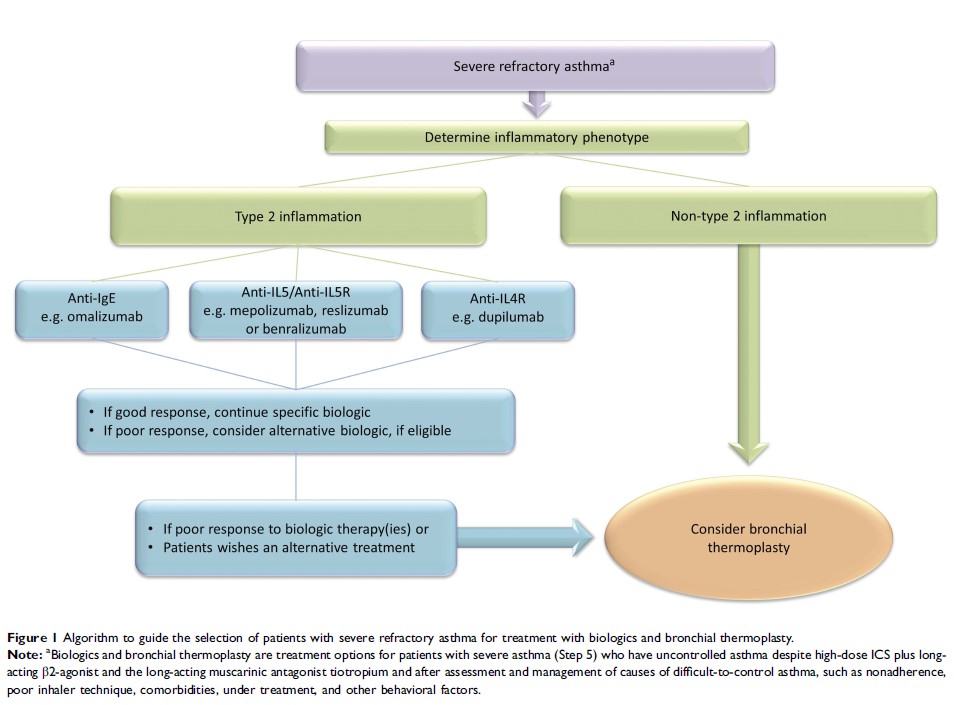
Results: Bronchial thermoplasty is a treatment option for patients with severe asthma after assessment and management of causes of difficult-to-control asthma, such as nonadherence, poor inhaler technique, comorbidities, under treatment, and other behavioral factors. Patients treated with bronchial thermoplasty in clinical practice have worse baseline characteristics and comparable clinical outcomes to clinical trial data. Bronchial thermoplasty causes a reduction in airway smooth muscle mass although it is uncertain whether this effect explains its efficacy since other mechanisms of action may be relevant, such as alterations in airway epithelial, gland, and/or nerve function; improvements in small airway function; or a placebo effect. The cost-effectiveness of bronchial thermoplasty is greater in countries where the costs of hospitalization and emergency department are high. The place of bronchial thermoplasty in the management of severe asthma is not certain, although some experts propose that bronchial thermoplasty should be considered for patients with severe asthma associated with non-type 2 inflammation or who fail to respond favorably to biologic therapies targeting type 2 inflammation.
Conclusion: Bronchial thermoplasty is a modestly effective treatment for severe asthma after assessment and management of causes of difficult-to-control asthma. Asthma morbidity increases during and shortly after treatment. Follow-up studies provide reassurance on the long-term safety of the procedure. Uncertainties remain about predictors of response, mechanism(s) of action, and place in management of severe asthma.
Keywords: bronchial thermoplasty, severe asthma