115195
论文已发表
注册即可获取德孚的最新动态
IF 收录期刊
- 3.6 Breast Cancer (Dove Med Press)
- 4.3 Clin Epidemiol
- 2.6 Cancer Manag Res
- 3.2 Infect Drug Resist
- 4.1 Clin Interv Aging
- 6.1 Drug Des Dev Ther
- 4.1 Int J Chronic Obstr
- 8.7 Int J Nanomed
- 2.5 Int J Women's Health
- 3.2 Neuropsych Dis Treat
- 2.4 OncoTargets Ther
- 2.6 Patient Prefer Adher
- 2.6 Ther Clin Risk Manag
- 3.1 J Pain Res
- 3.5 Diabet Metab Synd Ob
- 4.5 Psychol Res Behav Ma
- 3.4 Nat Sci Sleep
- 2.4 Pharmgenomics Pers Med
- 2.6 Risk Manag Healthc Policy
- 4.6 J Inflamm Res
- 2.3 Int J Gen Med
- 3.9 J Hepatocell Carcinoma
- 3.3 J Asthma Allergy
- 2.5 Clin Cosmet Investig Dermatol
- 3.0 J Multidiscip Healthc

小细胞肺癌患者中 DLL3,CTLA-4 和 MSTN 表达的患病率
Authors Regzedmaa O, Li Y, Li Y, Zhang H, Wang J, Gong H, Yuan Y, Li W, Liu H, Chen J
Received 20 May 2019
Accepted for publication 6 November 2019
Published 21 November 2019 Volume 2019:12 Pages 10043—10055
DOI https://doi.org/10.2147/OTT.S216362
Checked for plagiarism Yes
Review by Single-blind
Peer reviewers approved by Ms Aruna Narula
Peer reviewer comments 2
Editor who approved publication: Prof. Dr. Geoffrey Pietersz
Introduction: Immune-based and antibody-drug conjugate therapies have shown promise in the treatment of patients with small cell lung cancer (SCLC). However, better predictive biomarkers are needed for selection of the appropriate SCLC patients for these advanced therapies and also for evaluation of the efficacy of these treatments.
Objective: The aim of this study was to examine the expression of delta-like protein 3 (DLL3), cytotoxic T lymphocyte-associated protein 4 (CTLA-4), and mesothelin (MSTN) in patients with SCLC and compare them with those patients’ clinical characteristics.
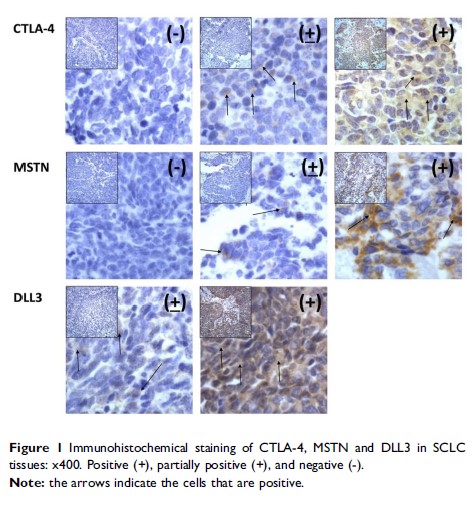
Methods: Immunohistochemical analyses of DLL3, CTLA-4 and MSTN expression were performed in 38 samples from patients with SCLC.
Results: We found that positive expression in patients of the biomarkers was as follows: for DLL3, 100% (38/38), for CTLA-4, 89.5% (36/38) and for MSTN 81.5% (31/38). The median survival time was 17.9 months in the DLL3 high expression group and 23 months in the DLL3 low expression group. Patients with a high expression of DLL3 showed a poorer prognosis than those with a low expression of DLL3 (HR=3.4; 95% CI, 1.34–8.6; p=0.01).
Conclusion: The expression of DLL3, CTLA-4 and MSTN was not correlated with patients’ age, sex, smoking status, stage, and tumor metastasis. The fact that there was a higher expression of DLL3, CTLA-4, and MSTN in SCLC suggested that these molecules could be used as predictive biomarkers for SCLC.
Keywords: small cell lung cancer, DLL3, CTLA-4, MSTN, prognosis