115195
论文已发表
注册即可获取德孚的最新动态
IF 收录期刊
- 3.6 Breast Cancer (Dove Med Press)
- 4.3 Clin Epidemiol
- 2.6 Cancer Manag Res
- 3.2 Infect Drug Resist
- 4.1 Clin Interv Aging
- 6.1 Drug Des Dev Ther
- 4.1 Int J Chronic Obstr
- 8.7 Int J Nanomed
- 2.5 Int J Women's Health
- 3.2 Neuropsych Dis Treat
- 2.4 OncoTargets Ther
- 2.6 Patient Prefer Adher
- 2.6 Ther Clin Risk Manag
- 3.1 J Pain Res
- 3.5 Diabet Metab Synd Ob
- 4.5 Psychol Res Behav Ma
- 3.4 Nat Sci Sleep
- 2.4 Pharmgenomics Pers Med
- 2.6 Risk Manag Healthc Policy
- 4.6 J Inflamm Res
- 2.3 Int J Gen Med
- 3.9 J Hepatocell Carcinoma
- 3.3 J Asthma Allergy
- 2.5 Clin Cosmet Investig Dermatol
- 3.0 J Multidiscip Healthc

对从中国儿科患者中分离的多药耐药革兰氏阴性菌的抗菌素耐药性和耐药性决定因素的研究
Authors Patil S, Chen H, Zhang X, Lian M, Ren PG, Wen F
Received 18 July 2019
Accepted for publication 17 October 2019
Published 22 November 2019 Volume 2019:12 Pages 3625—3634
DOI https://doi.org/10.2147/IDR.S223736
Checked for plagiarism Yes
Review by Single-blind
Peer reviewers approved by Dr Melinda Thomas
Peer reviewer comments 2
Editor who approved publication: Dr Joachim Wink
Introduction: The emergence of multi-drug-resistant Gram-negative bacteria (GNB) is a concern in China and globally. This study investigated antimicrobial resistance traits and resistance determinant detection in GNB isolates from paediatric patients in China.
Methods: In the present study, a total of 170 isolates of GNB including the most prevalent Escherichia coli, Klebsiella pneumoniae and Acinetobacter baumannii were collected from Shenzhen Children’s Hospital, China. ESBLs production was confirmed by using the combination disc diffusion method, and carbapenemase production was confirmed by using a carbapenem inactivation method followed by antimicrobial susceptibility. In addition, β-lactamase-encoding genes and co-existence of plasmid-borne colistin resistance mcr-1 gene were determined by PCR and sequencing.
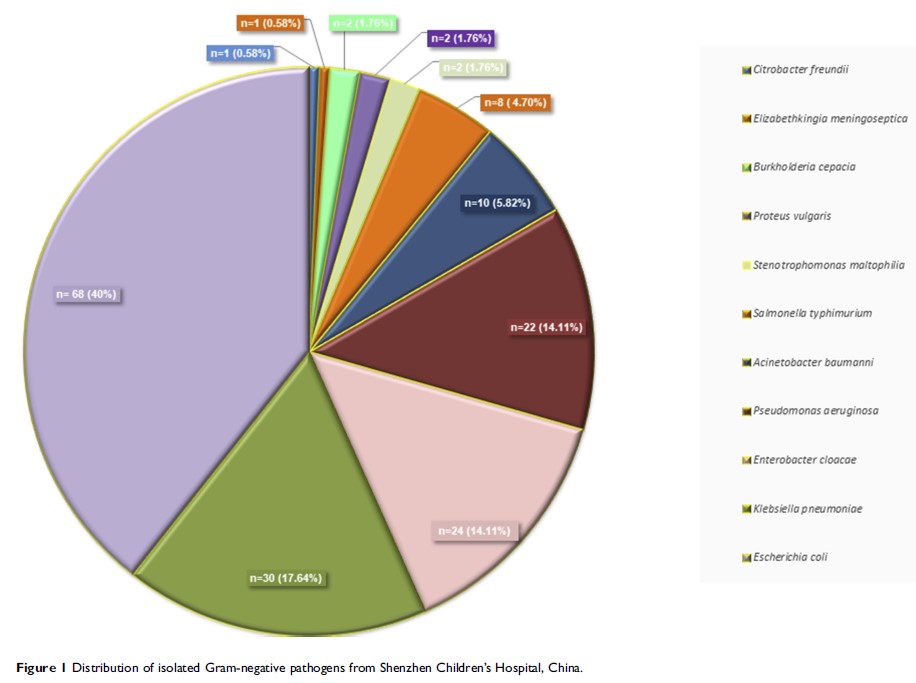
Results: Overall, 170 etiological agents (GNB) were recovered from 158 paediatric patients. The most prevalent species was E. coli 40% (n=68), followed by K. pneumoniae 17.64% (n=30), and Enterobacter cloacae 14.11% (n=24). Of 170 GNB, 71.76% (n=122) were multi-drug-resistant, 12.35% (n=21) extreme-drug resistant, and 7.64% (n=13) single-drug-resistant, while 8.23% (n=14) were sensitive to all of the studied antibiotics. The prevalence of ESBLs and carbapenemase producers were 60% and 17%, respectively. bla CTX-M was the most prevalent resistance gene (59.42%), followed by bla TEM (41.17%), bla SHV (34.270%), bla KPC (34.11%), bla OXA-48 (18.82%) and bla NDM-1 (17.64%).
Conclusion: The present study provides insights into the linkage between the resistance patterns of GNB to commonly used antibiotics and their uses in China. The findings are useful for understanding the genetics of resistance traits and difficulty in tackling of GNB in paediatric patients.
Keywords: Gram-negative bacteria, antimicrobial susceptibility, ESBLs, carbapenemase, molecular characterization