117333
论文已发表
注册即可获取德孚的最新动态
IF 收录期刊
- 3.6 Breast Cancer (Dove Med Press)
- 4.3 Clin Epidemiol
- 2.6 Cancer Manag Res
- 3.2 Infect Drug Resist
- 4.1 Clin Interv Aging
- 6.1 Drug Des Dev Ther
- 4.1 Int J Chronic Obstr
- 8.7 Int J Nanomed
- 2.5 Int J Women's Health
- 3.2 Neuropsych Dis Treat
- 2.4 OncoTargets Ther
- 2.6 Patient Prefer Adher
- 2.6 Ther Clin Risk Manag
- 3.1 J Pain Res
- 3.5 Diabet Metab Synd Ob
- 4.5 Psychol Res Behav Ma
- 3.4 Nat Sci Sleep
- 2.4 Pharmgenomics Pers Med
- 2.6 Risk Manag Healthc Policy
- 4.6 J Inflamm Res
- 2.3 Int J Gen Med
- 3.9 J Hepatocell Carcinoma
- 3.3 J Asthma Allergy
- 2.5 Clin Cosmet Investig Dermatol
- 3.0 J Multidiscip Healthc

本文章已被撤回:白藜芦醇通过抑制 SV-HUC-1-永生化人尿道上皮细胞中的 STAT3 磷酸化逆转香烟烟雾诱导的尿囊性上皮-间质转化
Authors Sun H, Zhang Z, Zhang T, Geng H, Xie D, Wang Y, Ding D, Zhang T, Yu D
Received 9 August 2019
Accepted for publication 6 November 2019
Published 26 November 2019 Volume 2019:12 Pages 10227—10237
DOI https://doi.org/10.2147/OTT.S226580
Checked for plagiarism Yes
Review by Single-blind
Peer reviewers approved by Ms Aruna Narula
Peer reviewer comments 3
Editor who approved publication: Dr Tohru Yamada
***本文章已被撤回***
Purpose: Bladder cancer is a malignant tumor of the urinary tract, and cigarette smoke (CS) is closely related to tumorigenesis. Resveratrol, a plant-derived bioactive nutrient, possesses multiple anticancer effects. However, the mechanism of CS-induced tumorigenesis is still not clear. The role of resveratrol in CS-meditated bladder cancer development has not been reported.
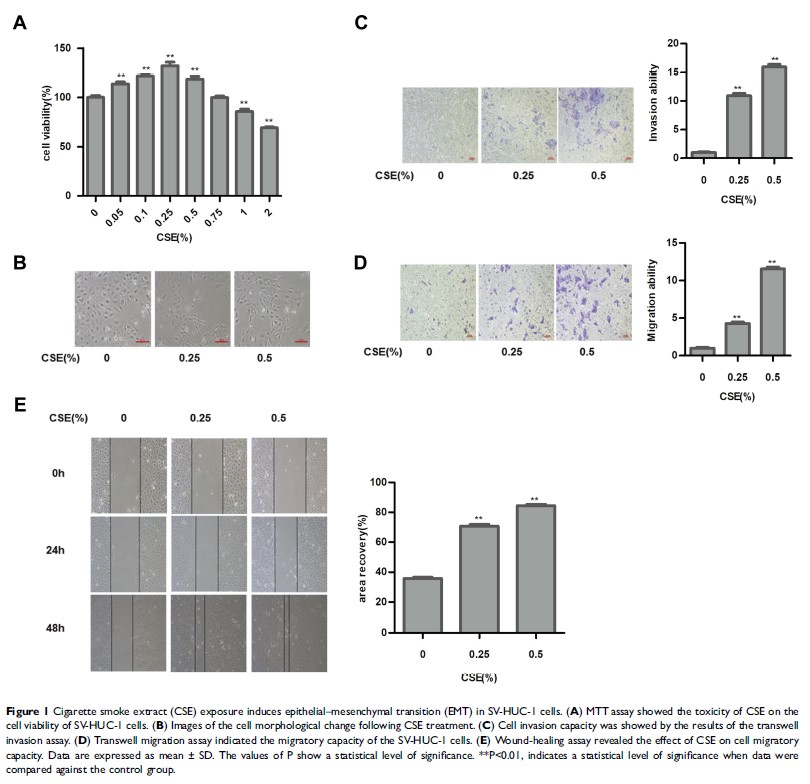
Methods: MTT assay showed the toxicity of cigarette smoke extract (CSE) on the cell viability of SV-HUC-1 cells. Western blotting detected the expression levels of related proteins. Transwell migration or invasion assay evaluated the capacity of cell migration or invasion after treatment. Wound-healing assay revealed the effect of cell migratory capacity. The cell cycle was detected by flow cytometry.
Results: Our study demonstrated that CSE-triggered epithelial–mesenchymal transition (EMT) in SV-HUC-1-immortalized human urothelial cells via the STAT3/TWIST1 pathway. Furthermore, the results showed resveratrol effectively inhibited STAT3 phosphorylation, thus reversed EMT triggered by CSE. Meanwhile, the cell proliferation was also suppressed.
Conclusion: In conclusion, inhibition of the STAT3 in CSE-induced EMT on bladder cancer may be a promising cancer treatment target for suppression by resveratrol.
Keywords: bladder cancer, cigarette smoke, resveratrol, STAT3/TWIST1