117333
论文已发表
注册即可获取德孚的最新动态
IF 收录期刊
- 3.6 Breast Cancer (Dove Med Press)
- 4.3 Clin Epidemiol
- 2.6 Cancer Manag Res
- 3.2 Infect Drug Resist
- 4.1 Clin Interv Aging
- 6.1 Drug Des Dev Ther
- 4.1 Int J Chronic Obstr
- 8.7 Int J Nanomed
- 2.5 Int J Women's Health
- 3.2 Neuropsych Dis Treat
- 2.4 OncoTargets Ther
- 2.6 Patient Prefer Adher
- 2.6 Ther Clin Risk Manag
- 3.1 J Pain Res
- 3.5 Diabet Metab Synd Ob
- 4.5 Psychol Res Behav Ma
- 3.4 Nat Sci Sleep
- 2.4 Pharmgenomics Pers Med
- 2.6 Risk Manag Healthc Policy
- 4.6 J Inflamm Res
- 2.3 Int J Gen Med
- 3.9 J Hepatocell Carcinoma
- 3.3 J Asthma Allergy
- 2.5 Clin Cosmet Investig Dermatol
- 3.0 J Multidiscip Healthc

原发性睾丸弥漫性大 B 细胞淋巴瘤中 CD79B 和 MYD88 致癌性突变的患病率及其临床意义:在中国进行的一项回顾性研究
Authors Chen Y, Ke L, Lu J, Wang J, Zhu W, Chen F, Lin S, Xu C, Wu M, Chen G
Received 6 July 2019
Accepted for publication 8 November 2019
Published 26 November 2019 Volume 2019:12 Pages 10165—10175
DOI https://doi.org/10.2147/OTT.S222189
Checked for plagiarism Yes
Review by Single-blind
Peer reviewers approved by Ms Shreya Arora
Peer reviewer comments 2
Editor who approved publication: Dr Yao Dai
Purpose: In this study, we investigated the prevalence of CD79B and MYD88 mutations and their relation to clinical characteristics in a cohort of Chinese patients with primary testicular diffuse large B cell lymphoma (PT-DLBCL).
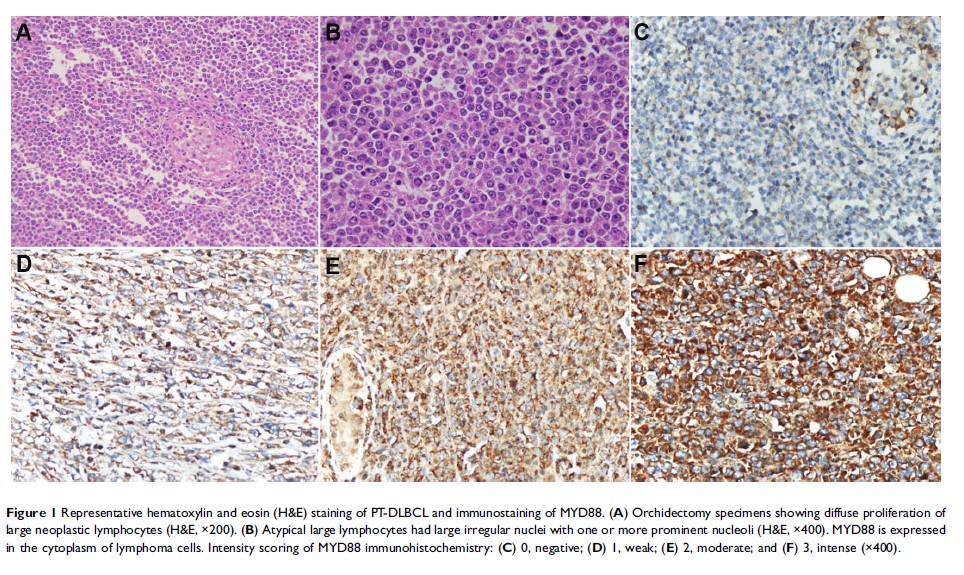
Patients and methods: We examined the mutational status of CD79B and MYD88 by Sanger sequencing, and the gene amplification and protein expression of MYD88 in tissue samples from 30 cases of PT-DLBCL by quantitative polymerase chain reaction and immunohistochemistry, respectively. Western blotting was used to analyze phosphorylated STAT3 (p-STAT3) and phosphorylated p65 (p-p65) protein expression in cell lines harboring retroviral constructs for WT MYD88 or MYD88 mutant.
Results: Immunophenotypically, MYD88 protein staining was positive in 26/30 (86.67%) cases, and 23/30 (76.7%) cases tested positive for p65 in the nucleus. Genetically, CD79B mutation was found in 13/30 (43.3%) cases, whereas the MYD88 L265P mutation was found in 18/30 (60.0%) cases. Interestingly, CD79B and MYD88 mutations were more prevalent in the non-germinal center B cell (GCB) subtype (83.3% and 76.9%, respectively) and were relatively rare in the GCB subtype (16.7% and 23.1%, respectively). Furthermore, although MYD88 was significantly amplified in PT-DLBCL, the amplification status showed no correlation with its mutational status and protein expression. Clinicopathological comparison between the mutant and wild-type group showed that both CD79B mutation and MYD88 L265P were not significantly correlated with age, anatomical site, Ann Arbor stage, non-GCB/GCB subtype, p65 protein expression, BCL-2 protein expression, or BCL-2/c-MYC double expression (P >0.05). Survival analyses showed that high IPI and advanced stage (stage III–IV) associated with worse outcome (P <0.05). The expression of p-STAT3 and p-p65 protein was upregulated in the mutant group, indicating that MYD88 mutant activated NF-κB and JAK–STAT3 signaling.
Conclusion: Our results suggest that MYD88 and CD79B mutations are important drivers of immune-privileged site-associated DLBCL and highlight potential therapeutic targets for personalized treatment.
Keywords: primary testicular lymphoma, CD79B , MYD88 , mutation, diffuse large B cell lymphoma, gene amplification