119942
论文已发表
注册即可获取德孚的最新动态
IF 收录期刊
- 3.6 Breast Cancer (Dove Med Press)
- 4.3 Clin Epidemiol
- 2.6 Cancer Manag Res
- 3.2 Infect Drug Resist
- 4.1 Clin Interv Aging
- 6.1 Drug Des Dev Ther
- 4.1 Int J Chronic Obstr
- 8.7 Int J Nanomed
- 2.5 Int J Women's Health
- 3.2 Neuropsych Dis Treat
- 2.4 OncoTargets Ther
- 2.6 Patient Prefer Adher
- 2.6 Ther Clin Risk Manag
- 3.1 J Pain Res
- 3.5 Diabet Metab Synd Ob
- 4.5 Psychol Res Behav Ma
- 3.4 Nat Sci Sleep
- 2.4 Pharmgenomics Pers Med
- 2.6 Risk Manag Healthc Policy
- 4.6 J Inflamm Res
- 2.3 Int J Gen Med
- 3.9 J Hepatocell Carcinoma
- 3.3 J Asthma Allergy
- 2.5 Clin Cosmet Investig Dermatol
- 3.0 J Multidiscip Healthc

甲状腺功能亢进中甲状腺功能正常化后可逆的情感症状和注意执行控制网络障碍
Authors Yuan L, Zhang Y, Luan D, Xu X, Yang Q, Zhao S, Zhou Z
Received 15 August 2019
Accepted for publication 11 November 2019
Published 26 November 2019 Volume 2019:15 Pages 3305—3312
DOI https://doi.org/10.2147/NDT.S227386
Checked for plagiarism Yes
Review by Single-blind
Peer reviewers approved by Dr Melinda Thomas
Peer reviewer comments 2
Editor who approved publication: Dr Yuping Ning
Introduction: Affective symptoms and attention impairments are found in patients with hyperthyroidism. Our previous data have revealed that the patients with hyperthyroidism experience impairments of the attention networks, but it remains unclear whether these disorders persist after the treatment of hyperthyroidism.
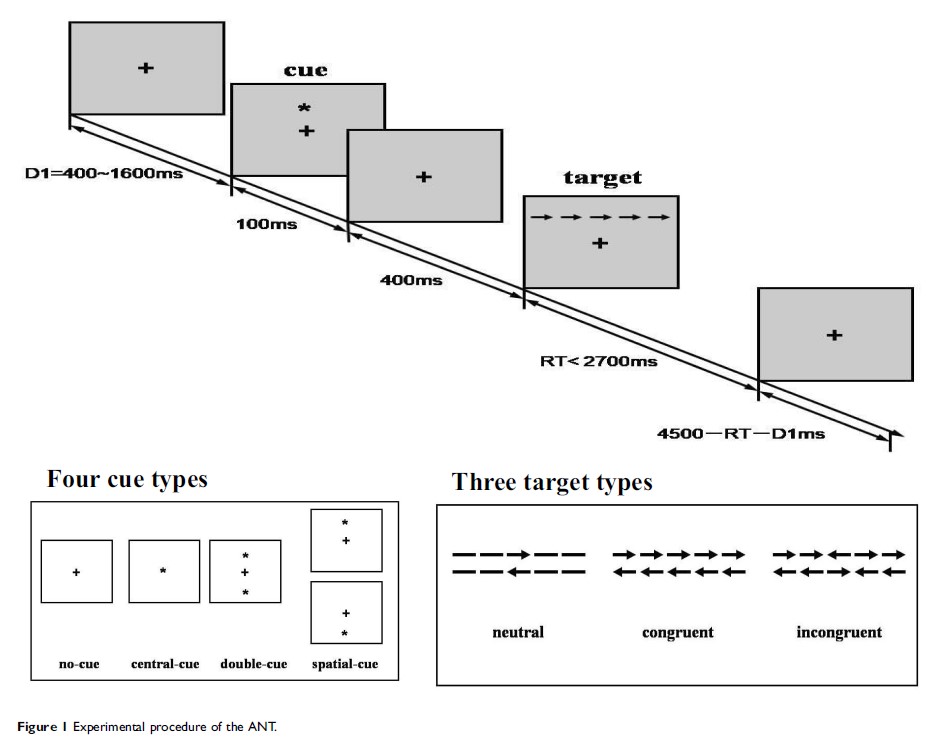
Methods: Twenty healthy controls and 25 hyperthyroid patients were recruited and performed the attention network test (ANT) which can simultaneously examine the alertness, orientation and execution control components of the participants. The effect of treatment on affective symptom and attention networks impairments were examined in the patient group after 1-year anti-thyroid medication and reaching euthyroidism for at least 3 months.
Results: Anxiety and depression scores of patients with hyperthyroidism were significantly higher than those of the healthy control group. The patients with hyperthyroidism had impairments of the alerting and executive control networks. Meanwhile, the score of HAMA correlated significantly with thyroid hormone and TSH levels, and there was a negative significant correlation between the score of HAMD and TSH level in all subjects. There was a positive correlation between the value of the executive control network and thyroid hormones’ levels in all subjects and in the hyperthyroidism group. Anxiety and depression symptoms were improved with methimazole treatment after euthyroidism was reached. The value of the executive control network no longer differed from that of healthy controls, but deficits in the alerting network of hyperthyroidism still persisted after treatment.
Conclusion: The patients with hyperthyroidism existed affective symptoms and attention networks impairments. Affective symptoms and attention executive control network impairment were improved following thyroid function normalization in hyperthyroidism.
Keywords: hyperthyroidism, thyroid hormones, cognition, affective symptoms, attention network test