119942
论文已发表
注册即可获取德孚的最新动态
IF 收录期刊
- 3.6 Breast Cancer (Dove Med Press)
- 4.3 Clin Epidemiol
- 2.6 Cancer Manag Res
- 3.2 Infect Drug Resist
- 4.1 Clin Interv Aging
- 6.1 Drug Des Dev Ther
- 4.1 Int J Chronic Obstr
- 8.7 Int J Nanomed
- 2.5 Int J Women's Health
- 3.2 Neuropsych Dis Treat
- 2.4 OncoTargets Ther
- 2.6 Patient Prefer Adher
- 2.6 Ther Clin Risk Manag
- 3.1 J Pain Res
- 3.5 Diabet Metab Synd Ob
- 4.5 Psychol Res Behav Ma
- 3.4 Nat Sci Sleep
- 2.4 Pharmgenomics Pers Med
- 2.6 Risk Manag Healthc Policy
- 4.6 J Inflamm Res
- 2.3 Int J Gen Med
- 3.9 J Hepatocell Carcinoma
- 3.3 J Asthma Allergy
- 2.5 Clin Cosmet Investig Dermatol
- 3.0 J Multidiscip Healthc

CCT6A 的过表达通过影响 G1-To-S 相变来促进癌细胞生长,并预测肝细胞癌的预后不良
Authors Zeng G, Wang J, Huang Y, Lian Y, Chen D, Wei H, Lin C, Huang Y
Received 30 August 2019
Accepted for publication 5 November 2019
Published 29 November 2019 Volume 2019:12 Pages 10427—10439
DOI https://doi.org/10.2147/OTT.S229231
Checked for plagiarism Yes
Review by Single-blind
Peer reviewers approved by Ms Isha Chandra
Peer reviewer comments 2
Editor who approved publication: Dr Takuya Aoki
Purpose: To determine the oncogenic role of the sixth subunit of chaperonin-containing tailless complex polypeptide 1 (CCT6A) in hepatocellular carcinoma (HCC) and address the correlation of CCT6A with clinicopathological characteristics and survival. Additionally, this study aimed to explore the effect of CCT6A on HCC cells and the underlying mechanisms.
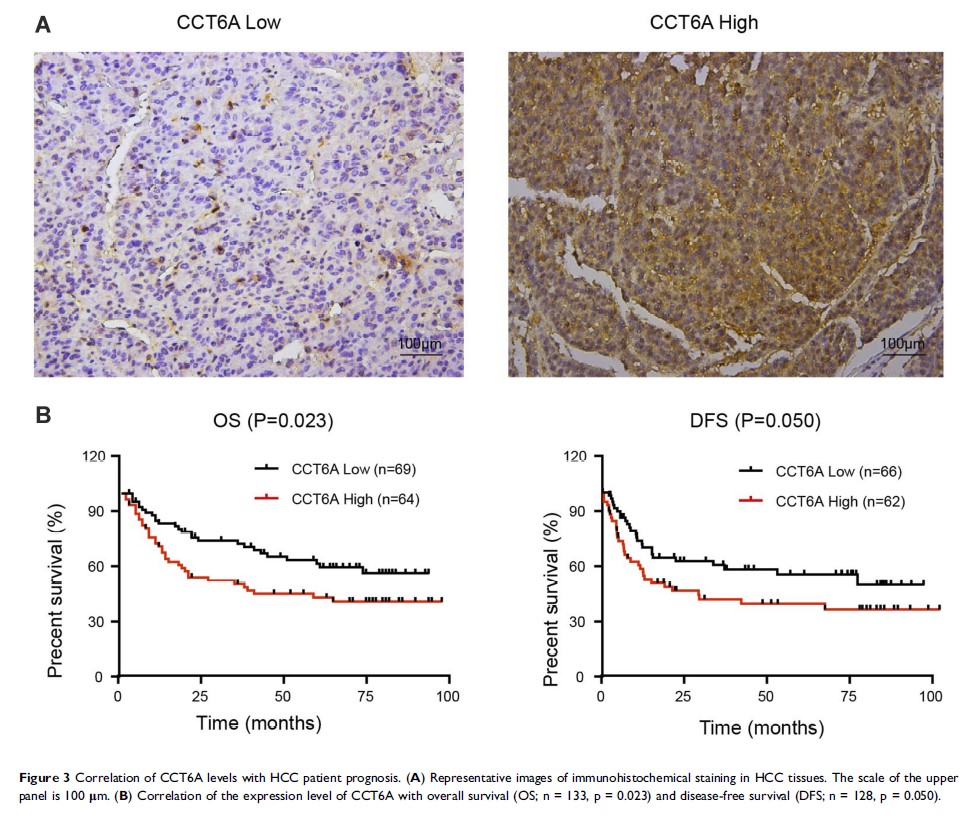
Methods: We searched for levels of CCT6A expression in the Oncomine database and GEPIA database, which was then validated by analyzing cancer and adjacent non-cancerous tissues of HCC patients using quantitative PCR, Western blot, and immunohistochemistry assays. The relationship between CCT6A expression and survival was analyzed from the GEPIA database and confirmed by immunohistochemistry assays of 133 HCC tissue sections. In addition, the effect of depleting CCT6A on cell proliferation was assessed by CCK-8 and colony formation assays. Cell cycle analysis, immunofluorescence assays, GSEA analysis, and cyclin D expression analyzed by Western blot were used to explore the possible underlying mechanism how dysregulated CCT6A affect the proliferation of HCC.
Results: Both mRNA and protein levels of CCT6A were increased in HCC tissues. Higher CCT6A expression was significantly associated with reduced overall survival (P = 0.023). CCT6A depletion inhibited cell proliferation and downregulated cyclin D, hindering the G1-to-S phase arrest.
Conclusion: CCT6A may contribute to HCC cell proliferation by accelerating the G1-to-S transition, as it maintains the expression of cyclin D. CCT6A could be considered an oncogene of HCC and could be used as a prognostic biomarker for HCC.
Keywords: HCC, survival, CCT6A, cell proliferation, cyclin D