117333
论文已发表
注册即可获取德孚的最新动态
IF 收录期刊
- 3.6 Breast Cancer (Dove Med Press)
- 4.3 Clin Epidemiol
- 2.6 Cancer Manag Res
- 3.2 Infect Drug Resist
- 4.1 Clin Interv Aging
- 6.1 Drug Des Dev Ther
- 4.1 Int J Chronic Obstr
- 8.7 Int J Nanomed
- 2.5 Int J Women's Health
- 3.2 Neuropsych Dis Treat
- 2.4 OncoTargets Ther
- 2.6 Patient Prefer Adher
- 2.6 Ther Clin Risk Manag
- 3.1 J Pain Res
- 3.5 Diabet Metab Synd Ob
- 4.5 Psychol Res Behav Ma
- 3.4 Nat Sci Sleep
- 2.4 Pharmgenomics Pers Med
- 2.6 Risk Manag Healthc Policy
- 4.6 J Inflamm Res
- 2.3 Int J Gen Med
- 3.9 J Hepatocell Carcinoma
- 3.3 J Asthma Allergy
- 2.5 Clin Cosmet Investig Dermatol
- 3.0 J Multidiscip Healthc

脐血中苯并[a]芘-DNA 加合物对青岛市 12 个月大婴儿神经发育的影响
Authors Zhang Y, Yang Y, Zhang Q, Cui J, Rahaman A, Huang XR, Su Y, Gao R, Wang B, Baloch Z
Received 12 June 2019
Accepted for publication 4 November 2019
Published 2 December 2019 Volume 2019:15 Pages 3351—3357
DOI https://doi.org/10.2147/NDT.S219244
Checked for plagiarism Yes
Review by Single-blind
Peer reviewers approved by Prof. Dr. Roumen Kirov
Peer reviewer comments 2
Editor who approved publication: Dr Yuping Ning
Introduction: The study was designed to explore the possible adverse effects of prenatal polycyclic aromatic hydrocarbons (PAHs) on the neurodevelopment of the infants at the age of 12 months in a birth cohort in Qingdao of China. Benzo[a]pyrene (BaP)-DNA adduct level in umbilical cord blood was measured by enzyme immunoassay.
Methods: Child neurodevelopment was assessed at both 6 months and 12 months of age using the Gesell Development Inventory (GDI).
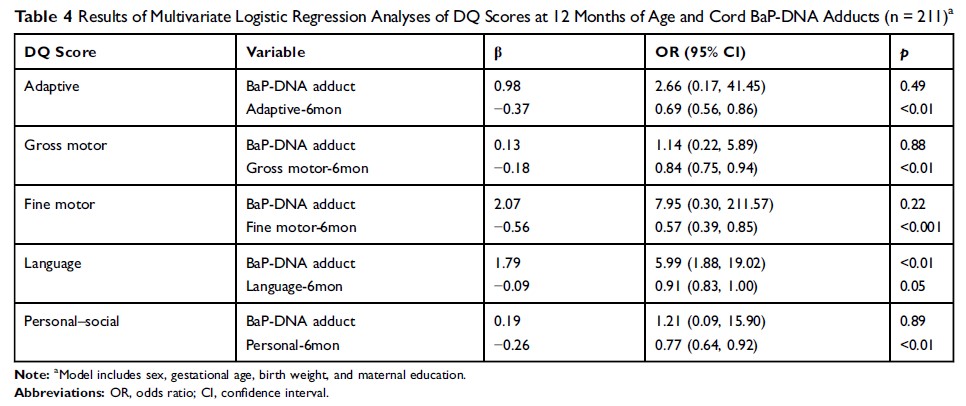
Results: This study results reveal that multivariate linear analysis, cord BaP-DNA adduct level was inversely associated with developmental quotient score in the adaptive domain [β = −0.08; 95% CI: (−0.16, −0.003); p = 0.04], gross motor domain [β = −0.10; 95% CI: (−0.20, −0.01); p = 0.02], fine motor domain [β = −0.15; 95% CI: (−0.25, −0.05); p = 0.01], language domain [β = −0.12; 95% CI: (−0.21, −0.03); p = 0.02], and personal–social domain [β = −0.13; 95% CI: (−0.22, −0.04); p <0.01]. Further, multivariate logistic regression analysis showed increased cord BaP-DNA adduct levels associated with increased odds of delayed in language domain.
Conclusion: In conclusion, the study suggested that prenatal PAH exposure monitored by umbilical cord blood BaP-DNA adducts may adversely affect the neurodevelopment of the infants at 12 months of age.
Keywords: neurodevelopment, PAH-DNA adducts, infant, polycyclic aromatic hydrocarbons, China