117333
论文已发表
注册即可获取德孚的最新动态
IF 收录期刊
- 3.6 Breast Cancer (Dove Med Press)
- 4.3 Clin Epidemiol
- 2.6 Cancer Manag Res
- 3.2 Infect Drug Resist
- 4.1 Clin Interv Aging
- 6.1 Drug Des Dev Ther
- 4.1 Int J Chronic Obstr
- 8.7 Int J Nanomed
- 2.5 Int J Women's Health
- 3.2 Neuropsych Dis Treat
- 2.4 OncoTargets Ther
- 2.6 Patient Prefer Adher
- 2.6 Ther Clin Risk Manag
- 3.1 J Pain Res
- 3.5 Diabet Metab Synd Ob
- 4.5 Psychol Res Behav Ma
- 3.4 Nat Sci Sleep
- 2.4 Pharmgenomics Pers Med
- 2.6 Risk Manag Healthc Policy
- 4.6 J Inflamm Res
- 2.3 Int J Gen Med
- 3.9 J Hepatocell Carcinoma
- 3.3 J Asthma Allergy
- 2.5 Clin Cosmet Investig Dermatol
- 3.0 J Multidiscip Healthc

13-[CH2CO-Cys-(Bzl)-OBzl]-小檗碱:探讨抗肿瘤功效与 ROS 和凋亡蛋白的相关性
Authors Li G, Ren Y, Zhang X, Zhao S, Wang Y, Wu J, Peng S, Zhao M
Received 14 September 2019
Accepted for publication 31 October 2019
Published 5 December 2019 Volume 2019:12 Pages 10651—10662
DOI https://doi.org/10.2147/OTT.S231035
Checked for plagiarism Yes
Review by Single-blind
Peer reviewer comments 3
Editor who approved publication: Dr Takuya Aoki
Background: The discovery of novel derivative of berberine (BBR) having higher anti-tumor activity in vivo is of clinical importance. In this profile, 13-[CH2CO-Cys-(Bzl)-OBzl]-berberine (13-Cys-BBR) was prepared for related assays.
Purpose: The object of preparation and evaluation is to show the advantages of 13-Cys-BBR over BBR in both in vitro and in vivo anti-tumor actions, furthermore to correlate the proliferation of cancer cells with ROS formation and anti-apoptosis protein (XIAP) expression inside cancer cells.
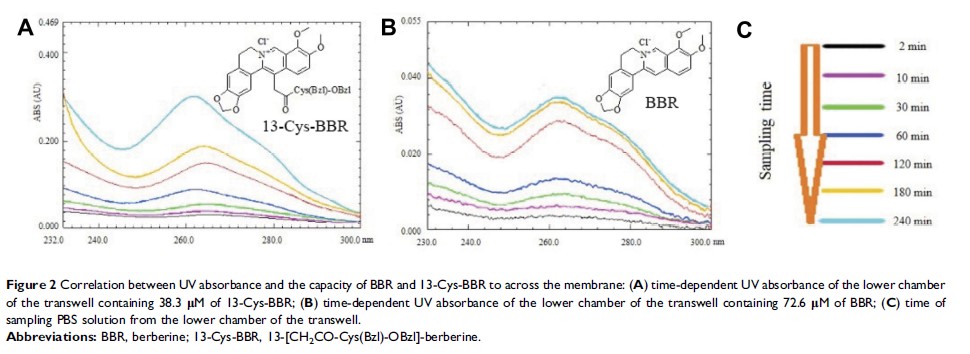
Methods: Transwell chamber was used to simulate the intestinal and cell wall for bioavailability evaluation; MTT assay was used to evaluate the in vitro anti-proliferation activity; fluorescein isothiocyanate content was used to represent ROS level in HCT-8 cells; Western blot assay was used to quantify the expression of XIAP, caspase-3, and poly ADP-ribose polymerase in HCT-8 cells; and S180 mouse model was used to evaluate the in vivo anti-tumor activity.
Results: In vitro the IC50 values (∼15–40 μM) of 13-Cys-BBR against the proliferation of eight cancer cell lines were significantly lower than those of BBR (∼25–140 μM); the content of ROS formed inside HCT-8 cells treated by 13-Cys-BBR was ∼3.44-folds higher than that inside HCT-8 cells treated by BBR; the expression of XIAP in HCT-8 cells treated by 13-Cys-BBR was ∼1.21-folds lower than that in HCT-8 cells treated by BBR; the tumor weight of S180 mice orally treated by 2 μmol/kg/day of 13-Cys-BBR (∼1.5 g) was significantly lower than that of S180 mice orally treated by 2 μmol/kg/day of BBR (∼2.5 g); and the active pocket of XIAP was more suitable for 13-Cys-BBR than for BBR.
Conclusion: The anti-tumor action correlates with ROS and apoptosis protein, which suggests 13-Cys-BBR is a promising candidate for preclinical study.
Keywords: berberine, 13-position modification, anti-tumor, ROS, XIAP